 HYGO News
 Trump Meets 7'9" Gator Olivier Rioux: 'Barron Always Says 6'9" Is Not That Tall -- Now I Understand'; Welcomes 2025 NCAA Champs Florida Gators; Judge Jeanine Slams DC US Attorney's Office $7/Month 'Water Club'
Trump Meets 7’9” Gator Olivier Rioux: “Barron Always Says 6’9” Is Not That Tall — Now I Understand”; Welcomes 2025 NCAA Champs Florida Gators; Judge Jeanine Slams DC US Attorney’s Office $7/Month “Water Club”
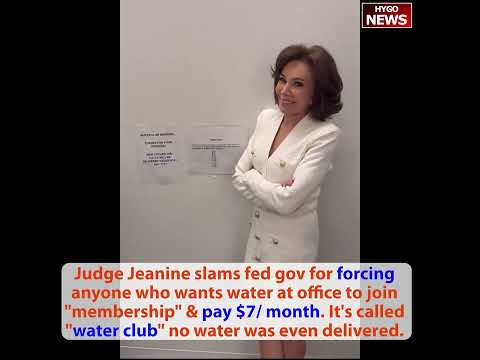
Multiple stories converged in May 2025. President Trump welcomed the 2025 NCAA Men’s Basketball champion University of Florida Gators to the White House, and made a personal observation upon meeting 7’9” Gator Olivier Rioux: “I have a son who’s 6’9”, but 6’9” is not, I now see… He always says, ‘Dad, I’m not that tall compared to some of these guys.’ And now I understand what he’s talking about.” Trump praised head coach Todd Golden: “A really great young head coach… he’s unbelievable as a coach. Oh, would I like to be his agent? Don’t go anywhere, coach.” Separately, U.S. Attorney (now judge) Jeanine Pirro exposed federal government waste: “I’m at the water cooler in the United States Attorney’s Office in Washington, DC. The United States gave $44 billion a year through USAID for dance classes in Wuhan, China and Sesame Street in Iraq. But here in the US Attorney’s Office, US Attorneys and staff, in order to get water, they have to join a water club and pay. $7 a month. And today they asked for our patience — no water was delivered.” Rep. Sean Casten (D-IL) declared oil, gas, and coal industries “losers.”
Meeting Olivier Rioux
The NCAA champions ceremony produced a memorable moment when Trump met 7’9” Olivier Rioux.
Trump addressed Rioux directly: “And you’re a beautiful looking guy. No, it’s really to be that tall and I think it’s great.”
He asked about basketball status: “How is your good player? Getting there.”
He stated the obvious: “What a big advantage. Well, boy, these are good looking guys. They’re definitely tall.”
He offered his staff observation: “One of my guys said downstairs, he’s a big guy, he said, these are the tallest human beings I’ve ever seen.”
Then came the Barron reference: “You know, I have a son who’s six or nine, but six foot nine is not, I now see, you know, he always says, dad, I’m not that tall compared to some of these guys. And now I understand what he’s talking about.”
Olivier Rioux, at 7 feet 9 inches, was among the tallest basketball players in American college sports. Born in Canada, Rioux had been recruited to Florida based on his extraordinary height combined with developing basketball skills. At 7’9”, he was taller than NBA legend Manute Bol (7’7”) and only slightly shorter than the tallest basketball players in professional history.
Barron Trump’s height had been a subject of significant public interest. Photographs of Barron during his father’s 2024 campaign and subsequent events had shown a young man who dwarfed his father (6’3”) and most other people in various settings. Barron’s listed height of 6’9” made him one of the tallest presidential children in American history.
The humor of the moment captured a universal dynamic. Even at 6’9” — a height that would make someone conspicuous in virtually any setting — Barron was not especially tall compared to serious basketball players. Rioux at 7’9” was a full foot taller than Barron. Trump’s realization that his son’s complaints about not being “that tall” in basketball contexts were legitimate was both humorous and genuine.
Welcoming the 2025 Champions
Trump delivered the formal welcome.
“Today we’re delighted to welcome the 2025 NCAA basketball champions, the University of Florida Gators,” Trump said.
He singled out the coach: “Congratulations also to a really great young head coach, Todd Golden on the entire job he did, the season, the inspiration that he gave these players.”
He added effusive praise: “He’s unbelievable as a coach. I heard a lot of great things about him. Oh, would I like to be his agent? Don’t go anywhere, coach. Stay, stay, coach. You can’t live.”
The 2025 Florida Gators had won the NCAA Men’s Basketball Championship in April, defeating Houston in the championship game. The tournament had been the culmination of a dominant season for Florida under Golden, who at 39 was among the youngest coaches to win a national championship.
Todd Golden had been an unusual coaching success story. He had previously coached at San Francisco, where he had revived a struggling program. Florida had hired him in 2022, and by 2025 he had built a championship-caliber team. His tactical innovations and player development had drawn attention from professional basketball organizations.
Trump’s “would I like to be his agent” comment was characteristic Trump business framing. Any young coaching talent who had just won a national championship would have tremendous market value. Top college basketball coaches could earn $5-10+ million annually; championship-winning coaches could negotiate even higher compensation. Trump was observing that a coach with Golden’s credentials would command substantial professional options.
The “don’t go anywhere, coach” and “stay, stay, coach” lines reflected the reality that championship success often produced coaching turnover as other schools (or NBA franchises) poached successful coaches. Florida would face recruiting and retention battles to keep Golden and his program intact.
The Water Club Scandal
Judge Jeanine Pirro’s video exposed a remarkable federal government waste story.
“Hi, everyone. It’s Judge Jeanine. I’m at the water cooler in the United States Attorney’s Office in Washington, DC,” she opened.
She set up the contrast with USAID spending: “You may recall that the United States gave something like $44 billion a year through USAID for things like dance classes in Wuhan, China and Sesame Street in Iraq.”
She delivered the revelation: “But here in the United States, in the United States Attorney’s Office, the U.S. attorneys as well as a staff, in order to get water, they have to join a water club and they have to pay. It’s a dues paying membership.”
She added the indignity: “Today they ask for our patients. Why? Because we couldn’t get water delivered today. Today there was no water delivered to the United States Attorney’s Office and remember, it’s only for those who pay $7 a month.”
She closed with sarcasm: “Now, ain’t it grand to be a part of the government and I’m just thrilled to be here.”
The Water Club story captured multiple levels of federal dysfunction:
The basic absurdity: Federal employees in Washington, D.C. had to pay out of pocket for drinking water at their offices. This was not a remote outpost in a developing country; this was the United States Attorney’s Office in the nation’s capital.
The pricing: $7 per month per employee for water service seemed high given the volumes involved. For a typical office of 100+ employees, this would represent $700+ monthly just for water. Over a year, thousands of dollars in employee fees for what should have been basic office infrastructure.
The unreliability: Even with employees paying, the service failed. “No water was delivered today” meant that federal employees had paid for water service that was not provided. They had no recourse and no refund process.
The comparison: The comparison with $44 billion in USAID spending on questionable foreign programs was devastating. While American tax dollars were flowing abroad for projects like “dance classes in Wuhan” (a genuine USAID line item), American federal employees in the U.S. were paying out of pocket for basic office water.
Judge Pirro’s broader point was institutional. A federal government that could not organize basic water service for its own employees, while simultaneously spending tens of billions on questionable foreign programs, had its priorities fundamentally misordered.
USAID Context
The USAID $44 billion reference was substantive. The United States Agency for International Development had become a major source of examples for DOGE’s waste findings:
“Dance classes in Wuhan”: USAID had funded cultural exchange programs in various foreign cities, including Wuhan, China. The juxtaposition of paying for dance classes in Wuhan while concerns about Chinese strategic competition, Wuhan Institute of Virology, and pandemic origins mounted made this particular line item politically symbolic.
“Sesame Street in Iraq”: USAID had funded localized versions of Sesame Street and similar children’s programming in Iraq, Afghanistan, and other post-conflict countries. The rationale was that children’s media could promote positive values. Critics saw it as paying American entertainment companies to produce Arabic-language Sesame Street with dubious strategic returns.
Other controversial items: USAID spending had included gender studies programs in Pakistan, LGBTQ rights advocacy in various countries, climate change communications in developing nations, and similar programs that had become politically controversial.
The Trump administration’s approach to USAID had been aggressive reform rather than shutdown. Major waste, duplication, and ideologically-driven spending had been eliminated. The organization had been reduced in size and refocused on strategic priorities.
Rep. Casten: “Losers”
The final segment featured Rep. Sean Casten (D-IL) in what the Hygo framing called a revealing moment.
“And so the oil industry, the gas industry, which is also losing market share, the coal industry, could play like a big boy,” Casten said. “They could do like the White Sox are doing and either say, I’m going to keep sucking until I go bankrupt because in competitive markets that’s what happens when you suck. Or I could find a way to pivot and sell people what they want because that’s how competitive markets work, that’s how entrepreneurs work. And goddamn it, I love America.”
He characterized the industries as refusing to compete: “They are instead choosing to say, to go to Congress and say, can you please kick the competitive people out of my industry because I can’t compete.”
He listed alleged policy asks: “So they’re going out there and saying, let’s ban the construction of new transmission lines. Let’s ban the construction of offshore wind because every time you build one of those, it makes it harder for me to sell my product to people who don’t want it.”
He extended the list: “Let’s ban the construction of EV charging stations. Let’s ban the construction of EVs. Let’s build LNG export terminals because if we export gas overseas, it raises the price of natural gas in the United States and I can make more money, especially if I don’t have to compete with the Yankees.”
He summarized his framing: “The trouble is that us winners work with a bunch of losers and they love their losers, right?”
Casten’s characterization of American oil, gas, and coal industries as “losers” was politically revealing. These industries:
- Employed hundreds of thousands of Americans in well-paying jobs
- Were concentrated in specific states (Texas, Oklahoma, Pennsylvania, West Virginia, North Dakota, Wyoming)
- Had been major political drivers of Trump’s coalition
- Were essential to American energy security
- Had achieved American energy independence by 2019-2020
A Democratic representative describing these industries as “losers” was effectively describing millions of American workers and their communities as losers. The political framing was almost designed to alienate working-class voters in energy-producing regions.
The Trump administration’s response to this kind of framing was the OBBB’s energy provisions, which would:
- Eliminate many clean energy subsidies that had created artificial competitive advantages for renewables
- Expand LNG export authorization
- Remove regulatory barriers to oil, gas, and coal development
- Cancel various Biden-era restrictions on fossil fuel infrastructure
The administration’s framing was that Casten’s “losers” were actually patriots powering American industry, and that the policy battle was between Democrats wanting to destroy American energy producers and Republicans wanting to support them.
Key Takeaways
- Trump meets 7’9” Gator Rioux: “Barron at 6’9” always said he’s not that tall compared to these guys. Now I understand.”
- 2025 NCAA champions Florida Gators at White House; Trump praises coach Todd Golden: “Unbelievable as a coach.”
- Judge Jeanine exposes Water Club: “$7/month membership at US Attorney’s Office for water. Today none was delivered.”
- USAID contrast: “$44 billion a year for dance classes in Wuhan and Sesame Street in Iraq.”
- Rep. Casten (D-IL) calls American oil, gas, coal industries “losers” — OBBB dismantles Green New Scam.