 HYGO News
 Trump signs HALT Fentanyl Act into law, Angel Mom thanks Trump; Miller: illegals been treated better
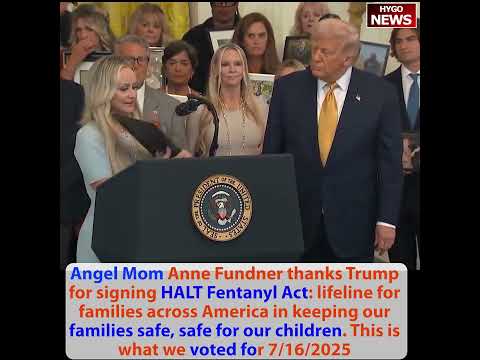
Trump signs HALT Fentanyl Act into law, Angel Mom thanks Trump; Miller: illegals been treated better
President Trump signed the HALT Fentanyl Act into law — permanently classifying fentanyl-related substances as Schedule I under the Controlled Substances Act. “Today we strike a righteous blow to the drug dealers, narcotic traffickers, and criminal cartels that we’ve all been hearing so much about for so many years, and very little has been done,” the president said. Angel Mom Anne Fundner, whose son Weston died from fentanyl, stood with Trump at the signing exactly one year after she had told Weston’s story at the Republican National Convention: “For four years we felt ignored. But you’ve changed that. And we appreciate that so much … thank you for keeping America safe and for our children. And this is what we voted for, Mr. President.” White House Deputy Chief of Staff Stephen Miller laid out the quality-of-life argument for mass deportation: “No more waiting in line at an emergency room? No more massive traffic in Los Angeles? Your health insurance premiums go down? Your public school classroom size will shrink dramatically? They have more time to educate every student?"
"Not an Auto Pen”
The detail that opened the segment matters in context. “And this is not an auto pen, right? That’s for sure.”
After weeks of Trump raising the Biden autopen controversy as “maybe the biggest scandal in 50 to 100 years,” the HALT Fentanyl Act signing was choreographed to confirm, on camera, that Trump was using his actual hand to sign. The contrast is deliberate. Biden, according to Trump’s framing, may have been distanced from signatures that went out in his name via autopen. Trump is signing every one himself. The visible proof is part of the political message.
”Righteous Blow”
Trump framed the signing as both punitive and reparative. “Today we strike a righteous blow to the drug dealers, narcotic traffickers, and criminal cartels that we’ve all been hearing so much about for so many years, and very little has been done. And we take a historic step toward justice for every family touched by the fentanyl scourge as we signed the HALT FENTANIL Act into Law.”
“Righteous blow” is a specific register. It is the language of retribution framed in moral terms. Not merely a law-enforcement action, but justice. The implicit argument: fentanyl traffickers have inflicted mass death on American families, and the law is the official response of a wronged nation.
The “very little has been done” concession is directed at prior administrations. Fentanyl has been a growing crisis since the mid-2010s, and through multiple administrations, the scheduling of fentanyl analogs has been addressed through temporary orders rather than permanent statute. The HALT Fentanyl Act makes the scheduling permanent and expands it to cover related substances that have been used to circumvent prior orders.
The Scheduling Mechanism
Permanent Schedule I classification carries specific legal consequences. Schedule I substances are those the government classifies as having no accepted medical use and a high potential for abuse. That classification triggers enhanced criminal penalties for manufacturing, distribution, and possession; enables broader prosecutorial authority over chemical precursors; and removes defenses based on the technical novelty of specific analogs.
Prior to permanent scheduling, fentanyl analog manufacturers — often Chinese chemical producers — could synthesize new compounds that were chemically similar to already-scheduled fentanyl but technically distinct. By the time regulators scheduled the new compound, the market had already shifted to another analog. The permanent scheduling closes that chase-the-analog problem by classing entire chemical families preemptively.
Anne Fundner’s Story
Angel Mom Anne Fundner was the signing ceremony’s most resonant voice. “Good afternoon, Mr. President and distinguished guests. My name is Anne Funder. I’m going to hold. Thank you. Okay. And I’m an angel parent.”
“Angel parent” — the term used by parents whose children have died from fentanyl — is the self-identification that locates her in a community of loss that has become one of the most organized advocacy networks in American politics.
“One year ago today, on July 16th, I stood in front of America and told the story of my son, Weston, the RNC. And about how he was a beautiful, loving, had a wonderful life. We did everything right.”
“We did everything right” is the phrase that haunts angel parents. Their children were not reckless. They were not long-term addicts. Many fentanyl deaths involve counterfeit pills — a single pill taken once that happened to contain a fatal dose of fentanyl. The parents followed the rules. The children followed their parents. The death happened anyway.
”We Felt Ignored”
“President Trump, for four years we felt ignored. But you’ve changed that. And we appreciate that so much.”
Four years ignored. That is a direct indictment of the Biden administration’s response to the fentanyl crisis from a parent who lost her son during that administration. Fundner’s framing is that the prior administration did not treat angel parents as political stakeholders worth meeting, listening to, or acting on.
“You’ve closed the borders, sanctioned cartels, imposed tariffs, closed shipping loopholes. Most people don’t know about that. That was a big one. Delt with countries where it’s coming from. You mobilized Treasury, Justice Department, Homeland Security, lawmakers, legislators.”
Fundner’s list is unusually detailed for an Angel Mom statement. She is walking through the specific policy levers — border enforcement, cartel sanctions, tariffs as leverage on source countries, shipping loopholes that allowed fentanyl precursors to enter the U.S. through the postal system, multi-agency coordination. That level of policy fluency from an angel parent reflects how deeply engaged these families have become with the operational detail of what Washington can actually do.
”This Is What We Voted For”
“And today the signing of the HALT FENTANIL Act, bipartisan and overwhelmingly supported by everybody. Thank you for keeping America safe and for our children. And this is what we voted for, Mr. President. God bless you. God bless our angel families who are all here with us today. And all of you sitting up here with us. And God bless America.”
“This is what we voted for” is the political validation. For angel families, the 2024 election was not about taxes, the economy, or any of the standard political dimensions. It was about whether an administration would treat fentanyl as the national emergency they believe it to be. The HALT Fentanyl Act is their answer.
Miller: “Always Been Treated Better”
Stephen Miller, the White House Deputy Chief of Staff and the architect of the second-term immigration enforcement posture, laid out the quality-of-life argument for mass deportation with an unusual level of specificity.
“Look, at every turn, illegal aliens have always been treated better than Americans. The difference is, in this administration, they’re getting a ticket out of America so that we can take care of our own people.”
“Always been treated better” is the framing. The argument: prior administrations have, in Miller’s view, prioritized the interests of unauthorized immigrants over the interests of American citizens across multiple categories — benefits access, public services, due-process protections, work permits, and so on. The current administration reverses that ordering. Americans first; unauthorized immigrants exit the country.
The Quality-of-Life Catalog
Miller then catalogued the specific ways ordinary Americans would benefit from mass deportation. “Do you have any idea how many resources will be opened up for Americans when the illegals are gone? No more waiting in line at an emergency room? No more massive traffic in Los Angeles? Your health insurance premiums go down? Your public school classroom size will shrink dramatically? They have more time to educate every student? You won’t have to compete for public benefits?”
That is a specific, testable set of claims:
- Emergency room wait times: unauthorized immigrants do account for a portion of emergency room usage, particularly in border states and in jurisdictions with large undocumented populations. Whether removing them produces shorter wait times depends on the counterfactual — what share of ER capacity is consumed by this population.
- Los Angeles traffic: the claim that mass deportation would measurably reduce traffic in Los Angeles is rhetorical rather than empirical. Traffic congestion has multiple drivers, and immigration status is not a primary variable in most congestion models.
- Health insurance premiums: unauthorized immigrants do contribute to certain cost pools (emergency Medicaid, uncompensated care funds) that indirectly affect premium levels. Whether removing them would produce measurable premium relief is a subject of ongoing analysis.
- Classroom size: for school districts with large immigrant populations, removing unauthorized-immigrant families would reduce student counts and could produce smaller class sizes. That effect would be concentrated in specific districts, not spread evenly nationwide.
- Public benefits competition: the argument that American citizens are losing benefit access to unauthorized immigrants depends on how “competition” is measured. Some benefit categories are legally closed to unauthorized immigrants; others have more porous boundaries. The specifics vary.
”You’re Not Going to Be in Line by Millions of Illegal Aliens”
Miller’s framing is designed for Americans who have been on the receiving end of public services that feel stretched. “If you’re down in your luck, you’re having a hard time and you do need to get support from the government, you’re not going to be in line by millions of illegal aliens from the third world. This is going to be such a gift to the quality of life of everyday Americans, Jesse. It’s hard to even express the wonders that await for working people this time.”
“In line by millions of illegal aliens from the third world” — the phrasing is blunt. Miller is speaking to Americans who believe they have been economically crowded out by immigration-driven labor supply and benefit-program usage. The “quality of life … wonders that await for working people” framing is the Miller theory of how mass deportation translates into a visible upgrade in the everyday American experience.
Whether that promise materializes at the promised scale will be one of the defining empirical questions of the second term. Miller is staking a specific claim: measurable quality-of-life improvements, observable to working-class Americans, as a direct consequence of enforcement.
Two Framings, One Posture
Fundner and Miller represent two different registers of the same political argument. Fundner is the personal case — a mother who lost her son and is thanking the president who, in her view, is finally doing what should have been done years ago. Miller is the systemic case — a White House staffer arguing that the enforcement regime will produce visible quality-of-life gains for citizens.
The HALT Fentanyl Act signing ties them together. The fentanyl crisis and the immigration crisis are, in the administration’s framing, linked — the cartels trafficking fentanyl into the United States are the same networks that traffic people across the southern border, and the same enforcement apparatus addresses both. The signing is the legal weapon against the traffickers. The deportation regime is the demographic reset that relieves pressure on American systems.
Key Takeaways
- President Trump signed the HALT Fentanyl Act into law, permanently classifying fentanyl-related substances as Schedule I and calling it “a righteous blow to the drug dealers, narcotic traffickers, and criminal cartels.”
- Trump emphasized he was signing personally, not via autopen: “And this is not an auto pen, right? That’s for sure” — continuing his ongoing critique of Biden-era autopen practice.
- Angel Mom Anne Fundner, who lost her son Weston to fentanyl, stood with Trump exactly one year after her RNC speech: “For four years we felt ignored. But you’ve changed that … This is what we voted for, Mr. President.”
- Fundner credited the administration’s multi-lever approach: “You’ve closed the borders, sanctioned cartels, imposed tariffs, closed shipping loopholes … mobilized Treasury, Justice Department, Homeland Security.”
- Stephen Miller laid out the mass deportation quality-of-life case: “No more waiting in line at an emergency room? No more massive traffic in Los Angeles? Your health insurance premiums go down? Your public school classroom size will shrink dramatically?”