 HYGO News
 Trump Establishes National Energy Dominance Council: 'The War Against American Energy Has Officially Ended'
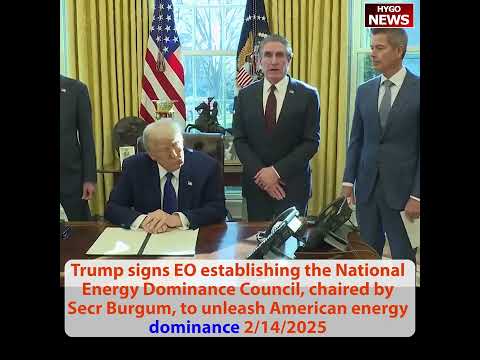
Trump Establishes National Energy Dominance Council: “The War Against American Energy Has Officially Ended”
On February 14, 2025, President Trump signed an executive order establishing the National Energy Dominance Council, a whole-of-government body granted sweeping authority over federal agencies involved in energy permitting, production, generation, distribution, regulation, and transportation. Interior Secretary Doug Burgum, named as the council’s chair, declared that “under the Biden administration, there was a war against American energy, and today that war officially has ended.” Energy Secretary Chris Wright was named vice chair, with additional members drawn from across the cabinet. Burgum outlined a vision that connected energy dominance to three strategic priorities: lower prices for Americans, peace abroad by undermining adversaries’ oil revenue, and winning the AI arms race against China.
”We Have More Energy Than Any Other Country”
Trump signed the order in the Oval Office and framed it in characteristically direct terms. “Here is an executive order establishing the National Energy Dominance Council,” Trump said. “This will reduce costs with respect to energy, establish American independence with energy, and also unleash energy dominance.”
He underscored the fundamental advantage the United States held. “We have more energy than any other country, and now we’re unleashing it, to put it nicely,” Trump said.
The executive order represented the institutionalization of Trump’s energy agenda. Rather than relying on individual executive actions and agency-level decisions, the council created a permanent coordinating body with the authority to direct federal agencies across the energy sector. Its mandate included cutting bureaucratic red tape, enhancing private sector investments, and focusing on innovation instead of what Trump called “totally unnecessary regulation.”
Burgum: “A War Against American Energy”
Secretary Burgum, who had served as governor of North Dakota before joining the Trump cabinet, delivered the most substantive explanation of the council’s purpose and the problem it was designed to solve.
“President Trump wisely understood that under the Biden administration, there was a war against American energy, and today that war officially has ended,” Burgum said. He noted that Trump had declared a national energy emergency on his first day in office, setting the stage for the council’s creation.
Burgum described the specific ways the Biden administration had constrained energy production. “Under the Biden administration, they restricted the production of oil and gas,” he said. “Production is still coming, but when you stop holding leases, when you take 625 million acres of land out of ocean, land out of production possibilities through an executive order, you’re really restricting the balance sheet of America.”
The reference to 625 million acres was to Biden’s last-minute offshore drilling ban, signed just weeks before he left office, which withdrew vast swaths of coastal waters from future oil and gas leasing. Trump had vowed to reverse the ban and had repeatedly criticized it as a politically motivated attempt to obstruct his energy agenda.
Burgum’s framing of the situation as a “180 degree” reversal was deliberate. “The Biden administration had a whole-of-government approach that had the war against U.S. energy. Now we need to turn that around 180 degrees and unleash that potential,” he said. “We’ve got to unleash it from the Gulf of America all the way up to Alaska."
"The Biggest Balance Sheet in the World”
Burgum then made an argument that connected energy policy to the national debt in a way that reframed both issues simultaneously.
“We have amazing resources in this country, and we haven’t been getting a return on them,” Burgum said. He catalogued the Interior Department’s holdings: “The Interior has 500 million acres of surface, 700 million acres of subsurface minerals, critical minerals, and offshore close to 2 billion acres.”
He then delivered the key insight: “That balance sheet is the biggest balance sheet in the world, and it’s been completely underutilized. Everybody knows we have $36 trillion in debt as a country, but no one knows how many hundreds of trillions of dollars of assets we have.”
The argument was powerful because it reframed the national debt conversation. If the United States held hundreds of trillions of dollars in energy and mineral assets under public lands and offshore territories, the $36 trillion debt looked more like a management problem than a solvency crisis. The question was not whether the country could afford to pay its debts but whether the government was extracting sufficient value from its assets.
“President Trump is asking us to go get a return on that investment for the American people,” Burgum said. The language of return on investment — borrowed from the corporate world — positioned the Energy Dominance Council not as a deregulatory body but as an asset management operation designed to maximize the value of the public’s holdings.
Three Strategic Priorities
Burgum connected the energy agenda to three distinct strategic imperatives, each addressing a different dimension of American security and prosperity.
First, domestic prosperity: “We’re going to have prosperity at home with lower prices,” Burgum said. The connection between increased energy production and lower consumer prices was the most politically salient argument. Americans experiencing elevated gas, electricity, and heating costs would benefit directly from expanded domestic production.
Second, peace through energy dominance: “We’re also going to have peace abroad, because the wars that we’ve been engaged in or our allies have been fighting over the past few years have been funded by the oil sales of our adversaries,” Burgum said. The argument was that Russia’s war in Ukraine and Iran’s support for proxy conflicts were both financed by oil revenue. If the United States flooded global energy markets with cheap American oil and gas, it would drive down prices and reduce the revenue available to adversarial regimes.
Third, winning the AI race: “We also are in an AI arms race with China. The only way we win that is with more electricity,” Burgum said. The AI connection was increasingly recognized across the technology sector. Training large AI models requires enormous amounts of computing power, which in turn requires enormous amounts of electricity. Data centers were consuming a rapidly growing share of American electricity generation, and the bottleneck for AI development was increasingly becoming energy availability rather than chip supply.
Burgum warned that the current electricity grid was not up to the task. “We also have an energy emergency in terms of electricity. Too much intermittent, unreliable, not enough base load. We’ve been shutting down the base load that we have,” he said. “President Trump is going to reverse that, and it’s going to allow us to win the AI arms race, which is the most important thing that we have to do relative to our future.”
Undoing Biden’s Last-Minute Actions
The establishment of the Energy Dominance Council was the latest in a series of Trump administration actions designed to reverse Biden-era energy restrictions. Biden had used his final weeks in office to implement some of the most aggressive environmental protections of his presidency, including the 625-million-acre offshore drilling ban.
Biden had justified the ban using authority under the Outer Continental Shelf Lands Act, protecting areas along the East and West coasts, the eastern Gulf of Mexico, and portions of Alaska’s Northern Bering Sea. The Trump administration viewed the last-minute action as an attempt to lock in policy restrictions that the voters had rejected in the 2024 election.
The Energy Dominance Council’s sweeping mandate — covering everything from permitting to production to transportation — was designed to provide the institutional infrastructure needed to reverse not just individual Biden actions but the entire regulatory framework that had constrained American energy development over the previous four years.
Key Takeaways
- Trump signed an executive order establishing the National Energy Dominance Council, chaired by Interior Secretary Doug Burgum with Energy Secretary Chris Wright as vice chair.
- Burgum declared “the war against American energy has officially ended” and said the council would reverse Biden-era restrictions “180 degrees,” unleashing production “from the Gulf of America all the way up to Alaska.”
- Burgum argued the Interior Department controls “the biggest balance sheet in the world” — 500 million surface acres, 700 million subsurface mineral acres, and nearly 2 billion offshore acres — worth “hundreds of trillions of dollars.”
- The council connected energy dominance to three strategic goals: lower domestic prices, defunding adversaries’ wars by reducing global oil revenue, and winning the AI arms race by expanding electricity generation.
- The order granted the council sweeping authority over federal agencies involved in energy permitting, production, regulation, and transportation, with a mandate to cut red tape and enhance private investment.