 HYGO News
 Trump Bans COVID Vaccine Mandates in Schools; Lutnick Declares 'Golden Age of Manufacturing'; Steel Industry Saved
Trump Bans COVID Vaccine Mandates in Schools; Lutnick Declares “Golden Age of Manufacturing”; Steel Industry Saved
President Trump signed an executive order on February 15, 2025, banning federal funding for any school that requires students to receive COVID-19 vaccinations. Commerce Secretary-designate Howard Lutnick declared the end of “the nanny state” and the beginning of “the golden age of manufacturing,” Transportation Secretary Sean Duffy announced a review of Biden-era CAFE standards that had driven up vehicle costs by “billions of dollars in taxes and carbon credits,” and Trump himself took credit for saving the American steel industry through first-term tariffs, stating that “had I not done that, you wouldn’t have one steel mill operating in this country.”
COVID Vaccine Mandate Ban for Schools
Trump opened the signing event with the executive order that would generate the most immediate headlines. “This first executive order prohibits federal funding for COVID-19 mandates, vaccine mandates in schools,” Trump said. He then clarified the mechanism: “So any schools that require students to be vaccinated with the COVID-19 shot — then there’s no more federal funding.”
The order was direct in its application: schools that maintained COVID-19 vaccination requirements as a condition of attendance would lose access to federal education dollars. The financial leverage was significant, as federal funding represented a substantial portion of many school districts’ budgets, particularly in lower-income areas.
The policy addressed a grievance that had been building since the pandemic era. Many parents had objected to COVID-19 vaccine mandates for school-age children, arguing that the risk-benefit calculation for young, healthy children did not justify mandatory vaccination, particularly as the virus evolved and the vaccines’ efficacy against transmission diminished. The executive order gave these families a concrete policy victory while leaving individual parents free to choose vaccination for their children if they wished.
Trump’s simple summary — “Okay, that solves that problem” — reflected the administration’s approach to pandemic-era mandates: clean, decisive reversal without extended deliberation.
Lutnick: “The End of the Nanny State”
Commerce Secretary-designate Howard Lutnick used the event to make a sweeping declaration about the direction of the Trump administration’s regulatory philosophy.
“The nanny state — you’re feeling the end of the nanny state,” Lutnick said. “From straws made of paper to regulation endlessly harming Americans and holding us back.”
The paper straw reference was a characteristically vivid example of the kind of regulatory overreach that frustrated ordinary Americans. Lutnick was connecting a consumer-level annoyance to the broader structural problem of a regulatory environment that, in his view, had been suppressing American economic potential.
“It slows down our production and manufacturing, which we were talking about with the Prime Minister of India yesterday,” Lutnick continued. “You’re hearing that about energy dominance. It’s going to go away.”
Lutnick then made the promise that would define the administration’s economic messaging. “The Trump administration and this president cares about Americans, and you’re going to feel a change,” he said. “You’re going to feel the price of energy coming down. You’re going to feel prices coming down. You’re going to feel an explosion.”
He concluded with the framing that elevated the deregulatory agenda from policy to aspiration: “The golden age of manufacturing of America has always been there. It’s just been stifled by regulation, and that time is over.”
The statement was notable for its optimism. Lutnick was not arguing that America needed to build a manufacturing base from scratch but rather that the existing potential had been suppressed by government. Remove the suppression, and the golden age would emerge naturally.
Duffy: Bringing Down the Cost of a Car
Transportation Secretary Sean Duffy announced a review of Biden-era fuel economy standards that he argued had been driving up vehicle prices for American consumers.
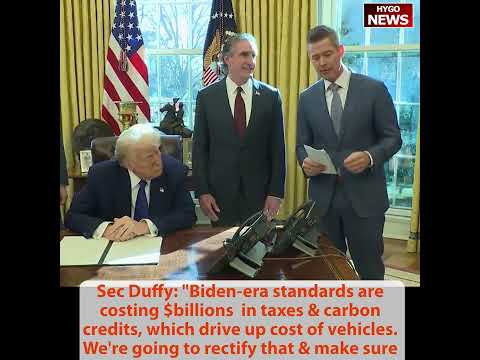
“We’ve introduced our rules to start to look at the CAFE standards,” Duffy said. “We’re looking at how much it costs for end users when they put gas in their car, and the Biden-era standards are costing billions of dollars in taxes and carbon credits, which drive up the cost of vehicles.”
The Corporate Average Fuel Economy (CAFE) standards, which set minimum fuel efficiency requirements for new vehicles, had been significantly tightened under the Biden administration as part of its climate agenda. The stricter standards effectively required automakers to sell more electric vehicles and invest in expensive fuel-saving technologies for conventional vehicles, costs that were passed through to consumers in the form of higher sticker prices.
“We’re going to rectify that and make sure we’re bringing down the cost of a car,” Duffy said.
Duffy also announced progress on a major energy infrastructure project. “For your direction, we are going to move forward with a permitting process for the Texas Gulf Link Deepwater Port, making sure we can move energy in and out of the country,” Duffy said. “That was held up for five years. It was stonewalled. Bureaucrats got in the way. We’re now going to move forward with that, making sure we have great oil infrastructure in the country.”
The Texas Gulf Link project, which had been stalled during the Biden administration, would create a deepwater port facility capable of loading and unloading the largest oil tankers in the world, significantly expanding America’s capacity to export crude oil and import materials. The five-year delay represented exactly the kind of bureaucratic obstruction that the administration was pledging to eliminate.
Trump: “I Saved the Steel Industry”
Trump then delivered a detailed account of how his first-term tariffs had rescued the American steel industry from extinction.
“I saved the steel industry in my first term by putting on tariffs because China was dumping massive amounts of steel,” Trump said. “Others also, but mostly China. And I put very substantially — we took in 600 billion dollars’ worth of tariffs from China. No other president’s taken — literally haven’t gotten 10 cents from China. Not 10 cents.”
The claim about $600 billion in tariff revenue from China across his first term and continuing into the second was one of Trump’s most frequently cited economic statistics. While the exact figure was debated by economists — who noted that the tariff costs were borne by American importers rather than directly by the Chinese government — the revenue was real and represented a significant new source of federal income.
Trump described the counterfactual in stark terms. “Had I not done that, you wouldn’t have one steel mill — I think I can say, not one steel mill operating in this country,” he said. “And we need steel. We need steel. I mean, there are some things you have to have, and steel is one of them. For military, etc.”
He connected the steel argument to the U.S. Steel controversy. “We were talking about U.S. Steel last week. U.S. Steel would have been closed, totally closed. We saved it, and now it’s going to become, I think, very, very profitable,” Trump said.
The steel narrative was politically powerful because it demonstrated a concrete result from Trump’s tariff policy. An industry that had been heading for extinction under free-trade orthodoxy had been revived through tariffs. “The tariffs are going to save a lot of industries,” Trump predicted. “I think steel is going to be very strong. It’s going to be very strong. It’ll go back to being really powerful.”
Key Takeaways
- Trump signed an executive order banning federal funding for schools that require COVID-19 vaccinations, declaring “that solves that problem.”
- Commerce Secretary-designate Lutnick declared “the end of the nanny state” and said “the golden age of manufacturing of America has always been there — it’s just been stifled by regulation, and that time is over.”
- Transportation Secretary Duffy announced a review of Biden-era CAFE standards that were “costing billions of dollars in taxes and carbon credits” and driving up vehicle prices, and unblocked the Texas Gulf Link Deepwater Port project after a five-year bureaucratic delay.
- Trump said he “saved the steel industry” through first-term tariffs, claiming that without them “you wouldn’t have one steel mill operating in this country,” and took in $600 billion in tariffs from China.
- Trump predicted U.S. Steel would become “very, very profitable” after his administration blocked its sale to Japan’s Nippon Steel.