 HYGO News
 Trump Orders Agencies to Stop Enforcing 'Blatantly Illegal' Regulations; Blames Past Presidents for WTO and China: 'They Were Stupid'
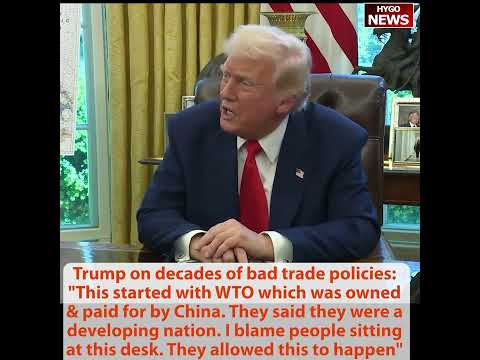
Trump Orders Agencies to Stop Enforcing “Blatantly Illegal” Regulations; Blames Past Presidents for WTO and China: “They Were Stupid”
President Trump signed a presidential memorandum in April 2025 directing all federal agencies to “cease enforcing regulations that are blatantly illegal or unconstitutional.” He then delivered an extended commentary on decades of trade failure, saying “this started with the World Trade Organization, which was owned and paid for by China. They considered them a developing nation. Well, we’re a developing nation too — look at our inner cities.” Trump blamed “the people sitting at this desk” more than China itself: “If you could read first grade and you could read these agreements, you’d say, these are terrible deals.” On TikTok, he said the deal was “on the table” but “China’s not exactly thrilled about signing it."
"Cease Enforcing Illegal Regulations”
A White House official introduced the memorandum with a sweeping assessment.
“There are a large number of regulations on the books — these are regulations that are currently in effect — that we believe blatantly violate the law, blatantly violate Supreme Court precedent, that otherwise are just blatantly illegal,” the official said.
The directive: “What this presidential memorandum does, basically, just directs the heads of your departments and agencies to follow the law and to cease enforcing regulations that are blatantly illegal or unconstitutional.”
Trump emphasized the significance: “It’s a big deal.”
He added the legislative component: “It’s really very important that we get these memorialized in Congress. Very important. For the law.”
The memorandum was one of the broadest deregulation actions any president had taken. Rather than targeting specific regulations for repeal through the Administrative Procedure Act’s notice-and-comment process — which could take years — Trump was ordering agencies to immediately stop enforcing regulations that violated the law or the Constitution. The Supreme Court’s recent decisions limiting administrative agency power, including the overturning of Chevron deference, had created a legal foundation for arguing that many existing regulations exceeded agency authority. The memorandum directed agencies to identify and suspend those regulations rather than waiting for courts to strike them down one by one.
”I Blame the People at This Desk”
Trump then delivered his most pointed critique of his predecessors on trade policy.
“I blame the people sitting right at this desk, right behind this desk,” he said. “You get your choice of seven — I happen to pick the Resolute. But I blame the people sitting behind in this chair, behind this desk, for being stupid and incompetent or not having courage.”
He set the timeline: “This should have been done years ago. This should have been done before Obama, in all fairness. Not only Biden, Obama. This should have been done many years ago.”
He identified the origin: “This started with the World Trade Organization, which was owned by China. It was owned and paid for by China.”
Trump highlighted the absurdity of China’s WTO classification: “They didn’t even have to do things. They considered them a nation that was undeveloped. They said they were a developing nation.”
He flipped the framing: “Well, we’re a developing nation too, if you think about it. Look at our inner cities. Look at what’s happened. I think we’re starting from ground zero there. So we’re a developing nation too.”
The “developing nation” comparison was both satirical and substantive. China — with the world’s second-largest economy, a space program, nuclear weapons, and a military that rivaled America’s — had maintained its WTO classification as a “developing nation,” which entitled it to preferential treatment in trade rules. The classification was a fiction that had allowed China to maintain higher tariffs, provide greater subsidies, and resist market-opening requirements that applied to “developed” nations.
Trump’s observation that America’s inner cities resembled developing-world conditions turned the classification on its head. If China qualified as “developing” with its gleaming cities and trillion-dollar GDP, then surely the deindustrialized communities of Detroit, Gary, and Camden qualified too.
”How Do You Get to Be President and Be Stupid?”
Trump escalated his critique of past presidents.
“A lot of people take heat for saying it, but I blame the people sitting at this desk more than I blame China,” he said. “If China can get away with what they got away with — with taking hundreds of billions and trillions of dollars right out of our pocket — because our people here were stupid. They were stupid people.”
He questioned the possible motivations: “Maybe corrupt. I don’t know. I don’t know how you can be that stupid. How do you get to be president and be stupid?”
He considered the alternatives: “But they certainly weren’t courageous. And they allowed this to happen.”
He described his first-term discovery: “I actually used to read the agreements. I’d say, ‘How could anybody agree to this stuff?’ I actually used to say, ‘Who would allow deals like this to be made for our country?’”
Trump’s assessment — that past presidents were “stupid” or “corrupt” or “not courageous” — was his most direct attack on the bipartisan establishment that had managed American trade policy for half a century. The argument was that the trade agreements were so obviously disadvantageous that any literate person could see their flaws. The failure to correct them required either stupidity (inability to understand the agreements), corruption (personal benefit from the arrangements), or cowardice (unwillingness to confront the consequences of change).
TikTok: “On the Table”
Trump addressed the TikTok deal status.
“It’s moving along,” he said. “But obviously I would say right now China’s not exactly thrilled about signing it.”
He described the American side: “We have a deal with some very good people, some very rich companies that would do a great job with it.”
The complication: “But we’re going to have to wait to see what’s going to happen with China.”
He expressed confidence: “I think China’s going to want to do it, actually.”
The TikTok deal remained in limbo because China’s approval was required for any transfer of the platform’s operations to American ownership. The tariff confrontation had created a broader context in which every bilateral issue — TikTok, trade, Taiwan, Iran — was interconnected. China’s willingness to approve the TikTok deal would likely depend on progress in the broader trade negotiations.
Key Takeaways
- Trump signed a memorandum directing all agencies to “cease enforcing regulations that are blatantly illegal or unconstitutional” — one of the broadest deregulation actions ever taken.
- He blamed past presidents more than China: “I blame the people sitting at this desk. They were stupid, incompetent, or not courageous.”
- On the WTO: “Owned and paid for by China. They considered China a developing nation. Well, we’re a developing nation too — look at our inner cities.”
- Trump said he used to read trade agreements in his first term: “How could anybody agree to this stuff? Who would allow deals like this?”
- TikTok deal is “on the table” but “China’s not exactly thrilled about signing it. We’re going to have to wait.”