 HYGO News
 Trump Signs TAKE IT DOWN Act Against AI Deepfakes: 'I Have Them All the Time But Nobody Does Anything'; First-Ever Medals of Sacrifice to Palm Beach County Officers; Eric Trump Credits Rep. Mast
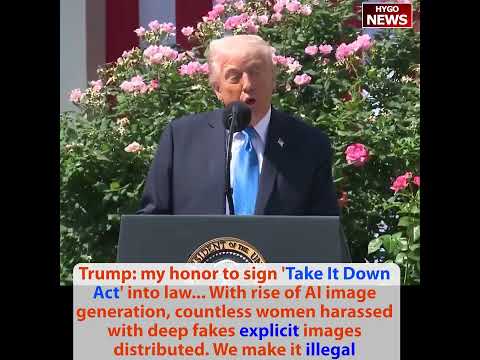
Trump Signs TAKE IT DOWN Act Against AI Deepfakes: “I Have Them All the Time But Nobody Does Anything”; First-Ever Medals of Sacrifice to Palm Beach County Officers; Eric Trump Credits Rep. Mast
In a May 2025 Rose Garden ceremony, President Trump signed the TAKE IT DOWN Act into law, creating the first federal criminal penalties for non-consensual explicit imagery and AI-generated deepfakes. Trump: “With the rise of AI image generation, countless women have been harassed with deepfakes and other explicit images distributed against their will… Today we’re making it totally illegal.” He made a self-deprecating aside about his own experience: “I have them all the time, but nobody does anything. I ask Pam, ‘Can you help me Pam?’ She says no, I’m too busy.” In the same ceremony, Trump awarded the first-ever Medals of Sacrifice to three heroic law enforcement officers from Palm Beach County, Florida, with Rep. Brian Mast introducing legislation to ensure the medal would be awarded to any future fallen law enforcement officer or first responder. Eric Trump recalled the genesis: “My father and I attended that funeral that day… one simple question was asked: Why is there no medal that commemorates fallen law enforcement?”
Signing the TAKE IT DOWN Act
Trump opened with his characterization of the signing.
“Today it’s my honor to officially sign the Take It Down Act into law,” Trump said. “It’s a big thing, very important, so horrible what takes place.”
He described the legal significance: “This would be the first ever federal law to combat the distribution of explicit imaginary, posted without subjects consent.”
He described the conduct: “They take horrible pictures, and I guess sometimes even make up the pictures, and they post it without consent or anything else.”
He addressed the AI dimension: “Very importantly, this includes for forgeries generated by artificial intelligence known as deepfakes.”
The technological context was critical. AI image generation had advanced dramatically between 2020 and 2025. Tools like Stable Diffusion, Midjourney, and various specialized “undressing” applications had made it possible for anyone with modest technical skill to create realistic-appearing explicit imagery of any person, including celebrities, public officials, private individuals, or even minors.
The traditional legal framework had not kept pace. Revenge porn laws had been enacted at the state level in most states, but these addressed unauthorized distribution of actual images. Deepfake imagery posed different legal questions: the imagery was not real, but the harm to the subject was real. Was creating a realistic-looking explicit image of a person using AI different from creating a photorealistic painting? Was there a First Amendment protection for “artistic expression” that might cover some AI-generated imagery?
The TAKE IT DOWN Act resolved these questions at the federal level. By establishing that non-consensual explicit imagery — whether real or AI-generated — was criminal, the bill closed the loophole that had allowed AI-generated deepfakes to proliferate without clear legal consequences.
”I Have Them All the Time”
Trump’s self-deprecating aside was characteristic.
“We’ve all heard about deepfakes,” Trump said. “I have them all the time, but nobody does anything.”
He continued the riff, referencing Attorney General Pam Bondi: “I ask Pam, can you help me Pam? She says, no, I’m too busy.”
He delivered the punchline: “Too busy doing other things. Don’t worry, you’ll survive.”
He shifted tone: “But a lot of people don’t survive. That’s true and so horrible.”
The self-deprecating humor served multiple purposes. First, it acknowledged that Trump himself was frequently the subject of deepfakes and manipulated imagery. In political contexts, opponents had generated AI-based imagery of Trump in various compromising situations. Second, it deflected any accusation that Trump was pursuing legislation for personal benefit — he explicitly framed himself as someone who could “survive” without legal protection. Third, it set up the serious pivot: many victims could not “survive” the psychological trauma of having fake explicit imagery of themselves distributed.
Trump’s serious conclusion framed the stakes: “With the rise of AI image generation, countless women have been harassed with deepfakes and other explicit images, distributed against their will. This is the wrong, and it’s just so horribly wrong.”
He acknowledged the severity: “And it’s a very abusive situation, like in some cases people have never seen before.”
He stated the action: “And today we’re making it totally illegal.”
The Real-World Harms
The “people don’t survive” reference was tragically accurate. Documented cases of suicide following deepfake victimization included:
High school students: Multiple cases of minors — both girls and boys — taking their own lives after classmates used AI tools to create fake explicit imagery and distributed it through social media. The combination of social humiliation, perceived permanence of digital content, and adolescent vulnerability had proven lethal in several well-publicized cases.
Adult women: Women in public-facing roles — including teachers, news anchors, and various professionals — who had been subjected to deepfake imagery distributed to colleagues, family members, or potential employers had experienced severe mental health consequences, including some documented suicides.
Celebrities: Although public figures typically had more resources to cope with such attacks, several celebrity deepfake incidents had produced significant mental health impacts and in some cases contributed to personal crises.
The TAKE IT DOWN Act would not prevent all such harms, but it would provide legal consequences for perpetrators and obligations on platforms to remove such content promptly. The combination of criminal penalties for creators and removal obligations for platforms was designed to disrupt the distribution chain that allowed deepfake imagery to spread before legal remedies could be pursued.
The First Medals of Sacrifice
Trump then transitioned to the second ceremony.
“And we award the first ever medals of sacrifice to three heroic law enforcement officers from Palm Beach County, Florida,” Trump said.
He recalled his personal connection: “I went to the service, it was crazy. It was just horrible.”
He introduced the legislation: “Earlier today, Congressman Brian Mast, who’s right here, introduced a bill to ensure this new medal will be awarded to any law enforcement officer or first responder who gives his or her life in the line of duty.”
Rep. Brian Mast — a Florida Republican and combat-wounded veteran who had lost both legs in Afghanistan — was introducing legislation to institutionalize the Medal of Sacrifice program. Under this legislation, the medal would be available for any law enforcement officer or first responder killed in the line of duty going forward, not just the three Palm Beach County officers being honored that day.
Eric Trump’s Remarks
Eric Trump provided the back story of the medal’s creation.
“My father and I attended that funeral that day, and I can’t tell you how moving that experience was,” Eric Trump said.
He described the originating question: “And one simple question was asked: why is there no medal, medal of valor, medal of sacrifice that commemorates law enforcement officers, first responders who have fallen in line of duty?”
He described the commitment: “And Congressman Mast, he was there with me that day. He was with my father, and we said, we’re gonna take care of this problem. We’re gonna get involved.”
He described the design process: “And the first call that was made was to the great R&O family who owns Tiffany’s. And they said, without hesitation, that they’d be honored to design something absolutely beautiful that’s attributed to these incredible officers, these incredible EMS responders.”
He described the timeline: “And here we are, roughly six months later, with something that’s truly beautiful.”
The Tiffany & Co. connection was notable. Tiffany’s had designed the Medal of Honor (the highest military decoration) during the Civil War and had continued to produce it since. The company’s iconic American craftsmanship tradition made it an appropriate choice for a new national medal honoring fallen law enforcement and first responders.
The six-month timeline was remarkable. From conception following the funeral to completed medal presentation had taken approximately half a year — an unusually fast pace for creating a new federal honor. This speed reflected both the Trump family’s direct personal involvement and the cooperation of Tiffany’s in expediting the design process.
The Funeral That Started It
The Palm Beach County officers being honored had been killed in the line of duty. The specific incident was not fully detailed in Trump’s remarks, but the fact that Trump and Eric Trump had personally attended the funeral indicated that the loss had occurred in a local incident affecting the Palm Beach County community where Trump’s Mar-a-Lago residence was located.
Palm Beach County had experienced a series of law enforcement losses over the preceding years. The relationship between Trump and local law enforcement had been close, with the Palm Beach County Sheriff’s Office providing extensive coordination with federal Secret Service during Trump’s visits to Mar-a-Lago. Trump’s attendance at officer funerals was well-documented.
Eric Trump’s description of “one simple question” at the funeral captured how the medal initiative had begun. Families of fallen law enforcement had long noted that their loved ones had not received the kind of national recognition given to fallen military members. The Purple Heart and related military decorations provided formal recognition and survivor benefits. No equivalent existed for fallen law enforcement officers and first responders until the Medals of Sacrifice initiative.
The Permanent Legacy
Eric Trump framed the medal’s long-term significance.
“This medal is gonna be given for hundreds and hundreds of years to come,” Eric Trump said.
He thanked the collaborators: “I wanna thank the Tiffany’s family. They are no family for all the work they put into it, and their entire team. I can tell you this has been a nonstop effort. I wanna thank the Congressman, without the Congressman, his staff, we would not be here today. I wanna thank the President for allowing us to do this.”
He stated the core mission: “It’s such an important mission.”
He addressed the families of the fallen: “And last but not least, I wanna send, on behalf of this entire nation, on behalf of our entire family, the incredible families of the Pompey Sheriff’s office and your incredible families, they made the ultimate sacrifice and know that we all appreciate their dedication.”
The “hundreds and hundreds of years” framing was significant. By establishing a new federal medal for law enforcement sacrifice, Trump was creating institutional machinery that would operate across many future administrations. Unlike executive orders that could be reversed or regulations that could be rescinded, the Medal of Sacrifice (once institutionalized by Mast’s legislation) would become a permanent feature of American federal honors.
The comparison to the Medal of Honor was apt. The Medal of Honor, established during the Civil War, had operated continuously for over 160 years, providing recognition for military valor across generations. A Medal of Sacrifice established in 2025 could similarly operate for centuries, providing recognition for law enforcement and first responder deaths across many decades and many administrations.
Key Takeaways
- Trump signs TAKE IT DOWN Act: First federal law against non-consensual explicit imagery and AI deepfakes — “making it totally illegal.”
- Trump on his own experience: “I have them all the time, but nobody does anything. But a lot of people don’t survive.”
- First-ever Medals of Sacrifice awarded to three Palm Beach County officers; Rep. Mast legislation institutionalizes for future.
- Eric Trump: “My father and I attended that funeral. One simple question: Why is there no medal for fallen law enforcement?”
- Tiffany’s designed the medal (same company that makes Medal of Honor) — six months from conception to first presentation.