 HYGO News
 Trump Signs EO Banning Gain-of-Function Research Funding in China and Iran; Kennedy: 'Not a Single Good Thing Has Come of It'
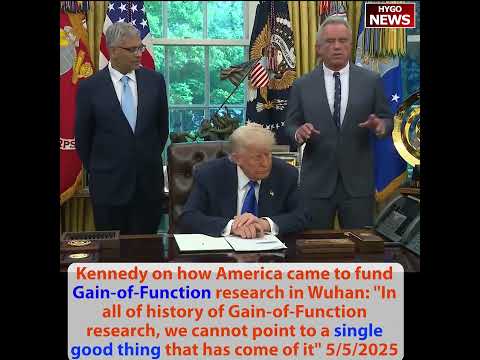
Trump Signs EO Banning Gain-of-Function Research Funding in China and Iran; Kennedy: “Not a Single Good Thing Has Come of It”
President Trump signed an executive order in May 2025 ending federal funding for gain-of-function research in China, Iran, and other nations with insufficient oversight. An adviser explained: “This provides powerful new tools to enforce the ban on federal funding for gain-of-function research abroad. It strengthens oversight and creates a strategy to ensure biomedical research protects human health.” HHS Secretary Kennedy delivered the historical context: “This research began with U.S. military agencies in 1947. By 1969, the CIA said they could kill the entire U.S. population for 29 cents per person. In all the history of gain-of-function research, we cannot point to a single good thing that has come of it.” Trump assessed: “It’s a big deal. Could have been that we wouldn’t have had the problem we had.”
The Executive Order
An adviser outlined the order’s provisions.
“Gain-of-function research is a type of biomedical research where pathogens — viruses — are adulterated to make them more potent or to change the way they function,” the adviser explained.
He connected to COVID: “Many people believe that gain-of-function research was one of the key causes of the COVID pandemic that struck us in the last decade.”
He described the order’s scope: “First, it provides powerful new tools to enforce the ban on federal funding for gain-of-function research abroad.”
He added: “It also strengthens other oversight mechanisms and creates an overarching strategy to ensure that biomedical research in general is being conducted safely and in a way that ultimately protects human health.”
Trump reacted: “It’s a big deal. Could have been that we wouldn’t have had the problem we had. A lot of people say that, sir — if we had this done earlier.”
The executive order addressed the most consequential biosecurity failure of the 21st century. American taxpayer money — funneled through organizations like EcoHealth Alliance — had funded gain-of-function research at the Wuhan Institute of Virology in China. That research, which involved manipulating bat coronaviruses to make them more transmissible, was widely believed to be connected to the COVID-19 pandemic that killed millions of people worldwide and caused trillions in economic damage.
The order ended this funding permanently — not just in China but in Iran and any other nation deemed to have insufficient research oversight. It also empowered American agencies to identify and terminate funding for any biological research that could threaten public health or national security.
Kennedy’s History of Bioweapons
Kennedy provided the most comprehensive public accounting of gain-of-function research’s origins.
“This was a kind of study engaged in by the United States military and intelligence agencies beginning in 1947,” Kennedy said.
He described the scale: “By 1969, the CIA said that they had reached nuclear equivalency — that they could kill the entire U.S. population for 29 cents per person.”
He recounted the first ban: “That year, President Nixon went to Fort Detrick and announced a unilateral end to this kind of research, what they call dual-use research — research that was for vaccination and also for military purposes.”
He described the international effort: “He then persuaded over 180 countries to sign the Bioweapons Charter in 1973. That basically ended gain-of-function research around the globe until 2001.”
He identified the reversal: “After the anthrax attacks, we passed the Patriot Act. And the Patriot Act had a little provision that said U.S. federal officials who violated the Bioweapons Charter cannot be prosecuted. That relaunched the bioweapons arms race, driven by gain-of-function research.”
He described the Obama-era shift: “In 2014, three of those bugs escaped from U.S. labs. President Obama declared a moratorium on future use. Instead, a lot of that research was moved offshore to the Wuhan lab.”
He described the current landscape: “It launched a bioweapons arms race around the world. China is engaged in it, developing weapons using AI and CRISPR technologies that are devastating. Russia is deeply engaged. Iran and many other countries.”
He delivered the verdict: “In all of the history of bioweapons gain-of-function research, we can’t point to a single good thing that’s come from it.”
He praised the president: “Today I commend President Trump for his courage and his vision in ending U.S. bioweapons research.”
Kennedy’s history lesson was the most detailed public explanation any government official had provided of how American-funded research likely caused the COVID pandemic. The narrative traced a direct line from Cold War bioweapons programs through the Patriot Act loophole to the Wuhan lab — connecting decisions made by American officials across decades to the pandemic that reshaped the world.
The “29 cents per person” detail from the CIA’s 1969 assessment was chilling in its specificity. The United States government had developed the capability to kill its own population for less than the cost of a stamp — and had then, after supposedly ending the program, allowed it to resume through legal loopholes and foreign partnerships.
The Obama-to-Wuhan Pipeline
Kennedy’s account of how gain-of-function research moved from American labs to Wuhan was the most politically explosive element of his narrative. When three pathogens escaped from U.S. labs in 2014, Obama’s response was a moratorium on domestic gain-of-function research. But instead of ending the research entirely, the funding was redirected to the Wuhan Institute of Virology — a Chinese government facility with lower safety standards and no American oversight.
The decision to offshore dangerous research to China was, in Kennedy’s telling, the proximate cause of the COVID pandemic. American tax dollars funded the research. American scientists designed the experiments. But the work was conducted in Chinese labs where containment failures could — and apparently did — release a novel coronavirus into the human population.
”Not a Single Good Thing”
Kennedy’s claim that gain-of-function research had produced no beneficial results was the most comprehensive indictment of the field. The standard justification for the research was that it was necessary to prepare for natural pandemics — to understand how viruses might evolve and develop vaccines in advance. Kennedy rejected this argument entirely, asserting that decades of gain-of-function research had produced weapons and accidents but never the vaccines it was supposed to generate.
The implication was that the entire field — consuming billions in funding and posing existential risks to humanity — had been a net negative for civilization. The viruses it created were more dangerous than any it predicted. The pandemics it caused were worse than any it prepared for. The executive order’s ban was not merely a policy change; it was a judgment that the research itself was unjustifiable.
Key Takeaways
- Trump signed EO ending all federal funding for gain-of-function research in China, Iran, and nations with insufficient oversight.
- Kennedy traced the history: military bioweapons since 1947, Nixon’s ban, Patriot Act loophole, Obama moratorium that moved research to Wuhan.
- Kennedy: “The CIA said they could kill the entire U.S. population for 29 cents per person. In all of history, not a single good thing has come from this research.”
- The EO empowers agencies to end funding for any biological research threatening public health or national security.
- Trump: “It’s a big deal. Could have been that we wouldn’t have had the problem we had.”