 HYGO News
 Trump to NOTUS Reporter: 'I Don't Even Know What the Hell That Is -- Get Yourself a Real Job'; RFK Jr. to Sen. Patty Murray: 'You Presided Over Destruction of Health of American People -- Sickest People in the World'
Trump to NOTUS Reporter: “I Don’t Even Know What the Hell That Is — Get Yourself a Real Job”; RFK Jr. to Sen. Patty Murray: “You Presided Over Destruction of Health of American People — Sickest People in the World”
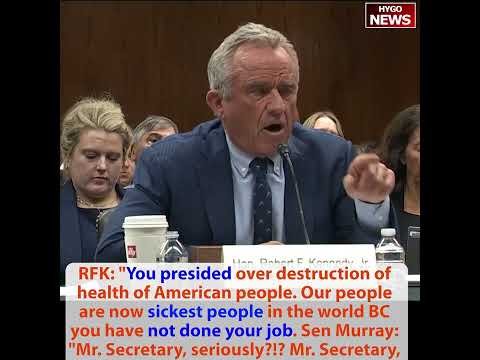
Two memorable exchanges from May 2025 captured the Trump administration’s confrontational style with the press and Senate Democrats. President Trump dismissed a question about the One Big Beautiful Bill’s House vote from a reporter at “NOTUS” (News of the United States): “I don’t even know what the hell that is. Get yourself a real job.” Separately, HHS Secretary Robert F. Kennedy Jr. responded to aggressive questioning from Senator Patty Murray (D-WA) with a devastating indictment: “You presided here, I think, for 32 years. You presided over the destruction of the health of the American people. Our people are now the sickest people in the world because you have not done your job. What have you done about the epidemic of chronic disease?” Murray’s frustrated response: “Mr. Secretary, seriously?!?” RFK Jr. also accused Murray of lying about a clinical trial: “What you said turned out to be completely untrue and you knew it was untrue."
"Get Yourself a Real Job”
The NOTUS reporter exchange was classic Trump press combat.
The reporter opened with a critical question: “Andy Harris said you didn’t adequately convince enough people to [vote for the bill] in the House.”
Trump was unfazed: “You mean after this speech? After this speech? Yeah, I think so. Well, what do we see after this? I think it was a great talk. It wasn’t a speech we talked about. Thank you.”
Trump then turned the question back: “Who do you work for?”
The reporter answered: “NOTUS.”
Trump feigned misunderstanding: “Who?”
The reporter repeated: “NOTUS.”
Trump delivered the dismissal: “I don’t even know what the hell that is. Get yourself a real job.”
NOTUS (News of the United States) was a relatively new journalism outlet launched in 2024 by Allbritton Journalism Institute. The publication had positioned itself as a serious political reporting organization focused on policy and institutions. Its name was a play on “POTUS” (President of the United States) and was meant to convey focus on American government and politics.
Trump’s dismissal served multiple functions: Delegitimization: By declaring unfamiliarity with NOTUS, Trump implicitly characterized it as unimportant. A major media outlet would be known to the President; an unknown outlet was by definition marginal.
Humor: The “get yourself a real job” line was a classic Trump insult delivered with timing that produced laughs. In the broader media environment where every Trump remark was parsed for substance, the pure entertainment value of his dismissals provided counterprogramming.
Deflection: By making the question about the reporter’s employer rather than the substance of Rep. Harris’s criticism, Trump avoided engaging with the critical premise. Whether he had “adequately convinced enough people” was a substantive question; whether NOTUS was a “real job” was pure theater.
Rep. Andy Harris’s Criticism
The underlying substantive question was about Rep. Andy Harris, who chaired the House Freedom Caucus. Harris had reportedly complained that Trump’s speech to House Republicans about the One Big Beautiful Bill had not been persuasive enough to overcome conservative concerns about the bill’s content.
The Freedom Caucus position on the OBBB was complicated:
- Conservative members wanted larger spending cuts and deeper deficit reduction
- Some members objected to the specific mix of tax cuts and work requirements
- Others wanted stronger immigration enforcement provisions
- Still others had concerns about specific Medicaid and welfare provisions
Trump’s challenge was holding the conservative Freedom Caucus while also retaining moderate Republicans who had different concerns. Getting both wings to agree on the same bill required careful balancing.
Trump’s response to the reporter — “why don’t we see how the vote is? I thought it was a great speech” — deflected the premise of the question. Harris might have complained, but the actual vote would determine whether Trump’s efforts had been adequate.
RFK Jr. vs. Sen. Murray
The more substantive confrontation was HHS Secretary Kennedy’s exchange with Senator Patty Murray at a congressional hearing.
Senator Murray had been aggressively questioning Kennedy about child care funding: “I’m asking you who made the decision to withhold child care and development block grant funding?”
Kennedy redirected with context about the budget process: “Senator, I want to point out that in 2021, at the beginning of his administration, President Biden submitted his budget on May 28.”
Murray tried to cut him off: “I’m not going to have to go out.”
Kennedy was insistent: “You know what? You made an accusation of me and I’m going to answer it.”
Murray: “Okay, I appreciate that.”
Kennedy made his point about procedural precedent: “In 2018, he submitted his budget. So we’re our budget. We’re a new administration. Okay, you can go out.”
The procedural point was that new administrations typically took months to prepare their first budgets. Murray’s criticism of Kennedy for not having made specific funding decisions during his first months in office ignored the reality that new administrations operated under continuing resolutions and partial budget authority during transitions.
”You Presided Over Destruction of Health”
Kennedy’s devastating counter-accusation came next.
“I also want to point out,” Kennedy said. “I have just two minutes left. I asked you a specific question. I want to point out something, Senator.”
He delivered the charge: “You presided here, I think, for 32 years. You presided over the destruction of the health of the American people.”
Murray was incredulous: “Well, I have to say that Mr. Secretary, seriously…”
Kennedy continued: “Because you have not done your job.”
Murray: “Mr. Secretary, seriously…”
Kennedy pressed: “What have you done about it? What have you done about the epidemic of chronic disease? Mr. Secretary, you are shivering. What have you done about the epidemic of chronic disease?”
The Chairman intervened: “Mr. Secretary, I would ask it to hold back and let the senator ask the questions.”
But Kennedy had made his point. The “32 years” reference was accurate — Patty Murray had served in the Senate since 1993, over three decades by the time of this hearing. During that period, she had chaired various health-related committees, been a senior member of the HELP (Health, Education, Labor, Pensions) Committee, and had substantial influence over American health policy.
The “destruction of health” charge was based on genuine and substantial data:
- American life expectancy had declined or stagnated since 2014
- Chronic disease prevalence had increased dramatically across categories
- Obesity rates had reached approximately 42% of American adults
- Type 2 diabetes had become prevalent in children
- Autism diagnoses had increased dramatically (causes disputed)
- Autoimmune disease rates had risen substantially
- Mental health conditions had increased, particularly among young people
- Drug overdose deaths had reached record highs
Kennedy’s argument was that if Murray had been chairing health-related committees for decades while these trends worsened, she bore substantial responsibility for policy failures that had produced these outcomes. A senior senator could not simultaneously claim credit for decades of health policy involvement while disclaiming responsibility for declining health outcomes.
”Sickest People in the World”
Kennedy’s “sickest people in the world” framing was the most politically provocative element.
The American population’s health metrics did compare poorly internationally:
- Life expectancy lagged most developed nations
- Maternal mortality was substantially higher than peer nations
- Infant mortality was higher than most developed nations
- Chronic disease rates exceeded most peers
- Mental health outcomes compared poorly
- Drug addiction rates exceeded most nations
Whether Americans were literally “the sickest people in the world” depended on comparison set and metrics. Across Europe, Japan, Korea, and most other developed economies, health outcomes were generally better than in the United States. Compared to the developing world, American outcomes were better in absolute terms but often worse per dollar spent on healthcare.
The “sickest” framing was therefore rhetorically overstated but substantively defensible. Given American wealth and healthcare spending, the outcomes were far worse than might be expected. This gap between investment and outcome was what Kennedy was attacking.
The NIH and Clinical Trials Dispute
Murray pivoted to a different criticism.
“In the last four months, you fired or pushed out nearly 5,000 NIH staff and terminated more than 1,600 NIH grants,” Murray said. “That includes more than 240 clinical trials across the country.”
She asked: “So whose decision was it to fire scientists and terminate these NIH grants and the clinical trials?”
Kennedy challenged the factual premise: “Senator, I don’t trust your information with all due respect. You told me two or three days ago or four days ago that we had cut a clinical trial in your state. What you said turned out to be completely untrue and you knew it was untrue because you corresponded with J. Pondichara.”
The Chairwoman: “Madam Chairman, I will answer that.”
Kennedy specified the specific dispute: “The woman that was in question as I clarified to you at the last committee was qualified for a clinical trial, unlike you stated. Untrue. I will. No, that is true. Untrue. She qualified this week.”
Murray pushed back: “We shouldn’t be talking about patients’ private information.”
Kennedy agreed but continued making his point: “I agree. And let’s leave that. And I will just say your staff didn’t get back to me until 45 minutes ago. We have the emails. We have the emails from your staff two weeks ago. Two weeks ago, you were corresponding. What you said you knew was untrue when you said it.”
He closed with the accusation: “You came here to argue with me. I came here to ask you questions about your budget request.”
The specific dispute concerned a constituent of Senator Murray who had been involved in a clinical trial. Murray had apparently claimed publicly that the Trump administration had improperly terminated a clinical trial that was important to her constituent. Kennedy was arguing that:
- The clinical trial had not actually been terminated
- The constituent had qualified for it
- Murray’s staff had been corresponding with HHS about the matter for weeks
- Therefore Murray had known the public claim was false when she made it
If Kennedy’s account was accurate, it represented a significant credibility problem for Murray. Public officials should not make false statements about specific policy matters to attack opponents when they have information showing the statements to be false.
The NIH Restructuring
The broader NIH restructuring context was significant. The Trump administration had been implementing substantial reforms to NIH (National Institutes of Health) operations:
Staffing reductions: Approximately 5,000 NIH staff had left through voluntary separations, retirements, or terminations. The reductions had focused on administrative and duplicative positions rather than front-line researchers.
Grant review: The administration had paused and reviewed NIH grants, particularly those related to gain-of-function research, diversity/equity/inclusion spending, and grants to foreign institutions including Chinese research organizations.
Clinical trial review: Trials involving controversial topics (gender transition for minors, various gain-of-function research) had been paused or terminated. Legitimate clinical research had generally continued.
Research priorities: Kennedy had emphasized redirecting NIH resources toward chronic disease research rather than the heavy emphasis on infectious disease and rare disease research of previous administrations.
Democratic senators (including Murray) had portrayed these changes as attacks on science. The administration had framed them as overdue reforms of an agency that had grown bureaucratically and had lost focus on America’s actual health challenges.
Key Takeaways
- Trump to NOTUS reporter: “I don’t even know what the hell that is. Get yourself a real job.”
- RFK Jr. to Murray (32-year senator): “You presided over the destruction of the health of the American people. Sickest people in the world.”
- Kennedy on “chronic disease epidemic”: America compares poorly to developed peers on life expectancy, obesity, diabetes, autoimmune, mental health.
- Kennedy accused Murray of making public statements she “knew was untrue” about terminated clinical trial.
- NIH restructuring: ~5,000 staff reduction, grant review, clinical trial review — reframed as reform vs. Murray’s “attack on science.”