 HYGO News
 Trump Shows Off Gold Card: '$5 Million, Could Be Yours'; 'Every Country's Called Us -- Tariffs Give Great Power to Negotiate'
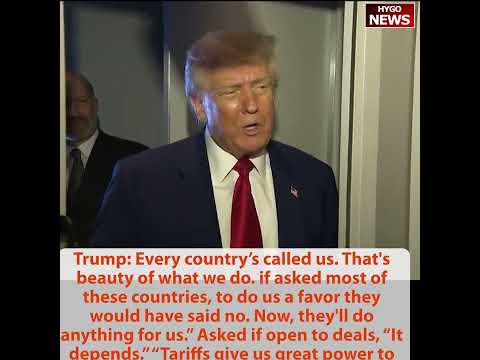
Trump Shows Off Gold Card: “$5 Million, Could Be Yours”; “Every Country’s Called Us — Tariffs Give Great Power to Negotiate”
President Trump gave a wide-ranging interview in April 2025, showing off the new Trump Gold Card immigration program — “For $5 million, this could be yours — it’ll be out in about less than two weeks” — while describing the diplomatic leverage the Liberation Day tariffs had created: “Every country’s called us. If we would have asked these countries to do us a favor, they would have said no. Now they’ll do anything for us.” He revealed that 90,000 plants had closed since NAFTA with 6 million jobs lost, compared the economy to “a very sick patient” that had undergone surgery on Liberation Day, and expressed frustration that foreign nations “laugh at us behind our backs because of our own stupidity.”
The Gold Card: “$5 Million”
Trump opened the interview with the physical reveal of the gold card.
“For $5 million, this could be yours,” Trump said, holding up the card. “That was the first of the cards. Do you know what that card is? Gold card. It’s the Trump card. Gold card.”
He joked about the first customer: “Who’s the first buyer? Me. Who’s the second? I don’t know. But I’m the first buyer.”
He provided the timeline: “It’ll be out in about less than two weeks probably. Pretty exciting, right?”
The gold card program was an immigration initiative that offered a path to U.S. residency for foreign nationals willing to invest $5 million in the country. The program replaced and reformulated the existing EB-5 investor visa program with a branded, streamlined approach that reflected Trump’s marketing instinct. By calling it the “Trump Gold Card” and presenting the physical card on camera, Trump transformed an immigration policy into a luxury product — something people would aspire to possess.
”Every Country’s Called Us”
Trump described the post-Liberation Day diplomatic landscape.
“And those tariffs have come in, and every country’s called us,” he said. “That’s the beauty of what we do. We put ourselves in the driver’s seat.”
He contrasted the current leverage with the pre-tariff reality: “If we would have asked some of these countries — most of these countries — to do us a favor, they would have said no. Now they’ll do anything for us.”
He stated the financial impact: “But we have tariffs. They’ve been set. And it’s going to make our country very rich.”
When asked whether he was open to deals, Trump replied: “It depends. If somebody said that we’re going to give you something that’s so phenomenal, as long as they’re giving us something that’s good.”
He cited a specific example: “For instance, with TikTok as an example — we have a situation with TikTok where China will probably say, ‘We’ll approve a deal, but will you do something on the tariffs?’”
Trump articulated the principle: “The tariffs give us great power to negotiate. I’ve used them very well in the first administration, as you saw. But now we’re taking it to a whole new level because it’s a worldwide situation.”
The TikTok example revealed how tariffs functioned as a multi-purpose diplomatic tool. The tariffs were not just about trade balance; they were leverage that could be deployed across any bilateral issue. China wanted tariff relief; the U.S. wanted TikTok resolved. The tariffs created the currency for negotiation across unrelated policy areas.
”90,000 Plants Since NAFTA”
Trump provided the statistic that quantified the scale of deindustrialization.
“This is a patient that was very sick,” he said. “We inherited it. We really inherited a terrible economy, with a lot of problems including loss of manufacturing and plants closed up all over the country.”
Then the number: “We’ve lost 90,000 plants since NAFTA, if you think of that. 90,000 — it’s not even believable. About 6 million jobs.”
He returned to the surgical metaphor: “So it was a sick patient. It went through an operation on Liberation Day, and it’s going to be a booming country. A very booming country. It’s going to be amazing, actually.”
He cited the evidence: “We see it because we have trillions of dollars committed to come in.”
The 90,000 plants figure put the deindustrialization of America in its most concrete terms. Every closed plant represented a community that had lost its economic anchor — the factory around which jobs, housing values, schools, and social institutions revolved. Ninety thousand closures meant ninety thousand communities diminished or destroyed, six million workers displaced, and the cascading social consequences that followed: opioid addiction, family breakdown, population decline, and the hollowing out of the American heartland.
”They Laugh at Us Behind Our Backs”
Trump expressed the personal motivation that drove the tariff policy.
“Well, it was very easy,” he said when asked how he made the decision. “I was tired. And I think a lot of people are tired of watching other countries ripping off the United States. This is a great country.”
He described the dynamic: “They laugh at us. Behind our backs, they laugh at us because of our own stupidity and the leaders.”
He cited a specific example: “We have a Persian Gulf situation. Billions and billions of dollars are being spent on getting oil for Japan, and they’re not paying anything for it. Essentially, they’re paying nothing for it.”
He described the military commitment: “We have tankers going back and forth that our men are protecting, losing their lives. We’re spending billions and billions on protection, and those tankers are going over to Japan.”
Trump recalled a specific moment: “I watched the Kuwaiti oil minister the other day laughing as he was explaining how much money they intend to make. And I said to myself, isn’t that a shame? He’s talking about how much money they’re going to make, and here we are — he’s smiling and laughing.”
He asked the fundamental question: “Why don’t we get some of it? Why is it that we’re protecting? We have frogmen, we have helicopters, we have aircraft carriers, and all sorts of ships all over the Persian Gulf, so that this man and his little group can make a lot of money? I think it’s ridiculous.”
The Persian Gulf example was Trump at his most viscerally persuasive. American sailors were risking their lives to protect oil shipments that enriched other nations while the United States received nothing in return. The image of a Kuwaiti minister laughing about his profits while American military personnel patrolled his shipping lanes captured the absurdity that Trump was determined to end.
Key Takeaways
- Trump revealed the Gold Card immigration program: “$5 million, could be yours — out in less than two weeks.”
- Post-Liberation Day: “Every country’s called us. Before, they would have said no. Now they’ll do anything for us.”
- He cited TikTok as an example of tariff leverage: “China will probably say, ‘We’ll approve a deal, but will you do something on the tariffs?’”
- Trump quantified deindustrialization: “We’ve lost 90,000 plants since NAFTA and about 6 million jobs.”
- On the Persian Gulf: “We have aircraft carriers protecting oil tankers going to Japan. The Kuwaiti oil minister is laughing about how much money they’ll make. Why don’t we get some of it?”