 HYGO News
 Trump: short months peace India/Pakistan, Israel/Iran, DRC/Rwanda; VP on historic 30 yrs DRC/Rwanda
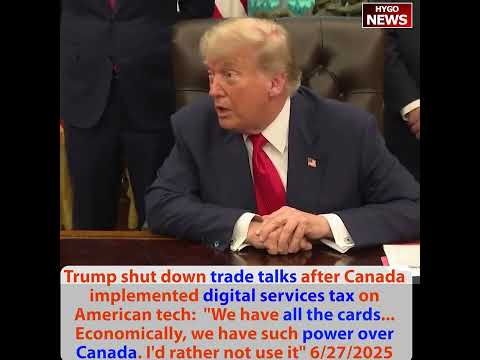
Trump: short months peace India/Pakistan, Israel/Iran, DRC/Rwanda; VP on historic 30 yrs DRC/Rwanda
Trump summarized the administration’s diplomatic accomplishments at an Oval Office event, listing the peace agreements secured “in a few short months” — India-Pakistan, Israel-Iran, DRC-Rwanda, and a Serbia-Kosovo de-escalation. Vice President Vance, speaking at the same event, called the DRC-Rwanda agreement a moment that will end “30 years of killing and war” and begin “a new story, a story of prosperity and of peace” for future generations. Trump then shifted to announcing that the administration is shutting down trade negotiations with Canada over a new Canadian digital services tax targeting American tech companies. His tone was firm: “We have all the cards.” The president’s willingness to use commercial leverage — stopping negotiations, threatening tariffs — to force Canadian reversal of the tax demonstrates the administration’s operating posture toward what it views as unfair trade practices.
”A Tremendous Breakthrough”
Trump opened with the sweeping claim. “This is a tremendous breakthrough in a few short months. We’ve now achieved peace between India and Pakistan, Israel and Iran, the DRC and Rwanda, a couple of others also, Serbia.”
The inventory is substantial. Four named conflicts where the administration claims peace-brokering credit:
India-Pakistan: Two nuclear-armed states with a history of direct military confrontation. The administration’s engagement helped de-escalate a recent crisis.
Israel-Iran: The 12-day war ended in a ceasefire that the administration brokered directly. The Iran nuclear program was destroyed by American military action. The ceasefire has held.
DRC-Rwanda: The formal peace agreement signed in the Oval Office. The three-decade conflict is, at least formally, resolved.
Serbia-Kosovo: Trump mentioned this briefly and with appropriate caveats. A potential war was averted rather than a peace explicitly secured. But preventing the war is itself a diplomatic outcome.
The Serbia-Kosovo Averted War
Trump offered the specific detail. “I have a friend in Serbia and they said, we’re going to go to war again. I will mention that it’s Kosovo, but it’s Kosovo, but they were going to have a big time war and we stopped it.”
Serbia-Kosovo tensions have persisted since Kosovo’s 2008 declaration of independence. Periodic escalations have brought the two sides close to armed confrontation. Trump’s first-term diplomacy had produced some progress; his second-term engagement, according to his account, has prevented a specific impending war.
“Because of trade” is Trump’s framing of the leverage. The administration used the threat of reduced trade access as the incentive for Serbian and Kosovar restraint. Countries that want access to American markets must avoid the regional aggression that would trigger American economic consequences.
”We Don’t Trade With People That Go To War”
Trump articulated the principle. “They want to trade with the United States. I said, we don’t trade with people that go to war.”
The formulation is interesting. It establishes an explicit linkage between trade policy and peace policy. American commercial engagement with other countries, in this framework, is conditional on those countries maintaining peaceful relations with their neighbors. Countries that initiate or participate in wars forfeit their commercial access.
Whether the principle is applied consistently is a separate question. American trade with various countries continues despite those countries’ involvement in various conflicts. But the principle, as Trump articulated it, is the framework the administration is claiming.
”Two Great Leaders”
Trump then addressed the India-Pakistan situation specifically. “And we said that also with, if you take a look at Pakistan and India, it was great. They have two great leaders, two great leaders, and they were able to stop. They were in the midst of a big fight, I guess everybody saw, and it was going to get very bad. And they are nuclear nations, very powerful nuclear nations.”
“Two great leaders” is Trump’s characterization of Indian Prime Minister Modi and Pakistani Prime Minister Sharif. Whether the characterization is diplomatically savvy or simply generous is debatable. What is clear is that Trump is publicly crediting both leaders with the restraint that prevented escalation.
“Very powerful nuclear nations” is the reminder of what was at stake. India and Pakistan both have nuclear weapons. A war between them, at any meaningful scale, would risk nuclear exchange. Preventing such a war is among the most consequential diplomatic objectives available. Trump is claiming credit for achieving that prevention.
Vance’s DRC-Rwanda Reflection
Vice President Vance then offered a more reflective assessment of the DRC-Rwanda agreement. “My fellow Americans, this is really a celebratory moment. This is a big moment for our country because under the president’s leadership, we’ve taken what was 30 years of killing and war, the worst war in terms of death counts since World War II, and now we’re on a pathway to peace.”
“30 years of killing and war” captures the conflict’s temporal scope. The Rwandan genocide occurred in 1994. The subsequent Congo wars, rooted in post-genocide regional dynamics, produced what has been described as the deadliest conflict since World War II. Estimated casualties range in the millions across successive phases.
“The worst war in terms of death counts since World War II” is Vance’s characterization. The specific death toll is contested, but the magnitude is not. Congolese wars have killed more people than any other post-World War II conflict by many counts.
”A New Story”
Vance’s historical framing. “And so if I think about what I know about these two countries for 30 years, pretty much the entire time that I can remember these two countries being in the news, much of the story has been about them fighting one another, about them killing one another. And now we can look forward to a future where my children will look at this moment as the beginning of a new story, a story of prosperity and of peace.”
“My children will look at this moment as the beginning of a new story” is the personal framing. Vance has young children. They will grow up in a world where the DRC-Rwanda story is, hopefully, a story of peace rather than of conflict. If the agreement holds, Vance’s children will never know the Africa-in-war narrative that has dominated international coverage of the region for their parents’ generation.
”Active Presidential Leadership”
Vance’s political framing was direct. “So thanks to the president, congratulations to the entire team and to my fellow Americans. We should all be really proud because it’s amazing what active presidential leadership can accomplish when it’s geared towards peace and prosperity. And that’s what we have in the Oval Office right now. So great job, sir.”
“Active presidential leadership” is the implicit contrast with the prior administration. Biden, in the administration’s framing, was not actively leading on these issues. Trump is. The difference, according to Vance, is the specific peace outcomes now being achieved.
Whether the characterization is fair depends on one’s assessment of the Biden administration’s foreign policy engagement. Biden’s administration did engage on various international issues. But the major peace achievements Vance is highlighting — India-Pakistan, Israel-Iran, DRC-Rwanda — were not central Biden priorities.
The Canada Pivot
The video then shifted to an entirely different topic. Trump announced that the administration is shutting down trade negotiations with Canada.
“We hear Canada, we have a great relationship with the people of Canada, but it’s been very difficult. And they put a charge in there. We’re a little bit early, we found out about it. And we have all the cards, every single one, we don’t want to do anything bad, but economically we have such power over Canada.”
The “charge” Trump references is Canada’s digital services tax — a tax targeting American technology companies. The tax, inspired by similar European measures, applies to major tech platforms operating in Canada based on their Canadian revenue.
”All The Cards”
Trump used his characteristic metaphor. “We have all the cards.”
The metaphor captures his view of the trade leverage. Canada exports heavily to the United States — the United States is Canada’s largest export market. American products compete in Canada but also in global markets. The United States can afford to reduce or disrupt its trade with Canada more easily than Canada can afford to disrupt its trade with the United States. That asymmetry is what Trump means by “all the cards.”
“I’d rather not use it” is the preferred outcome. Trump prefers that Canadian leaders reverse the digital services tax voluntarily rather than requiring American economic retaliation. But the tools for retaliation exist if reversal is not forthcoming.
”Trying To Copy Europe”
Trump characterized the Canadian move. “But they did something with our tech companies today trying to copy Europe. They copied Europe, it’s not gonna work out well for Europe either. It’s not gonna work out well for Canada. They were foolish to do it.”
The European context is important. The European Union has been pursuing various measures against American tech companies — the GDPR data regulations, the Digital Markets Act, the Digital Services Act, and various national digital services taxes. Those measures, collectively, represent European efforts to constrain and tax the dominant American tech platforms.
Canada’s digital services tax follows the European template. In Trump’s framing, Canada was “foolish” to copy a European approach that is, in his view, going to produce negative outcomes for Europe itself.
”Stop All Negotiations”
Trump announced the specific response. “And so I said, we’re gonna stop all negotiations with Canada right now until they straighten out their act.”
The trade negotiations that had been underway — Carney’s “more complex concept” vs. Trump’s “tariff concept” — are now on hold. The negotiations’ resumption is conditioned on Canadian reversal of the digital services tax.
That is substantial leverage. Canada’s economic planning has assumed continued trade relationship stability with the United States. A frozen negotiation means that the terms of Canadian-American trade for future years are not being set through negotiation — they may be set unilaterally by American tariff action.
”Is There Anything Canada Can Change Your Mind?”
A reporter asked the question. Trump’s response reaffirmed the position. “No, they put a tax on companies that were American companies that they should have very severe tax. Yeah, I guess they could remove it, they will, but I don’t really, I mean, it doesn’t matter to me.”
The response is deliberately cavalier. Trump is signaling that he is not eager to resume negotiations. Canada must address the digital services tax unilaterally. Once the tax is removed, negotiations can potentially resume. Trump’s posture is that the outcome does not concern him personally — Canada has the choice, and the consequences follow from the choice.
”They Do Most Of Their Businesses With Us”
Trump unpacked the trade math. “We have all the cards, we have all the cards. You know, we do a lot of business with Canada, but relatively little. They do most of their businesses with us. When you have that circumstance, you treat people better.”
The observation is empirically grounded. Canada’s largest trading partner is the United States by a substantial margin. The United States’ largest trading partner is currently China, though various alternative measures place Canada highly. The asymmetry matters. Canada cannot replace American market access easily. The United States can replace Canadian market access by shifting to other suppliers.
“When you have that circumstance, you treat people better” is the negotiating principle. Countries that depend on American markets should be motivated to maintain favorable trade relations with the United States. Countries that fail to do so can expect consequences.
”400% Tariffs On Dairy”
Trump then raised a longstanding grievance. “They’ve had farmers that are getting like 300, 400, 200% in tariffs. Nobody’s ever said anything like it. We have cases, you don’t read this and the people don’t report, but they charge us 400% on some dairy products. 400%, nobody writes that.”
Canadian dairy tariffs have been a persistent American grievance. Under Canada’s supply management system for dairy, imports face high tariff walls designed to protect Canadian dairy farmers from competition. The specific tariff rates vary by product, but 400% is within the range of actual historical rates on specific dairy categories.
“It’s not fair to our farmers and we’ve got to protect our farmers” is the American framing. Canadian protectionism, in Trump’s view, harms American farmers. American trade policy should address that harm through reciprocal measures.
Why The Canada Move Matters
The Canada move is significant for several reasons.
First, it demonstrates that the administration is willing to use trade leverage aggressively against close allies, not just adversaries. Canada is a NATO member, a neighbor, and a close economic partner. The administration is willing to freeze negotiations with Canada when Canadian policy conflicts with American interests.
Second, it sets a precedent for how the administration will respond to digital services taxes globally. The European Union, the United Kingdom, India, and others have implemented or considered similar taxes. The administration’s response to Canada’s tax signals how it will respond to the broader pattern.
Third, it tests the Carney-Trump working relationship. The NATO summit had produced apparent warmth between the two leaders. The Canadian digital services tax is now testing whether that warmth survives substantive policy conflict.
The Broader Pattern
The pattern across the day’s announcements — from DRC-Rwanda peace to Canada trade pressure — captures the administration’s operating posture. Where partners cooperate, peace and prosperity follow. Where partners act against American interests, consequences follow. The framework is consistent across regions and across different types of issues.
That consistency is what the administration is selling to its base and to the country. Active, assertive American leadership that produces specific outcomes — peace when peace is available, pressure when pressure is required. Either way, results.
Key Takeaways
- Trump’s four-peace summary: “We’ve now achieved peace between India and Pakistan, Israel and Iran, the DRC and Rwanda, a couple of others also, Serbia” — all “in a few short months.”
- VP Vance on DRC-Rwanda: “30 years of killing and war, the worst war in terms of death counts since World War II, and now we’re on a pathway to peace.”
- Trump’s trade-peace principle: “They want to trade with the United States. I said, we don’t trade with people that go to war.”
- On Canada’s digital services tax: “We’re gonna stop all negotiations with Canada right now until they straighten out their act.”
- The trade asymmetry: “They do most of their businesses with us. When you have that circumstance, you treat people better.”