 HYGO News
 Trump and Burgum Reverse Biden's 625 Million-Acre Drilling Ban: 'Back on the U.S. Balance Sheet'
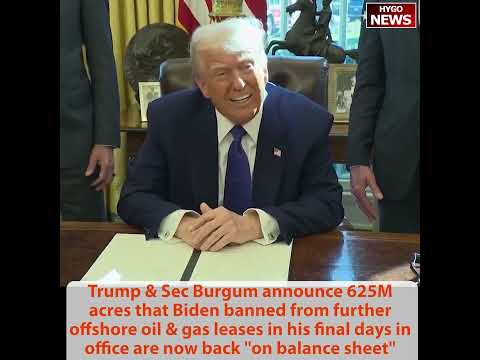
Trump and Burgum Reverse Biden’s 625 Million-Acre Drilling Ban: “Back on the U.S. Balance Sheet”
Interior Secretary Doug Burgum confirmed on February 14, 2025, that the 625 million acres of offshore territory that President Biden had banned from oil and gas leasing in his final days in office were “back on the U.S. balance sheet.” Trump signed an executive order instructing Burgum to reverse the ban, which the secretary described as having wiped “trillions” from America’s energy balance sheet. Energy Secretary Chris Wright then outlined the “simply tremendous” potential for new jobs along the Gulf of America coast, noting that the United States had transformed from the world’s largest natural gas importer to its largest net exporter in just two decades, and that allied nations like Japan and India were “thrilled” that America was “open for business” again.
”625 Million Acres Is One-Third the Size of the Lower 48”
Burgum opened with the scale of what Biden had done — and what Trump had just reversed. “The executive order by President Biden that wiped out these trillions from our balance sheet — President Trump signed an executive order instructing me as the Secretary of Interior to unban that ban, and that’s been accomplished,” Burgum said. “And so those are back on the U.S. balance sheet.”
He then quantified the territory involved. “The 625 million acres of offshore that was banned from further lease sales — further anything,” Burgum said. “625 million acres is one-third the size of the lower 48 that was taken off our balance sheet. It’s back on there now.”
The comparison to one-third of the contiguous United States put the scope of Biden’s ban into perspective. The ban had covered waters along the East and West coasts, the eastern Gulf of Mexico, and portions of Alaska’s Northern Bering Sea — a combined area larger than the entire state of Alaska. Biden had withdrawn these areas from future oil and gas leasing using authority under the Outer Continental Shelf Lands Act, claiming environmental protection as the justification.
Burgum framed the reversal as a restoration of public ownership. “President Trump cares about the American people. He knows that these public lands belong to the public,” the secretary said. “They don’t belong to Washington bureaucrats from the prior administration, and we’re going to make sure that we get a return on investment for the American people.”
Trump: “What They Did Was So Horrible”
Trump added his own commentary on the ban and its reversal, expressing particular frustration at the timing of Biden’s action.
“The amount of money that he took off our balance sheet, if you look at this balance sheet, it was incalculable,” Trump said. “Nobody’s ever seen anything like it, and he did that. I guess in the last few days of the administration, he just wiped it out.”
Trump underscored the magnitude: “625 million acres, which, if you sit down and look — it’s like, that’s a major part of the ocean, and he just gave it away and took it away.”
The president emphasized that Biden had acted unilaterally rather than through legislation. “Fortunately, it wasn’t done with an act of Congress or anything, and we did it in a — I think very abbreviated, very quick, and very legal procedure, and it’s now back on our balance sheet,” Trump said. “It’s back as part of our country.”
He concluded with a blunt assessment: “What they did was so horrible. It was just a terrible thing to do.”
The legal pathway was significant. Because Biden had used executive authority rather than legislation to withdraw the acreage, Trump was able to reverse the action through his own executive order. Had the ban been enacted through Congress, reversing it would have required new legislation — a far slower process that would have been subject to Democratic filibuster in the Senate.
Wright: “The Potential Is Simply Tremendous”
Energy Secretary Chris Wright fielded a question from a reporter with ties to the Gulf Coast about the potential for new jobs in the region, particularly in the natural gas and LNG sectors.
“I would say that that potential is simply tremendous,” Wright said. He then provided a historical arc that demonstrated how dramatically American energy had been transformed by the shale revolution.
“Twenty years ago, the United States was the biggest importer of natural gas in the world, and we had natural gas prices two or three times higher than they are today,” Wright said. “But with the shale revolution and great entrepreneurs in Texas and Louisiana and across our great country, we are now today the largest net exporter of natural gas in the world.”
The transformation Wright described was one of the most significant energy developments of the 21st century. The United States had gone from building import terminals to receive foreign LNG to constructing export terminals to ship American gas to the world. The reversal had been driven entirely by private-sector innovation in horizontal drilling and hydraulic fracturing — technologies that had unlocked vast reserves of natural gas from shale formations across the country.
Wright then addressed the damage done by the Biden administration’s pause on new LNG export approvals. “We paused. We stopped our ability to grow natural gas exports,” he said. “Both the Japanese government and Indian government expressed great distress about that. They’re going to count on energy imports from the U.S. and we may just change our mind.”
The revelation that Japan and India had expressed “great distress” over the Biden administration’s LNG export pause highlighted the international consequences of domestic energy policy. Both countries had been counting on American natural gas as a stable, affordable, and politically reliable energy source. The Biden administration’s pause had undermined that confidence and sent allied nations scrambling for alternatives — potentially including Russian gas.
“So I think they’re thrilled to see the actions of this president,” Wright said. “Say, ‘America is open for business.’ Yes, we have the energy, we have the people, we have huge job opportunities and investment opportunities — not just in the oil and gas industry but all those surrounding communities that are lifted up by that.”
Lower Costs Through Scale
Wright made a point that connected increased production to lower domestic consumer prices, addressing a concern that critics had raised about export-focused energy policy.
“More production here — and as we produce more production at scale — not only does it allow us to export, but it becomes more efficient and it helps us drive down the cost for our domestic consumers as well,” Wright said.
The argument was that increased production created economies of scale that benefited everyone. More wells drilled meant lower per-unit costs. More gas produced meant more supply in domestic markets. More exports meant more revenue for American companies, which could reinvest in further production. The virtuous cycle of production, efficiency, and lower prices was the opposite of the scarcity-based approach that the Biden administration’s restrictions had encouraged.
The Balance Sheet Argument
The most conceptually powerful argument to emerge from the event was Burgum’s “balance sheet” framing, which he had introduced the previous day and expanded upon here. The framing treated America’s energy resources as assets on a national balance sheet, with the federal government as a steward obligated to maximize returns for the public.
Under this framework, Biden’s 625-million-acre ban was not merely an environmental policy decision but a financial catastrophe — the equivalent of a corporate board voting to write off one-third of the company’s assets. Trump’s reversal was presented as restoring those assets to productive use and generating returns for the American people in the form of jobs, tax revenue, lower energy costs, and geopolitical leverage.
The balance sheet argument also provided a counter to the environmental case for restricting drilling. If the resources existed and belonged to the public, the question became whether the public was better served by developing them or leaving them idle. The Trump administration’s answer was emphatic: development created prosperity; restriction created dependency.
Key Takeaways
- Interior Secretary Burgum confirmed that Biden’s 625 million-acre offshore drilling ban — covering one-third the area of the lower 48 states — had been reversed and was “back on the U.S. balance sheet.”
- Trump called Biden’s last-minute ban “horrible” and “incalculable” in its financial impact, noting it was reversed through “a very abbreviated, very quick, and very legal procedure.”
- Energy Secretary Wright said the potential for Gulf Coast energy jobs was “simply tremendous,” noting the U.S. had transformed from the world’s largest natural gas importer to its largest net exporter in 20 years.
- Wright revealed that Japan and India had expressed “great distress” over Biden’s LNG export pause, and were now “thrilled” that America was “open for business” again.
- Wright argued that increased production at scale would simultaneously enable exports, create jobs, and “drive down the cost for our domestic consumers.”