 HYGO News
 Trump: SCOTUS ending birthright citizenship/sanctuary city funding/refugee, SUCH A BIG DAY; Rubio
Trump: SCOTUS ending birthright citizenship/sanctuary city funding/refugee, SUCH A BIG DAY; Rubio
With the Supreme Court’s nationwide-injunctions ruling in hand, Trump laid out the specific policies the administration will now move aggressively to implement — starting with ending birthright citizenship for children of undocumented immigrants. The logic is procedural: without nationwide injunctions blocking the policies from taking effect, the administration can implement and defend in court, with the presumption of legitimacy working in its favor rather than against it. Trump walked through the list: birthright citizenship, sanctuary city funding, refugee resettlement, transgender surgery funding, and what Trump called “numerous other priorities.” The same Oval Office event included the Rwanda-Congo peace signing, with Secretary of State Rubio connecting the day’s multiple threads into a single narrative about the administration’s simultaneous pursuit of domestic policy change and international peace-making.
”Now Properly File To Proceed”
Trump opened with the procedural consequence of the Supreme Court ruling. “Thanks to this decision, we can now properly file to proceed with numerous policies that have been wrongly enjoined on a nationwide basis.”
The operational change is significant. Before the Supreme Court’s ruling, the administration would issue a policy, face a single-judge nationwide injunction, and be forced to wait through years of appellate litigation before the policy could actually take effect. Now, policies can be implemented, and legal challenges must proceed under the traditional case-by-case framework rather than through nationwide blocks.
That change accelerates the administration’s policy timeline by years in some cases. Policies that would have been stuck in injunction litigation until 2027 or beyond can now take effect while the litigation proceeds.
Birthright Citizenship
Trump named the first priority. “Ending birthright citizenship, which now comes to the fore. That was meant for the babies of slaves. It wasn’t meant for people trying to scam the system and come into the country on a vacation.”
The birthright citizenship debate has been one of the most contested immigration issues for decades. The 14th Amendment’s Citizenship Clause provides that “all persons born or naturalized in the United States, and subject to the jurisdiction thereof, are citizens of the United States.” The historical context — ratification in 1868, three years after the Civil War’s end — indicates the amendment was designed to establish citizenship for freed slaves who had been denied it under prior law.
”Meant For The Babies Of Slaves”
Trump’s historical argument. “This was, in fact, it was the same date, the exact same date, the end of the Civil War. It was meant for the babies of slaves and it’s so clean and so obvious.”
The “same date” claim is approximate. The 14th Amendment was ratified in 1868, three years after the Civil War ended in 1865. But the connection is real — the amendment was the constitutional framework for addressing the legacy of slavery by establishing that those born on American soil were citizens by birth, correcting the exclusion that the Dred Scott decision had created.
Trump’s argument is that the amendment’s purpose — conferring citizenship on freed slaves and their descendants — does not extend to children of undocumented immigrants who are in the country temporarily or without authorization. That reading of the amendment is contested among constitutional scholars. The administration is prepared to litigate the question.
”Hundreds Of Thousands Of People Pouring In”
Trump extended the practical argument. “This lets us go there and finally win that case because hundreds of thousands of people are pouring into our country under birthright citizenship and it wasn’t meant for that reason.”
“Hundreds of thousands” is the approximate number of children born annually in the United States to undocumented parents. Each such child, under the current interpretation of the 14th Amendment, is an American citizen by birth. That citizenship then provides the foundation for subsequent family-based immigration petitions and for other legal protections.
The administration’s position is that the current interpretation is inconsistent with the amendment’s original purpose and that ending the interpretation would remove a significant driver of unauthorized entry.
The Full Priority List
Trump ran through the policies the administration will now pursue. “So thanks to this decision, we can now properly file to proceed with these numerous policies and those that have been wrongly enjoined on a nationwide basis, including birthright citizenship, ending sanctuary city funding, suspending refugee resettlement, freezing unnecessary funding, stopping federal taxpayers from paying for transgender surgeries and numerous other priorities.”
Each item is a distinct policy area:
Birthright citizenship: The constitutional interpretation issue above.
Sanctuary city funding: Federal grants to jurisdictions that refuse to cooperate with federal immigration enforcement. The administration wants to condition federal funding on cooperation.
Refugee resettlement: The federal program admitting refugees from various crisis regions. The administration has suspended or reduced the program.
Freezing unnecessary funding: Broad executive authority to pause spending on programs the administration views as non-essential.
Transgender surgeries for federal programs: The question of whether federal health programs cover gender transition surgery.
Each policy has been subject to legal challenges. Each has faced nationwide injunctions. Each can now be implemented while litigation continues.
”Taking Power Away From Absolutely Crazy Radical Left Judges”
Trump framed the broader significance. “Well, I think taking power away from these absolutely crazy radical left judges is a tremendous, this is such a big day. This is such a big day.”
“Absolutely crazy radical left judges” is Trump’s characterization of the specific jurists who had been issuing the injunctions. The characterization is political rather than analytical — most of the judges in question have strong professional credentials and have operated within established judicial doctrine. What the administration objects to is their specific use of nationwide injunctions against specific administration policies.
“Such a big day” repeats Trump’s preferred framing. The Supreme Court’s ruling is not a minor procedural adjustment. It is a fundamental shift in how the judicial branch interacts with the executive branch.
”This May Dominate The Signing”
Trump acknowledged the news competition. “It’s sort of sad because we’re doing the signing at three o’clock and this may very well dominate the signing of a big war that was going on and really affecting the continent of, think of it, the entire continent of Africa was being affected. We’re settling that war today and this will probably be your headline, but this is a very big moment.”
Trump is genuinely concerned about the news agenda. The Supreme Court ruling and the Rwanda-Congo peace signing are both major stories. The press will have to choose which to lead with. Trump suspects the Supreme Court story will dominate, leaving the peace agreement — which affects millions of lives directly — in the secondary coverage.
“The entire continent of Africa was being affected” is accurate. The Great Lakes region conflicts have affected not just Rwanda and Congo but also Uganda, Burundi, Tanzania, and neighboring countries through refugee flows, arms trafficking, and regional instability.
”Bad Power, Sick Power, Unfair Power”
Trump characterized what the Supreme Court ruling had removed. “It only takes bad power away from judges. It really doesn’t take, it takes bad power, sick power, unfair power.”
The progression — bad, sick, unfair — is Trump’s escalating characterization. The power that nationwide injunctions represented was, in his view, not merely excessive but morally problematic. Judges exercising it were exercising power they should not have had. Removing it, therefore, is not a diminishment of legitimate judicial authority but a restoration of proper institutional boundaries.
”Different Subject Right Now”
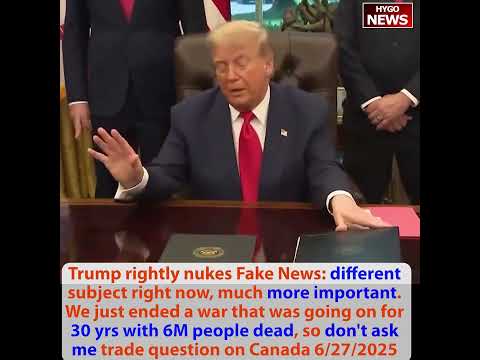
A reporter tried to pivot Trump to a Canada trade question. Trump redirected. “Why not? Why not? Why not, by the way? Why? I mean, because this is about a different subject right now. This is right now actually a much more important subject. We just ended a war that was going on for 30 years with 6 million people died. So don’t ask me a trade question on Canada.”
The redirection is revealing. Trump wants to keep the focus on the peace agreement and the Supreme Court ruling. The Canada trade question, however legitimate, does not belong in this particular press availability. The press secretary’s carefully managed schedule has the Canada question reserved for a different setting.
“6 million people died” is Trump’s citation of the Congo war casualty figure. The actual death toll is contested — estimates range from 3 million to 6 million — but the 6 million figure captures the upper bound of serious estimates. Whatever the exact number, the scale is larger than almost any other conflict in recent world history.
Rubio On The Peace Priority
Secretary of State Rubio then provided the integrating narrative. “I made it very clear that one of the priority this administration under your leadership is going to be the pursuit of peace. And from day one, whether it’s been in Ukraine and Russia, whether it’s been Pakistan, India, whether it’s been Iran and Israel and in the continent of Africa, your priority’s been on peace. And today we see this come to fruition.”
Rubio’s framing connects the Rwanda-Congo peace to the broader administration peace agenda. Ukraine-Russia, India-Pakistan, Iran-Israel, Africa — each is a theater where the administration has been working on peace. The DRC-Rwanda signing is the most tangible recent outcome, but the broader pattern is consistent engagement across regions.
”Wars Get A Lot More Attention Than Peace”
Rubio offered the observation that animates much of his diplomatic work. “It’s sad. Wars get a lot more attention than peace, but peace is harder than war, a lot harder.”
The observation is correct. Wars produce dramatic events — battles, casualties, refugee flows, dramatic images. Peace agreements produce paperwork — signatures, annexes, implementation mechanisms, slow-moving reconciliation. Media attention naturally gravitates toward the dramatic over the deliberate.
“Peace is harder than war” is Rubio’s philosophical claim. Going to war requires political will and military mobilization. Making peace requires the same plus sustained diplomatic engagement, compromise, and the management of competing interests across multiple parties. Peace agreements that actually hold are among the most difficult political achievements available.
”The Harder Path”
Rubio’s compliment to the signing parties. “I want to congratulate both of the leaders here and their respective presidents for choosing the harder path, which is often peace, than the easier path, which sometimes is war as costly and as bloody as it may be.”
Rwanda and Congo chose peace. They could have chosen continued conflict. Both paths had costs. The peace path, despite being harder in specific respects, produces outcomes that the war path cannot produce — normal civilian life, economic development, family reunification.
The leaders who signed the agreement made the choice that their predecessors, across three decades, had not made. That choice deserves congratulation.
”The Number One Voice For Peace”
Rubio’s framing of Trump’s role. “I echo the vice president’s statements, and that is that Americans should be very proud that the number one voice for peace in the world today is our president, your president.”
The claim is expansive. “The number one voice for peace in the world today” is Rubio positioning Trump as the most consequential peace-maker currently active. That framing contrasts with the more common characterization of Trump as a disruptive force in international affairs.
The administration’s view, which Rubio is articulating, is that disruption of bad diplomatic patterns can be the precondition for genuine peace. Prior approaches did not produce DRC-Rwanda peace. Prior approaches did not produce India-Pakistan de-escalation. Prior approaches did not produce the destruction of Iran’s nuclear program followed by ceasefire. Trump’s willingness to abandon prior approaches is, in this framing, exactly what enabled the current outcomes.
Dr. Bullos’s Work
Rubio closed with an acknowledgment of specific staff work. “And I want to again recognize Dr. Bullos and the work he’s put into this from day one. He’s really put a lot of time and effort as our friends from the respective countries can share with us.”
The reference to Dr. Bullos — presumably a specific State Department official who worked on the DRC-Rwanda negotiations — is the kind of public recognition that signals appreciation for diplomatic career staff. Major diplomatic agreements require sustained work by career staff beneath the political leadership. Recognizing their contribution is how political leaders encourage continued effort.
The Day’s Cumulative Achievement
Taken together, the day’s announcements represent an unusual concentration of achievement. The Supreme Court has removed a major institutional constraint on presidential policy-making. The Rwanda-Congo peace agreement has formalized the end of a three-decade war. The Canada trade pressure has demonstrated the administration’s willingness to use leverage against close allies. The broader foreign policy portfolio — Ukraine-Russia, India-Pakistan, Iran-Israel — continues to move.
That concentration of activity is the administration’s operating mode. Multiple tracks proceed simultaneously. Each produces its own outcomes. The cumulative effect is a political environment that favors the administration’s framing.
Key Takeaways
- Trump on the ruling’s enabling effect: “We can now properly file to proceed with numerous policies that have been wrongly enjoined on a nationwide basis, ending birthright citizenship…ending sanctuary city funding, suspending refugee resettlement, freezing unnecessary funding, stopping federal taxpayers from paying for transgender surgeries.”
- Trump on birthright citizenship: “It was meant for the babies of slaves…hundreds of thousands of people are pouring into our country under birthright citizenship and it wasn’t meant for that reason.”
- Trump dismissing Canada trade question: “This is about a different subject right now…We just ended a war that was going on for 30 years with 6 million people died.”
- Rubio on peace and war: “Wars get a lot more attention than peace, but peace is harder than war, a lot harder.”
- Rubio on Trump: “The number one voice for peace in the world today is our president.”