 HYGO News
 Trump Revokes Chris Krebs Clearance: 'He's the Fraud'; Strips Miles Taylor: 'I Think He's Guilty of Treason'
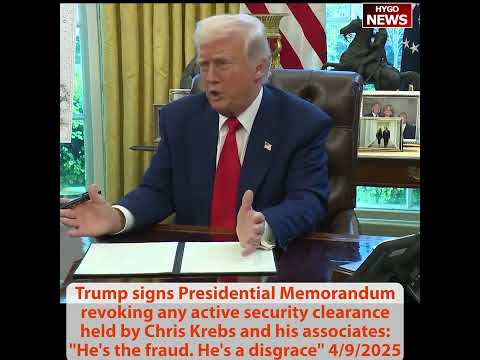
Trump Revokes Chris Krebs Clearance: “He’s the Fraud”; Strips Miles Taylor: “I Think He’s Guilty of Treason”
President Trump signed two presidential memoranda in April 2025 targeting former officials he accused of betrayal. The first revoked security clearances for Christopher Krebs, the former CISA director who had declared the 2020 election “the most secure in history” — Trump called him “the fraud” and “a disgrace.” The second stripped Miles Taylor, the anonymous author of a bestselling anti-Trump book written while serving in DHS, ordering a DOJ investigation. “I think he’s guilty of treason, if you want to know the truth,” Trump said. He also reiterated his election reform demands: “Paper ballots, same-day voting, voter ID, and a citizen piece of paper before you can vote.”
Krebs: “He’s the Fraud, He’s a Disgrace”
A White House official introduced the first memorandum.
“Christopher Krebs, the former head of CISA — this is a man who weaponized his position against free speech in the election context,” the official said. The memorandum also “further instructs your Department of Justice and other aspects of your government to investigate some of the malign acts that he participated in while he was still head of CISA.”
Trump then provided his extended commentary on Krebs.
“I don’t know that I met him. I’m sure I met him, but I didn’t know him,” Trump said. “And he came out right after the election — which was a rigged election, badly rigged election. We did phenomenally in that election.”
He described Krebs’s public statements: “This guy Krebs was saying, ‘Oh, the election was great, it was great.’ Well, it’s been proven that it was not only not great — when you look at all these lawyers and law firms that are signing, giving us hundreds of millions of dollars — it was proven by so many different ways and so many different forms.”
Trump delivered the verdict: “He’s the fraud. He’s a disgrace.”
He added a warning: “So we’ll find out whether or not it was a safe election. And if it wasn’t, he’s got a big price to pay. And he’s a bad guy.”
Krebs had served as the first director of the Cybersecurity and Infrastructure Security Agency (CISA). After the 2020 election, he issued a statement calling it “the most secure in American history” — a statement that Trump had publicly challenged and that had led to Krebs’s firing in November 2020. The security clearance revocation and DOJ investigation represented the completion of accountability that Trump had begun in his first term but could not fully execute before leaving office.
Election Reform: “Paper Ballots, Same-Day Voting, Voter ID”
Trump used the Krebs discussion to reiterate his comprehensive election reform demands.
“Frankly, we should go to paper ballots, same-day voting, voter ID,” he said. “And one other thing — a vote, you should get a little certificate that says you’re a citizen of our country. You get a citizen piece of paper that says you’re a citizen before you can vote.”
He explained the rationale for same-day voting: “If you don’t have same-day voting, they decide to change the air conditioning. ‘Oh, we’re fixing the air conditioning. Let’s move all these boxes. We’ll bring them back in a few days.’ And then they don’t bring back those boxes.”
The four-part reform — paper ballots, same-day voting, voter ID, and proof of citizenship — had been central to Trump’s governance agenda since his return to office. The election integrity executive order signed weeks earlier had addressed several of these elements, and the Krebs clearance revocation reinforced the administration’s seriousness about holding officials accountable for what it viewed as enabling election irregularities.
Miles Taylor: “Anonymous”
The second memorandum targeted Miles Taylor, the former DHS official who had written an anonymous book and op-ed criticizing Trump while serving in the administration.
A White House official explained: “Miles Taylor served in the Department of Homeland Security during your previous administration. In his capacity, he leaked classified information. He wrote a book under the pseudonym ‘Anonymous,’ making outrageous claims both about your administration and about others in it.”
The actions: “One, it’s going to strip any active clearance that he has in light of his past activities involving classified information. It’s also going to order the Department of Justice to investigate his activities to see what else might come up.”
Trump recalled his reaction: “I had no idea who this guy was. I saw him on CNN a lot. He’d be on all the time saying that the president — I had no idea.”
He described the situation: “In this office, you have a lot of young people, and they’re here. I’ll see them for two minutes. I assume he was in the office, but I barely remember him.”
Trump expressed his view of Taylor’s behavior: “Somebody that went out and wrote a book and said all sorts of terrible things — all lies. I think it’s like a traitor. Like, it’s like spying. He walks into the office. He’s supposed to be sitting there. There’ll be 20 people standing in the room.”
He noted the commercial aspect: “He wrote a book, ‘Anonymous,’ and everybody’s saying, ‘Who is it? Who is it?’ Then it was found out who he was, long time later. Got a lot of publicity off that. It’s like a promoter.”
Trump delivered his assessment: “I think he’s guilty of treason, if you want to know the truth. But we’ll find out.”
He framed the broader principle: “It’s time to find out whether or not somebody’s allowed to do that. Can they write a book because they happen to be one of a lot of people in a room? I think it’s a very important case.”
Trump noted the precedent: “It wouldn’t be sustainable for other presidents. I seem to be able to sustain. But if that happened to other presidents, it’s just unfair. And if it was a Democrat president, I’d say that’s a terrible thing.”
The Taylor case raised the question of where internal dissent ended and betrayal began. Government officials were entitled to disagree with their president — and to resign if the disagreement was fundamental. But writing an anonymous book while continuing to serve, leaking classified information, and using the access that came with government service to profit from attacking the president was, in Trump’s framing, something beyond dissent.
Key Takeaways
- Trump revoked Chris Krebs’s security clearance and ordered a DOJ investigation: “He’s the fraud. He’s a disgrace” for declaring the 2020 election “the most secure in history.”
- He reiterated election reform: “Paper ballots, same-day voting, voter ID, and a citizen piece of paper before you can vote.”
- Miles Taylor’s clearance stripped; DOJ investigation ordered for leaking classified information and writing the anonymous anti-Trump book.
- Trump on Taylor: “I think he’s guilty of treason, if you want to know the truth. It’s like a traitor, like spying.”
- He framed it as precedent: “It’s time to find out whether somebody’s allowed to do that. It wouldn’t be sustainable for other presidents.”