 HYGO News
 Trump Reveals Why He Paused Tariffs on 75 Countries: 'People Were Getting Yippy'; Schumer and Pelosi 'Never Had the Guts'
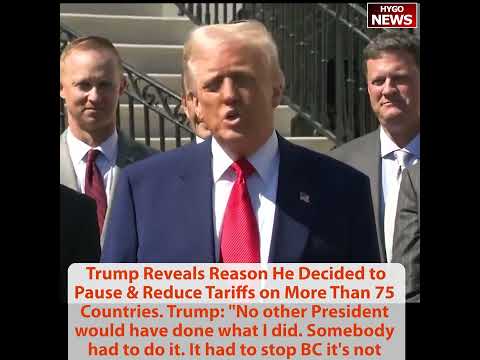
Trump Reveals Why He Paused Tariffs on 75 Countries: “People Were Getting Yippy”; Schumer and Pelosi “Never Had the Guts”
President Trump explained his decision to pause reciprocal tariffs for 75+ countries at a White House auto racing event in April 2025: “People were jumping a little bit out of line — they were getting yippy, a little bit afraid.” He maintained the full tariffs on China — “I did a 90-day pause for the people that didn’t retaliate, because I told them, if you retaliate, we’re going to double it” — and revealed that Charles Schwab had told him he’d “been waiting 40 years for somebody to do what I did.” When asked about the Schumer-Pelosi double standard on tariffs, Trump said: “They’ve wanted to do this for years, but they never had a president that had the guts to do it."
"People Were Getting Yippy”
A reporter asked the question directly: “Can you walk us through what you were thinking about? Why you decided to put a 90-day pause?”
Trump’s answer was vintage candor: “Well, I thought that people were jumping a little bit out of line. They were getting yippy, you know? They were getting a little bit yippy, a little bit afraid — unlike these champions.”
He provided the context: “Because we have a big job to do. No other president would have done what I did. No other president. They wouldn’t have done it. And it had to be done.”
He cited the unsustainable reality: “What was happening to us on trade — not only with China, but China was by far the biggest abuser in history. Somebody had to do it. They had to stop because it was not sustainable. Last year China made $1 trillion off trade with the United States. That’s not right. And now I’ve reversed it.”
He noted the revenue: “It’s for a short period of time, but I was making now $2 billion a day.”
The “yippy” characterization was both humorous and analytically honest. Markets, pundits, and some foreign leaders had reacted to the Liberation Day tariffs with what Trump considered disproportionate alarm. The 90-day pause was a concession to nervous markets while maintaining the fundamental policy. Countries that had not retaliated received a reprieve; China, which had retaliated, did not.
The Pause Logic: “If You Retaliate, We Double It”
Trump explained the differential treatment between countries.
“I did a 90-day pause for the people that didn’t retaliate,” he said. “Because I told them, if you retaliate, we’re going to double it. And that’s what I did with China, because they did retaliate.”
The two-tier system was a clear incentive structure. Countries that accepted the tariffs and came to the table to negotiate received a 90-day window at the lower 10% baseline rate. Countries that retaliated — escalating the trade war rather than negotiating — faced doubled rates. China’s 104% rate (subsequently increased further) reflected its choice to counter-retaliate rather than negotiate.
Trump described the global response: “We have many countries, as you know, many more than 75. And they all want to come. They want to come here, or they’ll go to Commerce, or they’ll go to Treasury. They’ll call John. They’ll do somebody. But they’re all calling: how do we do this? They all want to make a deal.”
Charles Schwab: “Waiting 40 Years”
Trump cited a private endorsement from one of America’s most respected financial figures.
“Charles Schwab was here a little while ago, one of the great financial people,” Trump said. “And he said he’s been waiting for 40 years for somebody to do what I did over the last month.”
Trump relayed Schwab’s assessment: “If you didn’t do it, you wouldn’t have a country. It wouldn’t be sustainable.”
The Schwab endorsement carried particular weight because Schwab was not a political operative or a Trump loyalist. He was one of the founders of modern retail investing, a man whose career depended on market stability and investor confidence. For Schwab to say he had waited 40 years for this action — and that failing to act would have been unsustainable — suggested that the tariff policy had support among serious financial thinkers that the market’s daily fluctuations did not reflect.
China: “They Just Don’t Know How to Go About It”
Trump offered his most psychologically sophisticated assessment of the Chinese negotiating position.
“China wants to make a deal,” he said. “They just don’t know how quite to go about it. It’s one of those things — they’re a proud people. President Xi’s a proud man. I know him very well. And they don’t know quite how to go about it, but they’ll figure it out in the process of figuring it out.”
The analysis acknowledged that China’s problem was not policy but pride. Xi Jinping could not appear to capitulate to American pressure without losing face domestically. The question was how to create a framework in which China could negotiate without appearing to surrender. Trump was signaling that he understood this dynamic and was willing to give China the space to find a face-saving path to the table.
Schumer and Pelosi: “Never Had the Guts”
A reporter posed the political question: “Chuck Schumer and Nancy Pelosi, they’ve been talking about tariffs for decades. How come when Democrat elites want tariffs, everything’s hunky-dory, but when President Trump wants tariffs, all hell breaks loose? Do you see this double standard?”
Trump appreciated the question: “I love this guy. Who the hell is that? That’s really nice. I appreciate that question.”
His answer: “No, Chuck Schumer and Nancy Pelosi — everybody knew you had to do it. But they never had the guts to do it. It does take guts. It even takes guts for our country to go through it.”
He referenced his own messaging: “That’s why they say, ‘Be cool.’ They were saying, ‘See, just be cool. It’s going to work out.’ And it’s working out. I can tell you, working out maybe faster than I thought.”
Trump described the investment wave as proof: “We have more car manufacturers coming into our country now — we’ve never seen anything like it. They’re coming because of the election, but they’re coming because of the tariffs. Three cancellations in Mexico building a plant — they’re all coming into the United States.”
He cited the tech investments: “Apple is going to spend $500 billion building a plant. They wouldn’t be doing that if I didn’t do this. They’d just keep building them in China."
"A Transition to Greatness”
Trump offered his most optimistic vision of the tariff policy’s trajectory.
“I think it’s going to work out amazing,” he said. “I think that our country is going to be, at the end of a year or shorter — I think we’re going to have something that nobody would have dreamt possible.”
He coined the phrase: “I think it’s really a transition to greatness. It’s going to be greatness. Our country is going to be — there’ll be nothing like it.”
Key Takeaways
- Trump paused tariffs on 75+ countries for 90 days because “people were getting yippy” — but maintained full rates on China for retaliating.
- The two-tier logic: “If you retaliate, we double it. That’s what I did with China.”
- Charles Schwab told Trump he’d “been waiting 40 years” for the tariff action: “If you didn’t do it, you wouldn’t have a country.”
- On China: “They want to make a deal. They just don’t know how to go about it. President Xi’s a proud man.”
- On Schumer and Pelosi: “Everybody knew you had to do it. They never had a president that had the guts.”