 HYGO News
 Trump Easter Prayer Service: 'In God We Trust -- We Will Never Change That'; Recounts Christ's Crucifixion and Resurrection
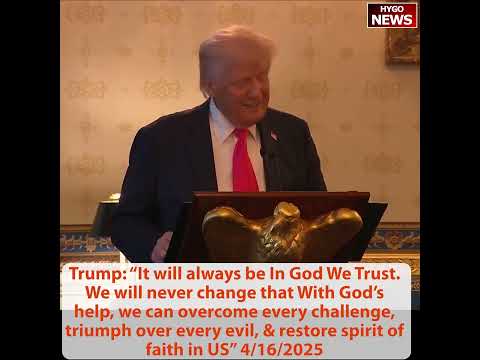
Trump Easter Prayer Service: “In God We Trust — We Will Never Change That”; Recounts Christ’s Crucifixion and Resurrection
President Trump hosted the White House Easter Prayer Service and Dinner in April 2025, delivering remarks that wove together his defense of religious heritage with a detailed retelling of the Easter story. Trump declared: “America has put our trust in God. It will always be In God We Trust. We will never change that.” He recounted the Passion narrative — “the living son of God entered Jerusalem in triumph. Soon after, the savior of mankind who brought truth and light into the world was betrayed, arrested and tried, beaten and nailed to a cross and crucified” — and quoted Billy Graham: “God proved his love on the cross. When Christ hung and bled and died, it was God saying to the world, I love you.” Rev. Franklin Graham delivered the opening prayer, noting “there’s been a spiritual drought in this city the last few years and in this house."
"In God We Trust — We Will Never Change That”
Trump opened by connecting the Easter gathering to America’s foundational religious identity.
“As we gather with family and friends, we’ll not forget the true source of our joy and our strength,” Trump said. “America has put our trust in God. It will always be In God We Trust. We will never change that.”
He acknowledged the opposition: “You know there’s a movement to change it. It will not happen. We won’t let that happen.”
He turned to someone in the audience: “Can you imagine a movement to change that? Robert, you’re not happy about that when you hear that. Look at him. He’s getting angry and angry. We can get angry too, can’t we?”
He confirmed: “Now it’s never going to change.”
The defense of “In God We Trust” was more than a statement about a motto. It was a declaration that the Trump administration would resist the secular progressive movement that had spent decades attempting to remove religious references from public life. From the removal of the Ten Commandments from courthouses to the elimination of prayer from public schools to the legal challenges against “In God We Trust” on currency, a sustained campaign had targeted every intersection of faith and government. Trump was drawing a line: under his presidency, that campaign would not advance.
”Restore the Spirit of Faith”
Trump expanded from the motto to a broader vision of religious renewal.
“And with God’s help, we can overcome every challenge, triumph over every evil and restore the spirit of faith in the United States for generations to come,” he said.
He connected it to his political mission: “We have a very simple slogan, make America great again and that’s exactly what we’re doing.”
The phrase “restore the spirit of faith” positioned the Trump presidency as part of a spiritual renewal as much as a political one. The argument was that America’s challenges — economic, social, cultural, and geopolitical — were ultimately downstream of a loss of faith. The hollowing out of manufacturing, the border crisis, the drug epidemic, the breakdown of families — all of these could be traced in part to a culture that had abandoned the moral framework that once held it together.
For Trump to articulate this connection at a White House Easter service was to claim that his administration’s work was not merely governmental but civilizational. The tariffs, the border enforcement, the DOGE reforms — all were part of a larger project to restore an America grounded in faith, family, and national purpose.
The Easter Narrative
Trump delivered a retelling of the Easter story that was striking in its detail and reverence.
“Three days later, Christ’s followers found the empty tomb,” Trump said. “Jesus had defeated darkness and death and promised new life to all of humankind. And that’s what we celebrate each year at Easter as we joyfully proclaim on Sunday, He is risen.”
He stated the theological significance: “The death and resurrection of Jesus are the essence of the Christian faith. Whether rich or poor, healthy or sick, young or old or in times of peace or war, Christians everywhere find solace and hope in the knowledge that Christ died for them and that they could be united with him in heaven.”
He added: “And that’s what we want. That’s what we all want.”
Trump continued: “The miracles of holy week set in motion a transformation in human existence. Countless millions of Americans have been moved by Christ’s example to heal the sick, defend their families, lift up their communities and make our country stronger, better and greater than ever before.”
He then recounted the Passion: “Nearly 2,000 years ago during the sacred week, the living son of God entered Jerusalem in triumph. Soon after, the savior of mankind who brought truth and light into the world was betrayed, arrested and tried, beaten and nailed to a cross and crucified. For our sake, he gave up his life.”
The specificity of Trump’s Easter narrative — the triumphal entry, the betrayal, the trial, the crucifixion, the empty tomb — went beyond the generic religious references that most presidents offered at holiday events. This was not a vague acknowledgment that “many faiths celebrate this season.” It was a specific Christian retelling of the central event in Christian theology. In a culture that had increasingly demanded that public officials dilute religious references to avoid offending anyone, Trump chose the opposite approach: he told the story as Christians tell it, without apology or qualification.
Billy Graham’s Words
Trump quoted the legendary evangelist to punctuate his Easter message.
“And as the very great Reverend Billy Graham once said, God proved his love on the cross. When Christ hung and bled and died, it was God saying to the world, I love you,” Trump recited.
He turned to Franklin Graham: “Those are beautiful words from a great man, Franklin, right? A great man — incredible father.”
The invocation of Billy Graham — perhaps the most respected Christian leader in American history — connected Trump’s White House to a tradition of presidential-evangelical partnership that stretched back to Eisenhower. Billy Graham had counseled every president from Truman to Obama. By quoting him at the Easter service, Trump was claiming a continuity with that tradition while implicitly contrasting his faith-forward approach with the Biden administration’s distance from evangelical Christianity.
Franklin Graham’s Prayer
Rev. Franklin Graham delivered the opening prayer with a pointed observation about the spiritual state of Washington.
“There’s been a spiritual drought in this city the last few years and in this house,” Graham said. “And so I’m very grateful for the Easter declaration that you put out.”
He began the prayer: “Our father and our God, we come tonight to say thank you. Thank you for sending your son, Jesus Christ, to this earth to take our sins.”
Graham’s “spiritual drought” comment was a direct reference to the Biden years, during which the White House had deemphasized traditional Christian observances, promoted Pride celebrations, and presided over policies that many evangelical Christians viewed as hostile to their faith. The contrast between a White House that hosted drag queen events and one that hosted Easter prayer services with Franklin Graham could not have been sharper.
The prayer service itself — held in the White House with cabinet members, faith leaders, and invited guests — was a statement that faith had returned to the center of American executive power. Under Trump, the White House was not merely tolerant of Christianity; it was celebratory.
The Political Context of Faith
Trump’s Easter service occurred against the backdrop of a cultural moment in which Christianity’s role in American public life was actively contested. The progressive left had increasingly characterized public expressions of Christian faith by political leaders as violations of the separation of church and state, as exclusionary to non-Christian Americans, or as evidence of Christian nationalism.
Trump’s response was not to retreat but to advance. The Easter prayer service was unapologetically Christian. The quotes were from Jesus and Billy Graham. The prayer was offered in Jesus’ name. The message was that America was founded on Christian principles and that those principles were the foundation of its greatness.
For the roughly 65% of Americans who identified as Christian, the message resonated. For the evangelical base that had supported Trump since 2016, the Easter service was confirmation that their faith had a champion in the White House — something many had not felt since the Reagan years.
Key Takeaways
- Trump declared at the White House Easter Prayer Service: “It will always be In God We Trust. We will never change that.”
- He recounted the Passion narrative in detail: “The savior of mankind was betrayed, arrested, tried, beaten, nailed to a cross, and crucified. For our sake, he gave up his life.”
- Trump quoted Billy Graham: “God proved his love on the cross. When Christ hung and bled and died, it was God saying to the world, I love you.”
- Franklin Graham noted “a spiritual drought in this city the last few years and in this house” — a direct reference to the Biden years.
- Trump connected faith to his agenda: “With God’s help, we can overcome every challenge, triumph over every evil, and restore the spirit of faith in the United States.”