 HYGO News
 Trump Unveils FIFA Club World Cup Trophy at White House; Hassett: 'First of Many Reports Like This'
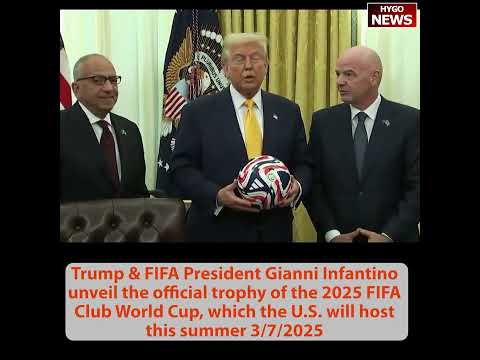
Trump Unveils FIFA Club World Cup Trophy at White House; Hassett: “First of Many Reports Like This”
FIFA President Gianni Infantino presented President Trump with a personalized match ball and unveiled the official trophy of the 2025 FIFA Club World Cup at the White House on March 8, 2025, marking 100 days until the tournament’s opening. The trophy — featuring a unique key mechanism and described as having “no other sports trophy like it” — would remain at the White House until the final on July 13. NEC Director Kevin Hassett then provided the economic analysis of February’s jobs data, highlighting that 10,000 manufacturing jobs were created while 10,000 government jobs were cut, and predicting the report was “the first of many that are going to look like this” as $1 trillion in factory commitments came online.
The Personalized Ball and Trophy Unveiling
Infantino opened the ceremony by presenting Trump with the official match ball for the Club World Cup, personalized with the president’s name.
“This is the official ball with your name,” Infantino said.
Trump’s reaction was characteristically warm. “That’s nice,” he said, examining the ball. “I would give it to Kristi, except it has my name on it.”
Infantino assured him: “We have another one.”
The ceremony then moved to the main attraction: the unveiling of the Club World Cup trophy, which marked 100 days until the tournament began.
“Today is 100 days to go for the new competition that we created together — the FIFA Club World Cup,” Infantino said. “The best clubs in the world with the best players in the world.”
Infantino then revealed the trophy with a dramatic flourish. “This is the trophy, but it’s not finished, because it’s unlike any other trophy,” he said. “There is a key.”
The trophy featured a mechanism that drew an audible reaction from Trump and the press pool. “There is no other sports trophy like that,” Infantino said as the key revealed the trophy’s full design.
“That is something,” Trump said. “We’ve got to win now.”
Infantino noted that Inter Miami and the Seattle Sounders would be among the American teams competing for the trophy. “It represents the past, the future, everything, the present,” he said of the design.
The trophy would stay at the White House until the final. “This will be at the White House for a little while,” Infantino said. “So if anybody needs a picture or anything, you can take it.”
Trump was pleased: “Let’s leave it here. We’ll have it in the White House quite a bit.”
The trophy display at the White House served both a ceremonial and a promotional purpose. Having the FIFA Club World Cup trophy in the most famous house in America — available for photos and media coverage — was effectively free advertising for a tournament that the administration wanted to showcase as part of America’s return to global prominence.
Hassett: “The First of Many Reports”
NEC Director Kevin Hassett then stepped to the podium for the economic briefing, placing the February jobs data in the context of the administration’s broader economic strategy.
“I thought it was a really, really impressive jobs report,” Hassett said. “In the Biden administration, there were some strong jobs numbers that were based on government employment, especially federal government employment. Over the last couple of years, about 25% of the job creation was government workers.”
He described the Trump reversal: “President Trump has made it clear that he wants to reduce spending on unproductive government workers. We saw a reduction in federal employment of about 10,000 workers. Despite that, we had a pretty strong jobs report.”
Hassett highlighted the manufacturing numbers: “The jobs report was especially strong for manufacturing. We created 10,000 manufacturing jobs in February.”
He drew the comparison with Biden: “To compare that to the Biden administration, 111,000 manufacturing jobs were destroyed last year, and 10,000 were created in February.”
He focused on the automotive component: “9,000 of those were auto jobs, which are a key focus of the President.”
Hassett then explained the mechanism driving the gains. “You could ask yourself, well, why were those jobs created here in the U.S.?” he said. “Well, it’s because people are wary of what might happen with tariffs in the future, and they’re already onshoring American production.”
He made the forward-looking case that set expectations for future reports: “It’s not just auto workers — this is not the first report that’s going to look like this. We’ve got more than $1 trillion of commitments of new factories in the U.S. because people are trying to onshore production.”
Hassett concluded: “This is the first of many reports that are going to look like this.”
The “first of many” prediction was the most optimistic forward-looking assessment any administration economic official had offered. Hassett was saying that February’s numbers — impressive on their own — represented the beginning of a trend that would accelerate as the $1 trillion-plus in factory commitments moved from announcements to actual construction and hiring. The tariff anticipation effect that had produced 10,000 manufacturing jobs in February would be amplified when the April 2 reciprocal tariffs actually took effect and companies faced the full financial reality of producing abroad versus producing in America.
The Economic-Sports Convergence
The pairing of the FIFA trophy unveiling with the jobs data briefing captured a recurring feature of the Trump White House: the deliberate juxtaposition of celebration and substance. The trophy represented the economic opportunity of hosting the world’s largest sporting events — $40 billion in impact, 200,000 jobs. The jobs data represented the manufacturing renaissance that was being driven by tariffs and deregulation. Together, they projected an America that was simultaneously hosting the world and rebuilding its industrial base.
The 100-day countdown to the Club World Cup also served as a reminder that the administration’s accomplishments would soon be showcased on a global stage. When millions of international visitors arrived for the tournament in June, they would encounter a country that was adding manufacturing jobs, reducing government waste, and projecting economic confidence. The tournament would be the administration’s most visible international advertisement.
Key Takeaways
- FIFA President Infantino presented Trump with a personalized match ball and unveiled the 2025 Club World Cup trophy at the White House, 100 days before the tournament.
- The trophy will remain at the White House until the July 13 final, with Infantino describing it as having “no other sports trophy like it.”
- NEC Director Hassett said February’s jobs data showed 10,000 manufacturing jobs created (9,000 auto) while 10,000 government jobs were cut — “the first of many reports that are going to look like this.”
- He compared Trump’s February to Biden’s final year: 10,000 manufacturing jobs created vs. 111,000 destroyed, with Biden’s economy relying on government hiring for 25% of job creation.
- Hassett said “$1 trillion of commitments of new factories” meant the onshoring trend would accelerate as companies moved from announcements to construction.