 HYGO News
 Trump Introduces Dr. Oz at CMS Swearing-In: 'No Cuts to Medicare'; Jokes About Oz Calling Him 'A Little Overweight' on TV
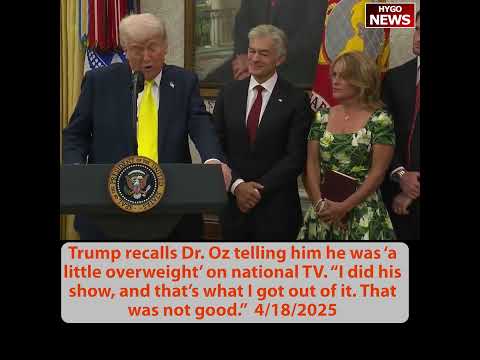
Trump Introduces Dr. Oz at CMS Swearing-In: “No Cuts to Medicare”; Jokes About Oz Calling Him “A Little Overweight” on TV
President Trump introduced Dr. Mehmet Oz at his swearing-in ceremony as the 17th Administrator of the Centers for Medicare and Medicaid Services in April 2025, reading an extensive list of credentials — Harvard degree, University of Pennsylvania medical degree, Wharton MBA, Columbia professorship, 400+ academic publications, and patents for cardiovascular surgery technologies. Trump joked about their personal history: “I only know the show. You know why? Because he said I’m a little overweight. I should lose some weight. I did his show and that’s what I got out of it. That was not good.” Trump then delivered the policy commitment: “As CMS Administrator, Dr. Oz will work to strengthen and protect Medicare for our nation’s seniors and Medicaid for the needy. Just as I promised, there will be no cuts.”
The Credentials
Trump read Oz’s background with visible surprise at the depth of the resume.
“Dr. Oz comes to this position as one of the nation’s most talented and beloved medical professionals,” Trump said.
He began the academic catalog: “He graduated from Harvard University.” Trump paused: “Ah, Harvard. Well, how convenient. Should we talk about Harvard?”
He continued: “Before obtaining his MD at the University of Pennsylvania School of Medicine. A great one. Really some amazing education while also earning an MBA from the wonderful Wharton School of Business.”
The medical career: “He completed his medical residency at the world-renowned New York Presbyterian Columbia University Medical Center. Dr. Oz then had a sterling medical career in which he became an internationally acclaimed heart and lung surgeon. Highly respected.”
The institutional roles: “He served as director of the Cardiovascular Institute and Integrative Medicine Program at New York Presbyterian and as a longtime professor at Columbia University’s College of Physicians and Surgeons.”
Trump’s reaction was genuine: “Boy, oh boy. Doctor, I thought he just did a show.”
The academic record: “Dr. Oz authored more than 400 contributions to academic and scientific publications and held several patents for technologies that revolutionized cardiovascular surgery.”
The reading of Oz’s credentials served a purpose beyond ceremony. Critics had dismissed Oz as a “TV doctor” — a celebrity personality who was unqualified to run the country’s largest healthcare payer. The credential reading demolished that narrative. Oz was not a television personality who happened to have a medical degree. He was a Harvard-educated, Wharton-trained, Columbia-tenured cardiovascular surgeon who had revolutionized surgical technology and authored hundreds of academic publications — and who had also built an extraordinarily successful television career.
The Wharton MBA was particularly significant. CMS was not just a healthcare agency; it was a financial operation that processed trillions of dollars in healthcare payments. Oz’s combination of medical expertise and business education made him uniquely qualified to address both the clinical and financial dimensions of the healthcare crisis.
”I’m a Little Overweight”
Trump’s characteristic humor emerged when he connected the credentials to his personal experience.
“I only know the show,” Trump said. “You know why I know the show? Because he said I’m a little overweight. I should lose some weight.”
He continued: “I did his show and that’s what I got out of it. That was not good.”
He then looked at the credentials list: “But I’m looking at all of those others. This is very impressive.”
The self-deprecating joke about being told he was overweight on national television was vintage Trump — disarming, relatable, and genuinely funny. It humanized a formal government ceremony and reminded the audience that Trump and Oz had a relationship that predated politics. Trump had been a guest on “The Dr. Oz Show,” where Oz had done what any doctor would do: told his patient the truth.
The joke also served as an unintentional advertisement for the MAHA movement’s core message. If even the President of the United States could laugh about being told he needed to lose weight, the stigma around honest health conversations was reduced. Oz’s willingness to tell Trump the truth on television was the same quality that would serve him at CMS — the courage to deliver uncomfortable diagnoses and the credibility to be trusted when delivering them.
”No Cuts — Only Help”
Trump delivered the policy commitment that would define the Oz appointment.
“As CMS administrator, Dr. Oz will work tirelessly to strengthen and protect Medicare for our nation’s seniors and Medicaid for the needy,” Trump said.
He was emphatic: “Just as I promised, there will be no cuts. We’re not going to have any cuts. We’re going to have only help.”
He outlined the mission: “Dr. Oz will work to improve the quality of care for decades to come and he’ll ensure that criminals, fraudsters, and illegal aliens are not permitted to rob America’s seniors.”
He acknowledged the threat: “They are trying, but they’re not going to get away with it.”
The “no cuts” pledge was politically significant. Democrats had spent months warning that Trump would cut Medicare and Medicaid, using the DOGE reforms as evidence that the administration was coming for entitlement programs. Trump’s explicit, public, and unambiguous promise — delivered at the CMS administrator’s swearing-in — made it impossible to sustain that narrative without directly contradicting the president’s own words.
The distinction between cutting programs and cutting fraud was the key insight. The administration’s position was that Medicare and Medicaid were not overfunded — they were robbed. Billions of dollars were being siphoned off by fraudsters, illegal immigrants, phantom enrollees, and states that diverted healthcare money to non-healthcare purposes. Eliminating that waste would free up resources to improve care for the people the programs were designed to serve.
The Kennedy Partnership
Trump connected Oz’s work to the broader MAHA initiative.
“He will also work alongside Secretary of Health and Human Services, Robert F. Kennedy, Jr.,” Trump said. “I’ve heard of him. He’s a pretty famous guy. He’s doing a great job too.”
He stated the joint mission: “To address the crisis of chronic illness and to make America healthy again.”
The Oz-Kennedy partnership at CMS and HHS represented a two-pronged approach to healthcare reform. Kennedy’s HHS would address the upstream causes of chronic disease — food quality, environmental toxins, pharmaceutical industry practices — while Oz’s CMS would reform the downstream payment systems that bore the cost of those diseases.
The combination was unprecedented. Never before had a presidential administration placed leaders at both HHS and CMS who shared a unified vision of healthcare as fundamentally about prevention rather than treatment, about health rather than healthcare, about making people well rather than managing their chronic conditions.
”The Most Important Part”
Trump closed with a personal tribute to Oz that elevated the appointment.
“I want to just thank Dr. Oz, because this is a big commitment he’s making,” Trump said. “He has a lot of options and this is a big, big commitment.”
He concluded: “And I want to congratulate you and your family on really an amazing life. And I think this is going to be, by far, the most important part of an already incredible life.”
The characterization of the CMS appointment as “the most important part” of Oz’s life was notable. Trump was not minimizing Oz’s medical career, his academic achievements, or his television success. He was saying that the opportunity to reform healthcare for 150 million Americans surpassed all of it. The implication was that public service at this scale — with the power to reduce chronic disease, eliminate fraud, and improve care for America’s most vulnerable — was the highest calling a medical professional could answer.
Key Takeaways
- Trump read Oz’s full credentials at the CMS swearing-in: Harvard, UPenn medical degree, Wharton MBA, Columbia professor, 400+ publications, cardiovascular surgery patents.
- He joked: “I only know the show — because he said I’m a little overweight. I did his show and that’s what I got out of it. That was not good.”
- Policy commitment: “There will be no cuts to Medicare or Medicaid. We’re going to have only help.”
- Mission: “Criminals, fraudsters, and illegal aliens will not be permitted to rob America’s seniors. They are trying, but they’re not going to get away with it.”
- Trump called the CMS role “by far the most important part of an already incredible life” for Oz.