 HYGO News
 Trump Reads the Receipts: $21M for India Voter Turnout, $100M for Condoms, $520M for a Consultant
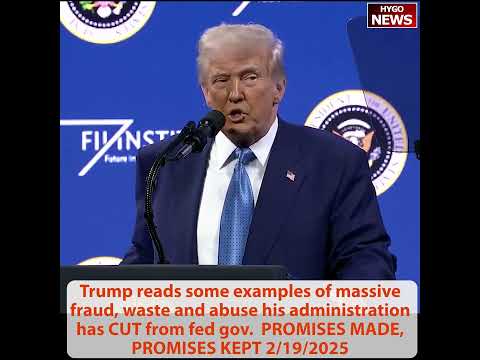
Trump Reads the Receipts: $21M for India Voter Turnout, $100M for Condoms, $520M for a Consultant
In one of the most memorable segments of his February 2025 FII Summit address, President Trump read aloud a list of federal expenditures that his administration had identified and canceled — transforming what could have been a dry policy recitation into a crowd-engaging performance. The examples ranged from the absurd ($20 million for Sesame Street international performances, $10 million for medical circumcisions in Mozambique) to the politically explosive ($21 million for voter turnout in India, $100 million for condoms for Hamas) to the simply staggering ($520 million for a single ESG consultant in Africa, $486 million for an elections consortium). Trump told the audience he could “read this list all day long” and that the examples he was sharing were “not nearly as bad as others."
"Here Are Just a Few Examples”
Trump set the stage by emphasizing that the list he was about to read was a random sample from a much larger catalogue of questionable spending.
“And here are just a few examples of where your money was going before I came along,” Trump said. “These are just some of the — just taken at random. Oh, there are much worse examples than this.”
He teased additional revelations. “I was just looking at them before the speech, and I can tell you they were much worse,” Trump said. “And there are some that are horrible, but I don’t want to really say them because they’re very, very embarrassing to people. Very, very embarrassing. And they’re really something, but you’ll be seeing it and you will be reading about it.”
The suggestion that even worse examples existed — too “incendiary” to read at a public event — served to heighten the audience’s sense that the waste was systemic rather than anecdotal. If these were the expenditures Trump was comfortable reading publicly, what were the ones he was holding back?
The Domestic Spending Examples
Trump began with expenditures within the United States.
“$2 million for sex change operations in Guatemala,” he read. The item drew immediate audience reaction.
“$20 million for Sesame Street performances, interact, $20 million,” Trump continued. He then offered his own cost analysis: “That’s a lot of money. You know, I know what it costs to do those things. You get a cast over for $50,000, give them a couple of bucks tip — that’s it. Not $20 million.”
The Sesame Street comparison was vintage Trump: taking an absurd expenditure and making it even more absurd by providing a common-sense cost estimate. Whether or not $50,000 was the actual cost of producing an international Sesame Street performance, the gap between a reasonable estimate and $20 million was the point.
“$101 million for 29 diversity, equity, and inclusion contracts at the Department of Education,” Trump read. “Wow.” The DEI spending at the Education Department — the same department Trump had called “a big con job” days earlier — reinforced the argument that the federal education bureaucracy was spending enormous sums on ideological programs rather than improving educational outcomes.
“$520 million for a consultant,” Trump said, pausing for emphasis. “I want to know, who is that consultant? To do ESG — that’s environmental, social, and governance investments in Africa.” The half-billion-dollar consultant fee was one of the largest single-line items, and Trump’s pointed question about the consultant’s identity suggested that the administration intended to investigate who had received the money.
The Foreign Aid Catalogue
The bulk of Trump’s list consisted of foreign aid expenditures that, read aloud, sounded increasingly absurd to an American audience concerned about domestic priorities.
“$25 million to promote biodiversity, conservation, and licit livelihoods by developing socially responsible behavior in Colombia,” Trump read. He added his own commentary: “Well, that’s nice. $25 million going to Colombia for something that nobody ever heard of.”
“$40 million to improve the social and economic inclusion of sedentary migrants,” he continued. “Nobody knows what that even means. And it’s not just — a bunch of people trying to figure out, what the hell does it all mean?”
The list continued: “$42 million for social and behavior changes in Uganda. $70 million for research of evidence-based solutions for development challenges. $10 million for Mozambique medical male circumcision.”
Each item, read in Trump’s distinctive cadence, landed with the audience because of the contrast between the specificity of the spending and its apparent disconnection from any American interest. Taxpayers struggling with inflation and housing costs were funding circumcision programs in Mozambique and behavior change campaigns in Uganda.
$21 Million for Voter Turnout in India
One expenditure drew particularly sharp commentary from Trump.
“And $21 million for voter turnout in India,” Trump read. “What do we need to spend $21 million for voter turnout in India? Wow, $21 million.”
He then drew a comparison that turned the item into a geopolitical observation. “I guess they were trying to get somebody else elected,” Trump said. “Well, we ought to tell the Indian government, because when we hear that Russia spent about $2 in our country, it was a big deal, right? They took some internet ads for $2,000. This is a total breakthrough. $21 million for India elections.”
The comparison was devastating. The United States had spent years investigating Russian interference in American elections, with the interference consisting largely of social media advertisements costing thousands of dollars. Meanwhile, the U.S. government had been spending $21 million to influence voter turnout in India — a democratic ally with 1.4 billion people whose elections were their own sovereign matter.
Trump’s rhetorical question — whether this was the U.S. “trying to get somebody else elected” — raised the possibility that what was described as neutral voter turnout assistance was actually a form of electoral interference, conducted openly and funded by American taxpayers.
Elections Consortium: $486 Million
The largest single program Trump cited was a $486 million expenditure for what he described as “the Consortium for Elections and Political Process Strengthening.”
“Including $22 million for inclusive, participatory political process in Moldova,” Trump added. The Moldova detail highlighted how the money was distributed across dozens of countries with individual line items that, taken separately, might not attract attention but collectively represented nearly half a billion dollars spent on influencing elections in other countries.
Additional election-related spending included “$29 million to strengthen the political landscape in Bangladesh” and “$2.5 million for inclusive democracies in South Africa.”
The $100 Million Figure
Trump saved the most explosive example for near the end. “$50 million plus another $50 million for condoms for Hamas,” he said. “$100 million for condoms. Condoms. Does everybody know what a condom is? For Hamas. $100 million.”
The item was politically nuclear because it combined two incendiary elements: a massive expenditure on a product associated with population programs, directed to an organization that the United States had designated as a terrorist group. Whether the money was technically directed to Hamas or to health programs in Gaza administered through intermediaries, Trump’s framing — “$100 million for condoms for Hamas” — was the version that would be remembered.
”I Could Read This List All Day Long”
Trump concluded by returning to the theme that the examples were merely a sample.
“These are just — I could read this list all day long. I just don’t want to bore you,” he said. “But these are just some, and not nearly as bad as others. And some are just — I just don’t want to say them because they’re too incendiary.”
The closing reiteration that worse examples existed served as a promise of future revelations and a justification for the continued DOGE mission. If the items Trump was willing to read publicly included half-billion-dollar consultant fees and $100 million in condom purchases, the items he was withholding as “too incendiary” represented a potential political earthquake.
Key Takeaways
- Trump read a list of canceled federal expenditures including $520M for a single ESG consultant in Africa, $101M for DEI at the Department of Education, and $20M for international Sesame Street performances.
- He highlighted $21 million for voter turnout in India, comparing it to the $2,000 in Russian social media ads that prompted years of election interference investigations in the U.S.
- Trump cited $486 million for an elections and political process consortium, with sub-grants to Moldova, Bangladesh, South Africa, and other countries.
- He described $100 million in spending on condoms directed to Hamas, calling it one of the most explosive examples on the list.
- Trump said the examples he shared were “not nearly as bad as others” and that some were “too incendiary” to read publicly, promising future revelations.