 HYGO News
 Trump reacts to NATO Sec Gen Mark Rutte calling him 'Daddy': very affectionately; Sec Def SLAMS CNN
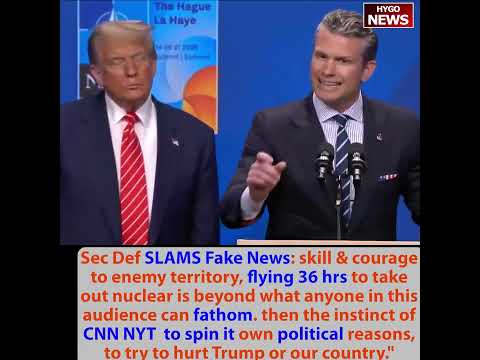
Trump reacts to NATO Sec Gen Mark Rutte calling him ‘Daddy’: very affectionately; Sec Def SLAMS CNN
NATO Secretary General Mark Rutte’s informal address of Trump as “daddy” during the summit became the viral moment that defined the media coverage of the event. A reporter followed up at Trump’s press availability, asking whether he views his NATO allies as children. Trump’s response was laconic and good-humored: “He likes me. I think he likes me. If he doesn’t, I’ll let you know. I’ll come back and I’ll hit him hard, okay? He did it very affectionately.” Defense Secretary Pete Hegseth separately used the summit’s close to deliver one of the sharpest media critiques of the week, defending the B-2 pilots who flew the 36-hour Iran mission and calling out CNN and The New York Times for the “instinct” to spin the operation’s success against the president.
”He Called You Daddy”
The reporter’s opening was direct. “Mark Rutter, the NATO chief, who is your friend, he called you daddy earlier. Do you regard your NATO allies as kind of children?”
The “daddy” reference was to a moment during the summit when Rutte had, in casual remarks, addressed Trump as “daddy.” The characterization was unusual for international diplomacy and became a viral clip within hours of its occurrence.
The reporter’s framing — “do you regard your NATO allies as kind of children?” — is the provocative reading of the “daddy” address. If Rutte calls Trump “daddy,” the implication might be that the NATO alliance is a parent-child relationship with Trump in the parental role. The framing invites Trump to accept or reject that implication.
”He Likes Me”
Trump’s response avoided the trap. “No, he likes me. I think he likes me. If he doesn’t, I’ll let you know. I’ll come back and I’ll hit him hard, okay? He did it very affectionately. Daddy, you’re my daddy.”
The response is disarming. Trump is treating Rutte’s informal address as an expression of genuine personal affection rather than as a political hierarchy statement. “He likes me” is the explanation. “Daddy, you’re my daddy” — Trump’s repetition of Rutte’s phrase — takes the joke and owns it.
“If he doesn’t, I’ll come back and I’ll hit him hard” is Trump’s characteristic humor. The self-aware acknowledgment that he would retaliate rhetorically if Rutte’s intent had been mocking rather than affectionate. The implicit conclusion is that Trump has evaluated Rutte’s intent and concluded it was affectionate.
”They Need Help A Little Bit At The Beginning”
The reporter pressed the deeper question. “Do you regard your NATO allies though as kind of like children and they’re obviously listening to you and they’re spending more and you’re obviously appreciative of that. But do you hope that actually they’re going to be able to defend themselves, defend Europe on their own without…”
Trump’s response was more substantive. “I think they need help a little bit at the beginning and I think they’ll be able to and I think they’ve got to remember this day. This is a big day for NATO. This was a very big day.”
The formulation — “need help a little bit at the beginning” — captures Trump’s practical framework. The NATO alliance’s transformation to European-financed self-defense is not immediate. It is a process. At the beginning of that process, America will provide support. As the process matures, Europeans will take on more of their own defense.
“They’ve got to remember this day” is the insistence that the commitment is foundational. Whatever happens in specific future moments, the European members must continue to honor the commitment they have made today.
The Specific Negotiation Anecdote
Trump recounted one negotiating exchange. “One of the gentlemen said, you know what? We’ve been trying to raise the rate for 30 years, he said, 20 years from almost the beginning and he’s been there for a long time. He said, until you came along, it never happened. What you did is amazing.”
The specific figure — “30 years” or “20 years from almost the beginning” — places the failed effort in the context of the NATO allies’ long-running attempts to increase defense spending. The effort has been constant for a generation. Results have been inconsistent. Until Trump’s pressure, the target levels had never been achieved.
“What you did is amazing” is the direct compliment Trump received from an ally. He is repeating it publicly, which is characteristic Trump communication. Compliments received are not kept private — they are shared as validation.
”Amazing Day For A Lot Of Reasons”
Trump summarized the summit. “It’s been sort of an amazing day for a lot of reasons but also for that.”
The day’s multiple achievements — the 5% GDP commitment, the Iran-related conversations, the bilateral meetings with various leaders — all contributed to Trump’s assessment. “Amazing day” is the compressed verdict.
”You Think They Can Do It Without You?”
The reporter’s follow-up probed the sustainability question. “You think they can do it without you though in the future? Can they do it with the past?”
Trump’s answer was measured. “Well, they’re smart. I mean, you have to ask Mark. There’s a reason the president calls out fake news for what it is.”
“They’re smart” is Trump’s acknowledgment that European leaders can, over time, manage their own defense. The current arrangement, where American leadership drives spending decisions, is not permanent. Europeans have the capacity to take over the leadership role as their defense budgets grow.
“You have to ask Mark” is the delegation. Rutte, as secretary general, has institutional responsibility for NATO’s future. Trump is deferring that specific question to the institutional figure charged with it.
The Transition To Hegseth
Trump’s pivot — “There’s a reason the president calls out fake news for what it is” — sets up the Hegseth material that follows. The transition from NATO to the media critique connects the two themes. Trump’s critique of the media is linked to his defense of the B-2 pilots. Hegseth amplifies that defense.
Hegseth On The Pilots
Defense Secretary Hegseth delivered the extended defense. “These pilots, these refuelers, these fighters, these air defenders, the skill and the courage it took to go into enemy territory flying 36 hours on behalf of the American people in the world to take out a nuclear program is beyond what anyone in this audience can fathom.”
“36 hours” is the specific flight time. The B-2 pilots who flew from Whiteman Air Force Base in Missouri to Iran and back were in the air for approximately 36 hours. That is longer than most commercial flights. It is longer than almost any other combat mission profile.
“Beyond what anyone in this audience can fathom” is the assertion that the media audience — the assembled reporters — cannot appreciate what the pilots did. Flying 36 hours in a high-performance bomber, through contested airspace, to a precision strike target, and returning safely is an operational achievement most observers cannot appreciate from their own experience.
”The Instinct Of CNN”
Hegseth then pivoted to the media critique. “And then the instinct, the instinct of CNN, the instinct of the New York Times is to try to find a way to spin it for their own political reasons to try to hurt President Trump or our country.”
“The instinct” is the key word. Hegseth is not accusing specific CNN or Times reporters of specific ethical violations. He is accusing the institutional instinct of the outlets — the default orientation from which coverage emerges. That instinct, in Hegseth’s framing, is to spin operational success into political failure for the administration.
”They Don’t Care What The Troops Think”
Hegseth extended the critique. “They don’t care what the troops think. They don’t care what the world thinks. They want to spin it to try to make him look bad based on a leak.”
The “they don’t care what the troops think” framing is the emotional core. American servicemembers executed an extraordinarily difficult mission. Their service deserves recognition. Coverage that undermines that recognition — that questions the completeness of their success — is, Hegseth is arguing, fundamentally disrespectful to their work.
”Plenty Of Leakers”
Hegseth addressed the specific leaked intelligence. “Of course, we’ve all seen plenty of leakers and what the leakers do, they have agendas and what do they do? Do they share the whole information or just the part that they want to introduce?”
The framing is about selective disclosure. Classified intelligence reports contain multiple assessments, multiple uncertainty levels, multiple qualifications. When a leaker extracts a specific paragraph and shares it with a reporter, the paragraph can be made to say one thing even if the full report says something different.
“Do they share the whole information or just the part that they want to introduce?” is the rhetorical question. The answer is that leakers share selectively, with the selection shaped by the leaker’s political intent.
”Low Confidence”
Hegseth unpacked the specific rating. “And when they introduce that preliminary report that’s deemed to be a low assessment, you know what a low assessment means? Low confidence in the data in that report. And why is there low confidence? Because all of the evidence of what was just bombed by 12,000, 30,000 pound bombs is buried under a mountain, devastated and obliterated.”
The “low confidence” rating is, in Hegseth’s explanation, a function of the very destruction the report is trying to assess. The damaged materials are buried under a mountain. Analysts cannot see them directly. The evidence available for assessment is limited. Therefore the confidence level is low.
Hegseth is arguing that the low confidence rating does not mean “the damage was small.” It means “we cannot see what the damage was because the damage is buried under rock.” Those are very different conclusions.
”Get A Big Shovel”
Hegseth’s rhetorical close was vivid. “So if you want to make an assessment of what happened at Fordo, you better get a big shovel and go really deep because Iran’s nuclear program is obliterated.”
The “big shovel” image captures the physical reality. If someone wants to see what actually happened at Fordow, they would need to excavate through hundreds of feet of shattered rock to reach what remains of the underground facility. The facility itself is not accessible for inspection. Its destruction can be inferred from the ordnance delivered and the surface effects, but direct post-strike inspection would require an engineering effort that is not feasible.
”Those That Dropped The Bombs Know”
Hegseth closed with the authority argument. “Somebody somewhere is trying to leak something to say, oh, with low confidence we think maybe it’s moderate. Those that dropped the bombs precisely in the right place know exactly what happened when that exploded. And you know who else knows? Iran. That’s why they came to the table right away because their nuclear capabilities have been set back beyond what they thought were possible because of the courage of a commander in chief who led our troops despite what the fake news wants to say.”
The argument has two authoritative witnesses. First, the American forces who executed the strike. They know what munitions they delivered, where they delivered them, and what the expected effects were. Their direct operational knowledge is the most reliable source for damage assessment.
Second, Iran itself. Iran’s behavior — coming to the negotiating table, accepting the ceasefire, engaging diplomatically — is itself the most telling indicator. States that have not been substantially damaged do not behave the way Iran is behaving. Iran’s behavior validates the damage assessment.
”The Courage Of A Commander In Chief”
Hegseth’s close credits Trump personally. “The courage of a commander in chief who led our troops despite what the fake news wants to say.”
The framing links the operational courage of the pilots to the political courage of the president. Both required willingness to accept consequences — the pilots accepted physical risk, the president accepted political risk. Both delivered, in Hegseth’s telling, extraordinary outcomes that the media framework refuses to acknowledge.
Air Force One Return
The video closed with Trump boarding Air Force One for the return to Washington. The NATO summit is complete. The 5% commitment is secured. The Iran post-strike messaging is consolidated. The next phase of the presidency begins as the Air Force One wheels lift off from The Hague.
Key Takeaways
- Trump on Rutte’s “daddy” address: “He likes me. I think he likes me. If he doesn’t, I’ll let you know. I’ll come back and I’ll hit him hard, okay? He did it very affectionately.”
- On NATO self-sufficiency: “I think they need help a little bit at the beginning and I think they’ll be able to.”
- Hegseth on the B-2 pilots: “36 hours on behalf of the American people in the world to take out a nuclear program is beyond what anyone in this audience can fathom.”
- On CNN and Times: “The instinct of CNN, the instinct of the New York Times is to try to find a way to spin it for their own political reasons.”
- Hegseth on “low confidence”: “you better get a big shovel and go really deep because Iran’s nuclear program is obliterated.”