 HYGO News
 Trump on Biden Gleason 9 Diagnosis: 'Same Doctor Who Said He Was Cognitively Fine -- Auto-Pen Is Becoming a Big Deal'; Rubio: Saudi Speech 'One of Most Profound in American History -- Builder, Not Bomber'
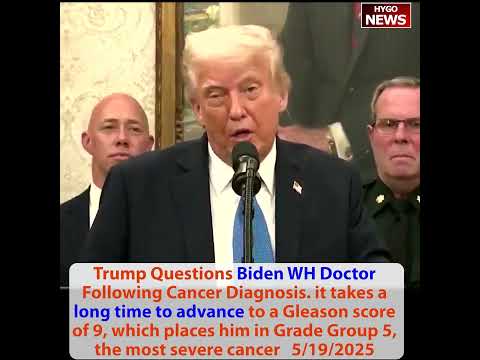
Trump on Biden Gleason 9 Diagnosis: “Same Doctor Who Said He Was Cognitively Fine — Auto-Pen Is Becoming a Big Deal”; Rubio: Saudi Speech “One of Most Profound in American History — Builder, Not Bomber”
Following the May 2025 announcement that Joe Biden had been diagnosed with aggressive Stage 4 prostate cancer (Gleason score 9), President Trump publicly questioned Biden’s White House physician. “It takes a long time to get to that situation… to get to a Stage 9. I think that if you take a look, it’s the same doctor that said that Joe was cognitively fine. There was nothing wrong with him.” Trump connected this to the broader cover-up question: “The auto-pen is becoming a very big deal because it seems like that maybe was the president who ever operated the auto pen.” Secretary of State Marco Rubio praised Trump’s Saudi Arabia speech: “I think it will go down as one of the most profound foreign policy speeches in American history. One of the cardinals told me it’s very unusual for us — we have an American president that wants peace. Our president is a builder, not a bomber.” On the One Big Beautiful Bill: “If we don’t get it, 68% tax increase, the largest in history. If we do, largest tax decrease in history."
"Same Doctor”
Trump’s public questioning of Biden’s White House physician came in the immediate aftermath of the Biden cancer diagnosis.
“It’s given just about and it takes a long time to get to that situation,” Trump said, referring to the Gleason 9 prostate cancer classification.
He raised the key question: “Now I think you know to get to a stage nine I think that if you take a look it’s the same doctor that said that Joe was cognitively fine. There was nothing wrong with him.”
He stated the implication: “Well he said if it’s the same doctor he said there was nothing wrong there and that’s being proven to be a sad situation.”
The Gleason scoring system is the standard metric for prostate cancer aggression. Gleason scores range from 2-10, with scores of 8-10 classified as “high grade” and considered the most aggressive forms. A Gleason 9 represents Grade Group 5, the highest severity category.
The timeline implications Trump was raising were medically significant. Prostate cancer typically progresses slowly over years or even decades. A Gleason 9 diagnosis in mid-2025 suggested that:
- The cancer had likely been present for years prior
- Routine prostate cancer screening during Biden’s presidency should have detected it earlier
- Either screening had not been performed, or results had not been disclosed
Biden’s White House physician was Dr. Kevin O’Connor, who had served as Biden’s personal physician for years. O’Connor had consistently issued annual health reports during Biden’s presidency stating that Biden was “fit for duty” and had not raised concerns about cognitive function or serious health conditions.
Trump’s point was that if O’Connor had certified Biden as healthy and cognitively fit — and these certifications had turned out to be wrong — then all of O’Connor’s medical judgments about Biden warranted scrutiny. Either O’Connor had missed serious medical conditions that should have been detectable with routine screening, or he had known about them and had concealed them from the public.
The Auto-Pen Scandal
Trump pivoted to connecting the cancer diagnosis to the auto-pen question.
“The auto-pen is becoming a big deal because it seems like that maybe was the president who ever operated the auto pen,” Trump said.
He described the broader implications: “But when they say that that was not good they also you know you have to look and you have to say that the test was not so good either in other words there are things going on that the public wasn’t informed.”
He named the accountability: “And I think somebody’s going to have to speak to his doctor if it’s the same or even if it’s two separate doctors why wasn’t the cognitive ability why wasn’t that discussed.”
The auto-pen controversy had escalated throughout 2025 as evidence mounted that Biden had not personally signed many of his presidential documents during his term. The auto-pen is a mechanical device that replicates a signature. Presidents had used it occasionally for ceremonial documents, but the extensive use during Biden’s term suggested that Biden might not have been personally approving or signing the documents that bore his signature.
The implications were constitutional. If Biden had not personally approved documents bearing his auto-pen signature — if unelected aides had determined which documents would be signed — then the legitimacy of those actions was questionable. Executive orders, pardons, judicial nominations, and other presidential actions taken under Biden’s name might have been effectively taken by staff rather than by the elected president.
Trump’s coupling of the cancer diagnosis with the auto-pen question was logical. Both pointed to the same underlying concern: Biden might have been incapacitated during significant portions of his presidency, with his public image being maintained through systematic deception. The cancer diagnosis made the physical incapacity claim more concrete, while the auto-pen pointed to the governance implications.
Trump concluded his comments on the topic: “And I think the doctor said he’s just fine and it’s turned out…”
The unfinished sentence implied the obvious conclusion: the doctor had been wrong, and either through negligence or deception had concealed Biden’s actual medical condition from the American public.
Rubio: “One of the Most Profound in American History”
Secretary of State Marco Rubio delivered fulsome praise of Trump’s Saudi Arabia speech.
“I don’t know how many of you got to see the president’s speech in Saudi Arabia,” Rubio said. “I think it will go down as one of the most profound foreign policy speeches in American history.”
He described the content: “It outlined a vision for the future and a vision of prosperity.”
He gave his summary: “And I tell people we have a president of peace.”
The Saudi Arabia speech had been delivered during Trump’s Riyadh visit in mid-May 2025. In the speech, Trump had articulated a doctrine explicitly rejecting the “nation-building” approach of previous American administrations. The key themes had been:
- Respect for national sovereignty and cultural differences
- Focus on commercial and investment relationships rather than ideological transformation
- Criticism of “interventionists” who had committed U.S. military resources to transform other societies
- Recognition that Middle Eastern progress had come from local leadership, not external imposition
- Partnership rather than lecture as the appropriate diplomatic posture
The “peace” framing Rubio offered captured the core message. Trump’s Middle East diplomacy was explicitly oriented around conflict resolution — Israel-Hamas, Russia-Ukraine, India-Pakistan, Iran-nuclear — rather than conflict prosecution. This represented a significant departure from post-9/11 American foreign policy, which had focused more on military intervention and regime change.
The Cardinal Anecdote
Rubio shared a revealing anecdote from his Vatican meetings.
“In fact I’ll tell you kind of an aside,” Rubio said. “One of the cardinals I was meeting with, the day before the papal mass, said to me, ‘You know, it’s very unusual for us. We have an American president that wants peace and it’s some of the Europeans that are constantly talking about doing war stuff. So it’s kind of the world’s upside down in their mind right now. It’s usually the other way around.’”
The cardinal’s observation reflected a genuine shift in international politics. Historically, European powers had been associated with more diplomatic, peace-oriented approaches to international relations, while American foreign policy had been more willing to use military force. The Bush and Obama administrations’ interventions in Iraq, Afghanistan, and elsewhere had reinforced this perception.
In 2025, the pattern had inverted:
- Trump was actively pursuing diplomatic resolution of multiple conflicts
- European leaders (particularly UK PM Keir Starmer, French President Macron, and various German officials) were pushing for continued military support to Ukraine, more confrontational posture toward Russia, and more aggressive defense spending
- NATO debates were being driven by European concerns that Trump was not sufficiently committed to confrontation with Russia
The “world’s upside down” characterization captured this anomaly. The traditional American-European dynamic had reversed: Americans were emphasizing peace while Europeans emphasized war.
”Builder, Not Bomber”
Rubio delivered the crystallized summary.
“It’s a great honor to work for a President who literally spends half his day maybe more trying to stop wars and prevent wars,” Rubio said.
He offered the phrase: “Our president is a builder, not a bomber.”
He expanded the framing: “He wants to make things. He wants to build things. He wants people to have prosperity and to be happy.”
He acknowledged the complexity: “And frankly, he knows we have to have national defense because of course that’s the world we live in.”
He described Trump’s preference: “But I think one of the things that troubles him deeply is how much money has to be spent on some of his military and war because it’s just the way the nature of the world is. He’d much rather be spending growing the economy and doing the deals that we’ve seen.”
The “builder, not bomber” formulation was catchy and accurate as a characterization of Trump’s approach. Throughout his first term and into his second, Trump had been consistent in emphasizing deal-making, commercial engagement, and peace brokerage over military intervention. His signature foreign policy accomplishments — the Abraham Accords, the Middle East investment commitments, the India-Pakistan ceasefire, the Russia-Ukraine diplomatic engagement — had been constructed rather than blown up.
Critics argued that Trump’s approach failed to recognize when military force was necessary, and that his “deal-making” was sometimes accommodation of adversaries. Supporters argued that traditional American foreign policy had over-relied on military force with poor results, and that Trump’s approach produced better outcomes at lower cost.
The financial point Rubio raised was real. American defense spending in the 2020s was consuming approximately $900 billion annually, representing a significant portion of federal discretionary spending. The opportunity cost of this spending — resources not available for economic growth, infrastructure, or other priorities — was substantial. A foreign policy that could achieve American security goals with lower military expenditure would free resources for other national priorities.
OBBB: “68% Tax Increase vs. Largest Tax Decrease”
Trump closed with the One Big Beautiful Bill framing.
“We’re looking to get the One Great Big Beautiful Bill,” Trump said. “It’ll be the greatest tax cuts in history.”
He described the binary: “If we don’t get it that means the Democrats will have stopped us and that means people will get a 68% tax increase, the largest in history.”
He described the alternative: “And if we do get it, we’re going to have the largest tax decrease in history.”
The 68% tax increase framing referred to what would happen if the Trump-era tax cuts from 2017 expired without extension. The Tax Cuts and Jobs Act provisions were scheduled to expire at the end of 2025, which would return tax rates and thresholds to pre-2017 levels. For many families, this would represent significant tax increases relative to the rates they had been paying for seven years.
The specific “68%” figure was an aggregated measure calculated across various tax provisions. The actual percentage increase for individual taxpayers would vary based on income, filing status, and other factors. But for many middle-income families, the combination of higher rates, lower standard deduction, and lost child tax credit expansion would produce substantial tax increases.
Trump’s political framing was sharp: “All my life I’ve watched politicians screaming we will cut your taxes. This is the only group where they say we’re going to raise your taxes and they think they’re going to win. There’s something wrong with them. I don’t know what the hell is going on. We are going to raise your taxes. And people said, ‘That’s strange. I’ve never heard it before.’”
The political observation was valid. Traditional campaign wisdom was that tax cuts were politically popular and tax increases were politically toxic. Democrats’ willingness to let the 2017 tax cuts expire — which would effectively raise taxes on most Americans — violated traditional political logic. Either Democrats believed they could successfully frame expiration as “tax the rich” (not applying to middle-class families), or they were making a principled fiscal argument that required them to accept political pain, or they had miscalculated the political consequences.
Key Takeaways
- Trump on Biden Gleason 9 cancer: “Same doctor who said he was cognitively fine. Auto-pen becoming a big deal — maybe that was the president who operated it.”
- Rubio on Saudi speech: “Will go down as one of the most profound foreign policy speeches in American history.”
- Cardinal anecdote: “Unusual — American president wants peace, Europeans constantly talking about war stuff. World’s upside down.”
- Rubio’s frame: “Our president is a builder, not a bomber. Spends half his day trying to stop wars.”
- OBBB binary: “If we don’t get it, 68% tax increase, largest in history. If we do, largest tax decrease in history.”