 HYGO News
 Trump proclaims Oct 13 as COLUMBUS DAY! Rubio: One day entire story will be told; Rollins: $50B
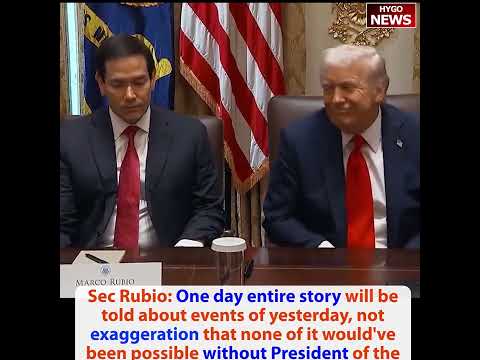
Trump proclaims Oct 13 as COLUMBUS DAY! Rubio: One day entire story will be told; Rollins: $50B
President Trump officially proclaimed October 13, 2025 as Columbus Day — reviving the traditional holiday celebrated under its historical name rather than the “Indigenous Peoples’ Day” rebrand pushed by prior administrations. On the Gaza deal, Trump said the priority is getting the hostages home first, with subsequent phases to follow based on Hamas compliance. Secretary of State Marco Rubio framed the diplomatic accomplishment: “One day, perhaps, the entire story will be told about the events of yesterday, but suffice it to say, it’s not an exaggeration that none of it would have been possible without the president of the United States being involved.” Agriculture Secretary Brooke Rollins then detailed the farmer inheritance from Biden: Trump 1.0 ended with an agriculture trade surplus; Trump 2.0 inherited a $50 billion ag deficit, with farmer input costs up 30-38%, labor costs up 47%, and interest rates up 73% under Biden. Trump committed to a “golden age” of rural prosperity, potentially including a bridge program for farmers during trade renegotiation. Trump: “This is a particularly important holiday for Italian Americans who celebrate the legacy of Christopher Columbus.” Rubio: “None of it would have been possible without the president of the United States being involved.” Rollins: “When we came back for Trump two, it was a 50 billion dollar ag deficit.”
Columbus Day Proclaimed
Trump opened the event with the historical framework. “Christopher Columbus, obviously, discovered the new world in 1492. He was a great Italian explorer. He sailed his three ships, the Nina, the Pinta and the Santa Maria, across the Atlantic Ocean and landed in what’s today the Caribbean.”
The Whisper transcription garbled “Nina, the Pinta” into “Nen of the Pinto” — Trump’s reference was to Columbus’s three ships on his 1492 voyage.
“But this is a particularly important holiday for Italian Americans who celebrate the legacy of Christopher Columbus and the innovation explorer zeal that he represented.”
The framing: Columbus Day as Italian-American heritage celebration. The holiday was originally established in 1937 by President FDR partly to recognize Italian-American contributions.
“In other words, we’re calling it Columbus Day. Yes.”
Trump’s line — emphasizing “we’re calling it Columbus Day” — directly responded to the Biden-era shift toward “Indigenous Peoples’ Day” framing. Biden had issued proclamations recognizing both holidays on the same day; Trump’s proclamation reverts to Columbus Day as the primary designation.
Gaza Deal: “First the Hostages”
A reporter asked about enforcement mechanisms: “What guarantees Hamas disarms and that Israel doesn’t resume bombing once the hostages are released?”
Trump’s answer focused on sequencing. “Well, the first thing we’re doing is getting our hostages back. OK, and that’s what people wanted more than anything else.”
Trump’s framework: phase one is hostage return. The disarmament questions, the durable ceasefire questions, the governance questions — those come in subsequent phases.
“They wanted these hostages back that have lived in hell like nobody has ever even dreamt possible.”
The hostages held by Hamas since October 7, 2023 had endured nearly two years of captivity in Gaza tunnel networks. Reports of torture, starvation, and sexual violence had emerged from released hostages.
“And after that, we’ll see. But they’ve agreed to things and I think it’s going to move along pretty well.”
Trump’s framing was deliberately open on later phases — don’t overcommit to specific guarantees when the deal’s first phase is still being executed.
Rubio: “Entire Story Will Be Told”
Secretary Rubio delivered remarkable framing on the president’s role. “You know, I don’t know if the one day, perhaps the entire story will be told about the events of yesterday, but suffice it to say it’s not an exaggeration that none of it would have been possible without the president of the United States being involved.”
The phrasing was careful — Rubio didn’t disclose specific details but indicated that the public account is partial. Behind-the-scenes diplomacy involved Trump personal involvement that hasn’t been made public.
“It really began with your trip to the Middle East, where these relationships were forged with partners in the region, personal relationships, close relationships that created the foundation where all this was possible.”
Trump’s May 2025 Middle East trip — covering Saudi Arabia, Qatar, UAE — built the personal relationships with regional leaders (MBS, Emir Tamim, MBZ) that Rubio identifies as foundational to the Gaza deal. Without those relationships, the multilateral coordination required for the deal wouldn’t have been available.
“Well, I think this really took a turn. Remember a month ago, I never thought this was possible.”
Rubio’s own expectation adjustment: as recently as September 2025, he didn’t believe the deal was achievable. The October 2025 breakthrough surprised even the senior diplomat leading the effort.
Rollins on Farm Economy
Agriculture Secretary Brooke Rollins pivoted to farmer issues. “The farm economy is in a very uncertain time. But that isn’t because of the current trade negotiations, although certainly the China part is part of that. But we inherited a slew of issues.”
Rollins framed the farmer pressure clearly: the trade friction with China is real, but the underlying stress predates Trump’s second-term trade moves.
“First of all, as the president said, when we left Trump one, we had an agriculture trade surplus. When we came back for Trump two, it was a 50 billion dollar ag deficit.”
The inheritance: Trump 1.0 delivered an ag surplus. The Biden four years reversed it into a $50 billion deficit. That’s a major structural deterioration in U.S. agriculture’s international position.
“That isn’t everything. That’s just agriculture.”
Rollins indicated the $50B was isolated to agriculture — other sectors had their own Biden-era deteriorations separately.
Input Costs Up 30-38%
“The second part is the cost of inputs for our farmers increased on average between 30 and 38 percent, but that includes fertilizer. It includes fuel. It includes interest rates. It includes labor.”
The input cost increases during Biden years:
- Fertilizer: driven by energy costs and Russia-Ukraine disruption of potash and phosphate supply
- Fuel: higher diesel prices affected tractors, harvesters, grain transport
- Interest rates: Fed tightening raised farm operating loan costs
- Labor: H-2A program wages rose sharply, plus inflation
“All of this came about under Joe Biden, a 47 percent increase in the cost of labor that now Secretary Chavez-DeRemer and Noem and I are working on.”
Labor up 47%. Secretary Lori Chavez-DeRemer (Labor) and Secretary Kristi Noem (DHS, with H-2A oversight) and Rollins are working jointly on farm labor reform.
“Fuel is coming down. Thank you. Interest rates, thankfully, are coming down.”
Under Trump 2.0, two of the four input cost categories — fuel and interest rates — are already reversing.
“73 percent increase in interest rates for our farmers. They couldn’t get loans.”
73% interest rate increases during Biden. Some farmers simply couldn’t secure operating loans, leading to consolidation pressure.
Rural “Golden Age”
“The president’s commitment is this, that we are moving into an era of rural prosperity of a golden age for our farmers in rural America.”
Trump’s framework for rural America: not just recovery to pre-Biden baseline, but “golden age” exceeding any prior period.
“The trade renegotiation and the trade realignment that Jamison and Scott and Howard have led with the president’s leadership is unlike anything that’s happened in the history of our country.”
The trade team: Jamieson Greer (USTR), Scott Bessent (Treasury), Howard Lutnick (Commerce). Rollins identifying the trade team working on agricultural market access.
“And those that will benefit the most are the original Americans, our farmers and our ranchers.”
The “original Americans” framing — farmers and ranchers as founding-era Americans — positioned rural producers as the deserving primary beneficiaries of the trade realignment.
Bridge Program
“The president has committed. If we need a bridge, he has talked about that to get us from the Biden years to the new Trump era.”
The bridge concept: tariff revenue redistribution to farmers (referenced in prior events) as transitional support while trade deals develop and Chinese soybean/corn purchases resume.
“That’s what we’re working on every day. We’ve got to get the government reopened so that we can move forward on that. And once we do, we’ll be able to move out a significant program to help our farmers.”
The shutdown blocks implementation. Until the shutdown ends, USDA can’t move the bridge program forward.
Long-Term Changes
“Long term, we have to change this hamster wheel of government. We’ve got to ensure that the farmers have the market to sell.”
The “hamster wheel” framing: the repeating cycle of crisis aid, subsidy, tariff disputes, and negotiation that has characterized U.S. ag policy for decades. Rollins wants to exit the cycle, not just reset it.
“And it’s a national security issue and on-shoring a lot of the food as well.”
Food security as national security. The framework: a nation that can’t feed itself from domestic production is strategically vulnerable. On-shoring food production — especially for critical categories — is a resilience issue.
Key Takeaways
- Trump on Columbus Day: “Christopher Columbus, obviously, discovered the new world in 1492. He was a great Italian explorer … this is a particularly important holiday for Italian Americans who celebrate the legacy of Christopher Columbus and the innovation explorer zeal that he represented. In other words, we’re calling it Columbus Day.”
- Trump on Gaza phases: “The first thing we’re doing is getting our hostages back … that’s what people wanted more than anything else. They wanted these hostages back that have lived in hell like nobody has ever even dreamt possible. And after that, we’ll see.”
- Rubio on the deal: “One day, perhaps, the entire story will be told about the events of yesterday, but suffice it to say it’s not an exaggeration that none of it would have been possible without the president of the United States being involved … It really began with your trip to the Middle East, where these relationships were forged.”
- Rollins on farm inheritance: “When we left Trump one, we had an agriculture trade surplus. When we came back for Trump two, it was a 50 billion dollar ag deficit … the cost of inputs for our farmers increased on average between 30 and 38 percent … 47 percent increase in the cost of labor … 73 percent increase in interest rates for our farmers. They couldn’t get loans.”
- Rollins on rural future: “We are moving into an era of rural prosperity of a golden age for our farmers in rural America … those that will benefit the most are the original Americans, our farmers and our ranchers.”