 HYGO News
 Trump Presents Elon Musk with Gold White House Key: 'Service Without Comparison in Modern History'; 'Willingly Accepted Outrageous Abuse, Slander, Lies Because He Loves Our Country'; CNBC's Santelli/Kiernan Stunned: 'Personal Income Up 0.8%, Triple Expectations; Trade Deficit Cut in Half'
Trump Presents Elon Musk with Gold White House Key: “Service Without Comparison in Modern History”; “Willingly Accepted Outrageous Abuse, Slander, Lies Because He Loves Our Country”; CNBC’s Santelli/Kiernan Stunned: “Personal Income Up 0.8%, Triple Expectations; Trade Deficit Cut in Half”
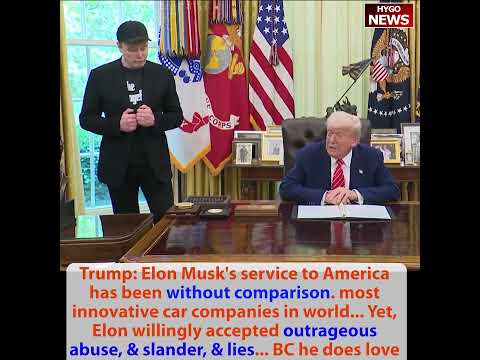
At Elon Musk’s farewell event in late May 2025, President Trump presented him with a gold White House key and a remarkable tribute. “Elon’s service to America has been without comparison in modern history. He’s already running one of the most innovative car companies in the world. You look at his factories and compare them with some of the old factories we have. And the most successful space company, and I guess in history you would have to say the largest free speech platform on the internet. Yet, Elon willingly, with all of the success, he willingly accepted the outrageous abuse and slander and lies and attacks because he does love our country.” On DOGE’s mindset impact: “He really has changed the mindset of a lot of people. A lot of people thought maybe we’ll cut 1% or 2% or 3%. Then they said, wow, we can cut a lot more than that.” Trump then played CNBC footage of Joe Kernan and Rick Santelli praising economic data. Santelli: “Personal income is up 0.8 to 1%. That is almost triple the expectations. The income numbers, really, for the first four months of the year, they’re stellar.” On the shrinking trade deficit: “I’ve never, ever in my lifetime had glimpses into the politics of an administration in the form of transparency like this one… I don’t think I’ve ever seen the trade deficit cut in half in one month.”
The Gold Key Presentation
Trump opened the ceremony with the presentation.
“I’m a little special something we have here,” Trump said. “Thank you. A very special that I give to very special people.”
He described the rarity: “I have given it to some, but they go to very special people.”
He explained the gesture: “And I thought I’d give it to Elon as a presentation from our country.”
He handed it to Musk: “Thank you, Elon. Thank you. Take care. Thank you. Thank you. Thank you. Thank you. Thank you. Thank you. Thank you. Thank you. Thank you. Thank you.”
Musk expressed appreciation: “That’s a good one. The luck on this is amazing.”
Someone added: “I’m going to be a salesman.”
The “gold White House key” was a specific ceremonial gift that presidents occasionally presented to particularly significant visitors or service members. Unlike the more common “keys to the city” that mayors gave, White House keys were:
- Extremely rare (perhaps dozens ever given)
- Presented personally by presidents
- Made of actual gold
- Symbolically significant
- Represented unique recognition
By receiving this key, Musk was joining an exclusive category of individuals whose contributions had warranted unique presidential recognition.
”Without Comparison in Modern History”
Trump’s tribute was extraordinary in its praise.
“But Elon’s service to America has been without comparison in modern history,” Trump said.
He cataloged Musk’s achievements: “He’s already running one of the most innovative car companies in the world.”
He made the industrial comparison: “You look at his factories and compare them with some of the old factories we have. And it’s a big difference.”
He continued the achievement list: “And the most successful space company, and I guess in history you would have to say the largest free speech platform on the internet, et cetera.”
The Musk Empire
The specific achievements Trump cited represented extraordinary personal accomplishment:
Tesla: One of the world’s most valuable automakers, leading the electric vehicle revolution. Market cap had reached over $1 trillion at peaks. Advanced manufacturing technology, autonomous driving development, energy storage systems.
SpaceX: Revolutionized space industry through reusable rockets, regular commercial launches, Starlink satellite internet, plans for Mars colonization. By 2025, SpaceX conducted more launches than all other organizations combined.
X (formerly Twitter): After acquisition in 2022, transformed into major platform for political discourse. “Largest free speech platform” reflected its centrality to public conversation.
Neuralink: Brain-computer interface technology with potential medical and enhancement applications.
The Boring Company: Tunnel construction for transportation.
xAI: Artificial intelligence development.
Various other ventures: Solar, crypto, energy, etc.
Cumulatively, Musk represented the most successful American entrepreneur of his generation. His combination of:
- Technical capability
- Business execution
- Risk tolerance
- Long-term vision
- Political engagement
was genuinely extraordinary.
”Willingly Accepted Outrageous Abuse”
Trump’s praise of Musk’s political service was specific.
“Yet, Elon willingly, with all of the success, he willingly accepted the outrageous abuse and slander and lies and attacks because he does love our country,” Trump said.
He elaborated: “I know that very much. He loves our country.”
He acknowledged Musk’s origin: “He comes from another country, a country that’s going through trials and tribulations, I would say.”
He reaffirmed Musk’s American commitment: “But he’s all about the USA and Americans, so I’m a great debt of gratitude.”
The “Outrageous Abuse” Pattern
The abuse Musk had endured during his DOGE service was extensive:
Political attacks: Democratic politicians had regularly attacked Musk personally as “oligarch,” “unelected billionaire,” etc.
Media criticism: Major media outlets had published extensive criticism of Musk’s approach, decisions, and personal character.
Protest actions: Tesla dealerships had been attacked, Tesla vehicles vandalized.
Boycott campaigns: Coordinated campaigns to damage Tesla’s reputation and sales.
Personal threats: Credible threats of physical violence against Musk and his family.
Regulatory harassment: Various federal and state agencies had been perceived as targeting Musk’s businesses.
Legal actions: Multiple lawsuits and legal challenges to his decisions.
Social media campaigns: Coordinated campaigns to delegitimize his voice.
Despite all of this, Musk had:
- Continued his DOGE service
- Not withdrawn from political engagement
- Maintained his business operations
- Continued public advocacy
- Completed his commitments
Trump’s acknowledgment of this sacrifice was important. Other wealthy individuals who might consider similar government service would see that:
- Such service was personally costly
- The abuse was real and unprecedented
- Presidential acknowledgment was meaningful
- The service was recognized and valued
”He Comes From Another Country”
Trump’s reference to Musk’s South African origin was diplomatically delicate.
Musk was born in Pretoria, South Africa, in 1971 to a Canadian mother and South African father. He had emigrated to Canada, then to the United States, eventually becoming a U.S. citizen.
Trump’s “trials and tribulations” reference to South Africa was consistent with his administration’s Afrikaner refugee program. Musk had been outspoken about:
- Deteriorating conditions in South Africa
- Anti-white political rhetoric
- Farm murders
- Land expropriation threats
- General decline of the country
As a former South African who had seen his country’s deterioration, Musk had particular perspective on why American engagement with failed state risks mattered. His commitment to American success was partly informed by his perspective on South African failure.
The DOGE Mindset Shift
Trump described DOGE’s institutional impact.
“So I just want to thank Elon for his time as a special government employee,” Trump said.
He joked about the terminology: “Can you imagine? They call him an employee. But it’s a special government employee.”
He described the transformation: “For coming and helping us, and he really has changed the mindset of a lot of people.”
He quantified the shift: “A lot of people thought maybe we’ll cut 1% or 2% or 3%. Then they said, wow, we can cut a lot more than that.”
He described the methodology: “And we’re going to do it very surgically. We’re going to continue on the march. We’re making America great again.”
The “Mindset Change”
The mindset shift Trump described was genuine and significant:
Pre-DOGE assumptions: Federal spending reduction had been considered possible in small increments:
- 1-3% annual reductions in specific programs
- Modest efficiency improvements
- Incremental personnel reductions
- Slow, careful process over years
DOGE demonstrated: Much larger reductions were possible:
- 30-50% reductions in specific agencies
- Elimination of wasteful programs entirely
- Dramatic personnel reductions
- Rapid identification and execution
Examples:
- USAID: Dramatic scope reduction
- Various redundant programs eliminated
- Contractor relationships renegotiated
- Real estate footprint reduced
Long-term impact: Federal managers now:
- Thought about efficiency differently
- Considered elimination rather than just reduction
- Expected regular review of spending
- Anticipated continuing scrutiny
This mindset transformation would outlast Musk’s 134-day service. Future cabinet secretaries, agency heads, and federal managers would operate under different assumptions about what was possible and expected.
The Santelli/Kernan Economic Data
Trump pivoted to economic data.
“I think what I’ll do, you don’t mind, numbers have just come out, which are rather extraordinary,” Trump said.
He introduced the clip: “And I thought I’d play a tape of one of the people who I respected over the years from Joe Kernan and Rick Santelli.”
He framed the evidence: “This just came out, and we’ll just play that for a second.”
The clip captured CNBC’s Rick Santelli discussing economic data: “Personal income is up 810. Up 810 to 1%. That is almost triple the expectations.”
Santelli continued the assessment: “The income numbers, really, for the first four months of the year, they’re stellar. They’re really stellar.”
He made the broader evaluation: “I mean, I can go back and look at the first four months of many different years, really very strong numbers. And you’re right. This administration is criticized for just about everything under the sun.”
He delivered remarkable praise: “I’ve never, ever in my lifetime, had glimpses into the politics of an administration in the form of transparency like this one.”
He made the fairness point: “Why don’t we give credit where credit is due?”
The Trade Deficit Reduction
Santelli and Kernan addressed the trade numbers.
Kernan (or Santelli) observed: “I also thought everybody was going to get one last order of imports that were going to be tariffed, and they were loaded up on things. How the hell did they already fix the trade, or not fix it? But to cut it in half, that’s crazy.”
He marveled at the data: “So there wasn’t a lot of front loading of things that they needed before the tariffs hit?”
The response: “Yeah, I’ll tell you what. It really does call in the question some of the conventional wisdoms. And it’s going to be interesting to see what happens next month when we get this number, or we see some of the other numbers like current accounts, see how they fared.”
He made the personal observation: “Because I don’t know. I’ve been watching these numbers a long time. I don’t think I’ve ever seen the trade deficit cut in half in one month.”
The Economic Data Significance
The specific economic data was genuinely remarkable:
Personal income +0.8%: Monthly personal income growth was up 0.8% — roughly three times expectations. This meant:
- Americans were earning substantially more
- Wage growth was stronger than forecasters anticipated
- Consumer spending power was increasing
- Economic strength was real rather than just inflation
Trade deficit halved: The trade deficit had been cut approximately in half in a single month. This meant:
- American exports were stronger than anticipated
- American imports were weaker than anticipated
- Trade rebalancing was happening
- Tariff policy was having intended effects
First four months stellar: Year-to-date data showed sustained strong performance. This meant:
- The economy was responding positively to administration policies
- Strength was not a one-month anomaly
- Trends were improving rather than deteriorating
- Forecasters had underestimated American resilience
Santelli’s “never seen… in my lifetime” framing was significant. Rick Santelli had been covering economic data for CNBC for decades. His professional experience dated back to before the 1987 market crash. If in his entire career he had never seen trade deficit cut in half in a single month, the current reduction was historically exceptional.
The Transparency Praise
Santelli’s comment about administration transparency was unusual from a financial reporter.
“I’ve never, ever in my lifetime, had glimpses into the politics of an administration in the form of transparency like this one,” Santelli said.
This was genuine praise. The Trump administration had been unusually transparent about:
- Decision-making processes
- Policy rationales
- Internal disagreements
- Negotiating positions
- Performance metrics
This contrasted with previous administrations that had been:
- Secretive about decisions
- Hostile to media inquiries
- Selective about data releases
- Defensive about setbacks
- Protective of internal processes
Santelli’s willingness to publicly note this transparency was politically significant. Conservative commentators praising transparency would have been dismissed as partisan. Santelli’s professional credibility gave his praise additional weight.
Trump’s Response and Staff Recognition
Trump responded to the data.
“Not bad. Not bad. Come on, guys,” Trump said. “Thank you. Thank you. Thank you. Thank you. Thank you. Thank you.”
He acknowledged his team: “I see Howard and Scott are here, so it’s great. You guys want to stand over here, you might as well. You’re the ones that help reduce those numbers.”
He made the prediction: “And it’ll only get better. The tariffs are so important. And that’s why we were so happy with the decision yesterday.”
The “Howard and Scott” reference was presumably to Commerce Secretary Howard Lutnick and Treasury Secretary Scott Bessent. These were the economic principals whose policies had produced the favorable data:
Bessent: Treasury Department policies, tariff implementation, international economic coordination.
Lutnick: Commerce Department policies, trade negotiations, economic data coordination.
Together, they represented the administration’s economic team that had been implementing Trump’s vision.
Key Takeaways
- Trump presents Musk with gold White House key: “Service without comparison in modern history.”
- Musk’s achievements: “Most innovative car company, most successful space company, largest free speech platform.”
- Trump on Musk’s sacrifice: “Willingly accepted outrageous abuse, slander, lies because he loves our country.”
- DOGE mindset change: “People thought cut 1% or 2%. Then said we can cut a lot more than that.”
- CNBC’s Santelli: “Personal income up 0.8%, triple expectations. Trade deficit cut in half — never seen in my lifetime.”