 HYGO News
 Trump After Walter Reed Physical: 'I Took a Cognitive Test -- Every Answer Right'; Markets 'Solid'; Iran 'Can't Have Nuclear Weapon'
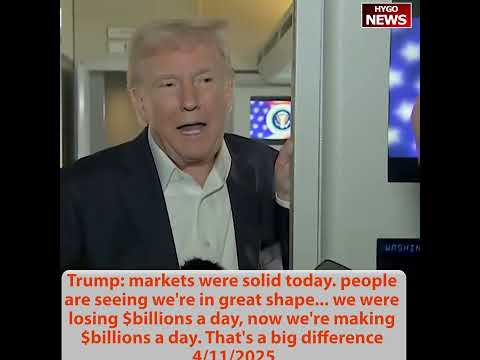
Trump After Walter Reed Physical: “I Took a Cognitive Test — Every Answer Right”; Markets “Solid”; Iran “Can’t Have Nuclear Weapon”
President Trump spoke to reporters outside Walter Reed National Military Medical Center in April 2025 after completing his annual physical, revealing: “I wanted to be a little different than Biden — I took a cognitive test, and I don’t know what to tell you other than I got every answer right.” He reported being in “very good shape — good heart, a good soul.” Trump then addressed multiple topics: markets were “solid today,” Iran negotiations were proceeding with the red line that “they can’t have a nuclear weapon,” tariff negotiations meant “we pretty much can do what we want to do, but we want to be fair,” and the border was “the best we’ve had, ever."
"Every Answer Right”
Trump emerged from Walter Reed in characteristically buoyant form.
“I think well,” he said when asked about the physical. “Every test you can imagine. Long time — the yearly physical. I think I did well.”
He previewed the results: “I think they’re releasing the report on Sunday. Doctors — highly respected doctors. Great place. Amazing place.”
When asked about suggestions: “A little bit, but overall I think I felt it was in very good shape. Good heart, a good soul. Very good soul.”
Then the headline: “I took — I wanted to be a little different than Biden — I took a cognitive test. And I don’t know what to tell you other than I got every answer right.”
He added: “I took just a lot of different tests having to do with various things. I think you’ll find that they’re going to release the report on Sunday.”
The “a little different than Biden” was the most politically loaded phrase in the entire statement. Biden had been publicly pressured to take a cognitive test throughout his presidency and had never done so — despite growing questions about his mental acuity that culminated in his withdrawal from the 2024 presidential race. By voluntarily taking a cognitive test and announcing a perfect score, Trump was simultaneously demonstrating his own fitness and highlighting the contrast with his predecessor’s refusal.
The decision to take the cognitive test voluntarily was strategic. No one had demanded it. Trump chose to include it in his annual physical precisely because it would generate the comparison with Biden that he wanted. The result — “every answer right” — would be in the news cycle for days, reinforcing the image of a president who was mentally sharp and transparent about his health.
Markets “Solid”
Trump addressed the financial markets, which had been volatile since Liberation Day.
“I think the markets were solid today,” he said. “I think people are seeing we’re in great shape.”
He cited the revenue reversal: “We were losing billions of dollars a day. And now we’re making billions of dollars a day. That’s a big difference.”
He referenced the tariff pause: “And we then brought it down to 10 percent. And so that made it a little bit less. But I did that because I wanted to be fair to other people — to other countries.”
The “losing billions” versus “making billions” framing captured the administration’s core economic argument in its simplest form. Before tariffs, the United States was running a trade deficit that transferred hundreds of billions annually to foreign economies. After tariffs, that money was flowing in the opposite direction — into the U.S. Treasury as tariff revenue. Whether the net economic effect was positive depended on complex calculations about consumer prices, supply chain adjustments, and investment flows, but the directional change in revenue was undeniable.
Iran: “Wonderful Country, But No Nuclear Weapon”
A reporter asked about the upcoming Saturday talks with Iran.
“What are your short-term goals for the talks?” the reporter asked.
“Only that,” Trump said. “I want them not to have a nuclear weapon. I want Iran to be a wonderful, great, happy country. But they can’t have a nuclear weapon.”
He confirmed the timeline: “And we’re negotiating with them on Saturday. We have a big meeting with them.”
Trump also noted concurrent diplomacy: “Right now we have a meeting with President Putin as we speak. There’s a meeting going on right now.”
He restated his vision: “With Iran, I want them to flourish. But they can’t have a nuclear weapon.”
The framing — wanting Iran to “flourish” while maintaining an absolute red line on nuclear weapons — was the administration’s diplomatic formula. The offer was peace, prosperity, and normalized relations. The condition was the abandonment of nuclear weapons ambitions. The alternative — which Trump had previously described as “not pretty” and which “everybody knows” — was military action.
Tariff Negotiations: “We Can Do What We Want”
Trump described the negotiating posture with characteristic directness.
“We’re talking to a lot of countries,” he said. “And ultimately, we pretty much can do what we want to do. But we want to be fair.”
He laid out the framework: “We can set the tariff. And they can choose not to deal with us, or they can choose to pay it. And that’s where we are.”
He elaborated: “We can set the tariff, or we can do it in a number of different ways. But that seems to be appropriate. And they can pay it, or negotiate it, or they can not pay it. They can just say, ‘We can’t do business with them.’ If they think it’s too high, they don’t have to do business with us. But I don’t think anybody would think that.”
The “we can do what we want” statement was not arrogance but a factual description of America’s negotiating position. The United States was the world’s largest consumer market. Every country needed access to American consumers more than America needed access to their markets. This asymmetry gave the president the ability to set terms and let other countries decide whether to accept them — a power that previous presidents had possessed but never exercised.
”Just Needed a New President”
Trump closed with the border, returning to one of his signature themes.
“What I’ve done should have been done by past presidents for many, many years,” he said. “They allowed this to happen.”
He cited the recent crisis: “How do you let people pour into our country like Biden allowed to happen? It’s a big focus.”
The result: “Now I have the best border we’ve had, ever.”
He recalled his favorite line: “You know the expression? Just needed a new president.”
The “just needed a new president” callback was a reference to his first-term claim that the border crisis didn’t require new legislation — just a president willing to enforce existing law. The 94% decline in border crossings since his inauguration had proven the point.
The Masters
In a lighter moment, Trump discussed the upcoming Masters tournament.
“They have so many great guys. They’re all friends of mine,” he said. “Scottie Scheffler’s great. Bryson’s great. Justin Rose is great. They’re all friends of mine. But it’s going to be a good Masters.”
The brief golf discussion provided the human touch that balanced the policy-heavy interview — a reminder that the president, between Walter Reed physicals and Iran negotiations, was still a sports fan looking forward to watching the Masters on Sunday.
Key Takeaways
- Trump voluntarily took a cognitive test during his Walter Reed physical: “I got every answer right” — contrasting with Biden’s refusal to be tested.
- Markets were “solid today”; Trump cited the reversal from “losing billions a day” to “making billions a day” in tariff revenue.
- On Iran: “I want them to be a wonderful, great, happy country. But they can’t have a nuclear weapon.” Saturday talks confirmed.
- Tariff negotiations: “We pretty much can do what we want to do, but we want to be fair. They can pay it, negotiate it, or not do business with us.”
- Border: “We now have the best border we’ve had, ever. Just needed a new president.”