 HYGO News
 Trump: peacemaker toughness to make peace; settlement between Rwanda & Congo; Tulsi Gabard wrong
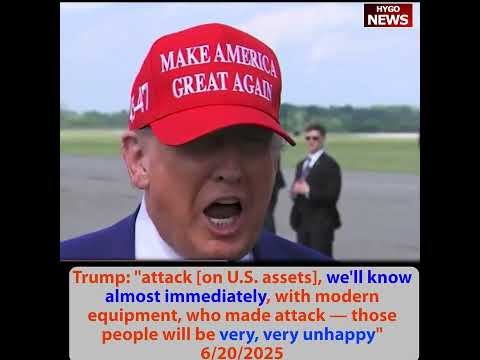
Trump: peacemaker toughness to make peace; settlement between Rwanda & Congo; Tulsi Gabard wrong
The press stakeout produced one of the most revealing exchanges of the Iran crisis when Trump was asked about the intelligence community’s assessment of Iran’s nuclear program. His response — “my intelligence community is wrong” followed by the direct identification of Director of National Intelligence Tulsi Gabbard as the specific official he was contradicting — is one of the more striking moments of public disagreement between a president and his own intelligence chief. Trump also announced that a peace settlement between Rwanda and the Congo would be signed in the coming days, crediting Vice President Vance and Secretary Rubio. He talked about India and Pakistan trade deals, the Abraham Accords, and the Serbia-Kosovo situation. He made the case that he should have received the Nobel Peace Prize “four or five times” but that the prize committee “only give it to liberals.” And he warned reporters that they were “in danger” standing with him, a blunt acknowledgment of the security environment his administration is operating in.
”My Intelligence Community Is Wrong”
The reporter’s question targeted the gap between Trump’s assertions and his DNI’s testimony. “What intelligence do you have that Iran is building a nuclear weapon? Your intelligence community has said they have no evidence that they are at this point.”
Trump’s response: “Well then my intelligence community is wrong.”
“Who in the intelligence community said that?”
Trump: “Your director of national intelligence, Tulsi Gabbard.”
Trump: “She’s wrong.”
The exchange is the clearest public disagreement between Trump and Gabbard on the Iran intelligence assessment. Trump is not claiming to have information Gabbard does not have. He is simply saying she is wrong.
What The Disagreement Means
The disagreement has to be read through the nuance that both Gabbard’s testimony and Leavitt’s subsequent clarification preserved. Gabbard’s formal March testimony was that Iran’s stockpile was at unprecedented levels for a non-nuclear state but that Iran had not made the political decision to weaponize. Trump’s assessment — that Iran “was very close” to a weapon — can be reconciled with Gabbard’s if you consider “very close” to mean “has the technical capability to weaponize rapidly once the decision is made.”
But Trump’s blunt “she’s wrong” framing does not preserve that nuance. He is publicly telling reporters that his DNI’s assessment is incorrect. The statement is unusual in American governance. Presidents typically either defend their intelligence chiefs or, in rare cases, replace them. Publicly contradicting the intelligence assessment while keeping the DNI in place is a more unusual dynamic.
Rwanda-Congo Peace Settlement
Trump then pivoted to one of the administration’s under-reported diplomatic achievements. “All about Rwanda and the Congo will be doing a peace settlement. Probably coming in on Monday or Tuesday, we’re going to be signing it up. We’ve stopped the very vicious war. So that was an honor for me to be involved.”
The Rwanda-Congo conflict has been one of the most persistent regional wars in Africa, with devastating human costs and repeated failed peace efforts. A settlement between the two governments — if it holds — would represent a significant diplomatic achievement. The administration is happy to take the credit.
Credit To Vance And Rubio
Trump’s public acknowledgment of his team was direct. “I want to thank JD Vance and for great job. And also our secretary of state Marco Rubio has done a fantastic job.”
The acknowledgment of Vance and Rubio’s work on the Rwanda-Congo negotiations is the kind of internal credit distribution that reveals how the administration is organized. Vance’s role in diplomatic negotiations is unusual for a Vice President — most VPs have focused on domestic priorities and limited foreign engagements. Trump’s willingness to deploy Vance on complicated international issues signals significant trust.
Rubio’s role as Secretary of State is unsurprising — it is the State Department’s formal responsibility — but the explicit praise is meaningful. Trump is not a leader who credits his team by default. When he does credit them, the credit carries weight.
”A Very Bloody War”
Trump’s description of the Rwanda-Congo conflict was candid. “So Rwanda, long term war with the Congo, a very bloody war. They’re all bloody, but this was a really bloody one.”
The observation — “they’re all bloody, but this was a really bloody one” — is the kind of candid assessment that Trump offers in press stakeouts. The Rwanda-Congo conflict has included episodes of genocide, mass displacement, and humanitarian catastrophe going back decades. Stopping it, or even reducing its intensity, is a substantial humanitarian win.
”He’s Going To Be Making Peace With Congo”
Trump then laid out the projected benefit. “He’s going to be making peace with Congo and they can get on to making trade deals with the United States and other places and have a much more normal form of life.”
The pairing of peace and trade is characteristic of Trump’s diplomatic framing. Peace is not just an end in itself. It is the precondition for economic engagement. Countries that resolve their conflicts can participate in global trade networks. That participation, in turn, creates the material conditions for continued peace.
India-Pakistan And The Trade Agenda
Trump continued with the regional trade roundup. “As you know, we did a very great job with India and Pakistan. And it looks like we’re going to be making a trade deal with India. And we had Pakistan in. It looks like we’re going to be making a trade deal with Pakistan. It’s a beautiful thing to watch.”
The India-Pakistan framing is remarkable. The two countries have been in a state of managed hostility for three-quarters of a century. The fact that both are simultaneously negotiating trade deals with the same American administration reflects a level of bilateral diplomatic engagement that both countries find valuable. Whether the deals ultimately close is a separate question, but the engagement itself is significant.
Serbia-Kosovo
Trump included the Balkans in his peace portfolio. “The Serbia coast of all likewise, they’ve been fighting for years. As you know, we brought that one to a conclusion.”
The Serbia-Kosovo relationship has been tense since Kosovo’s declaration of independence in 2008. Trump’s first-term diplomacy included efforts to normalize the bilateral relationship. His claim that the current administration has “brought that one to a conclusion” is characteristically expansive — the relationship remains complicated — but progress has been made.
Russia-Ukraine And Israel
Trump then turned to the unresolved conflicts. “And now we have a couple of big ones. We have Russia, Ukraine, which is making a little bit of progress. We have Israel and nobody really knows what that one is all about. We’re going to find out pretty soon, I guess.”
“Making a little bit of progress” on Russia-Ukraine is cautious framing. The administration has been trying to broker a resolution for months with limited public visibility into the terms being discussed. “Nobody really knows what that one is all about” for Israel-Iran is candid. The situation is dynamic, the factors numerous, and predictions are hard.
”We’ll Know Almost Immediately Who Made The Attack”
The reporter asked about intelligence capabilities. “If there is an attack on U.S. assets, will you promise to conduct a full investigation and make it transparent with the American people before blaming Iran for such an attack?”
Trump: “If there’s an attack, we’ll know almost immediately with modern equipment who made the attack. Those people will be very, very unhappy.”
The confidence in attribution capabilities reflects the reality of modern military and intelligence systems. The United States maintains extensive signals intelligence, satellite surveillance, and other assets that make rapid attribution of kinetic events possible. The “very, very unhappy” framing is Trump’s characteristic understatement for what amounts to a promise of military response.
The Iranian Foreign Minister’s Request
The reporter asked about a public proposal from Iran. “Mr. President, the Iranian Foreign Minister this afternoon said, if the U.S. is serious about negotiations, that you would call up Israel and request that they stop their airstrikes. Will you make that request?”
Trump’s response was diplomatically precise. “Well, I think it’s very hard to make that request right now. If somebody’s winning, it’s a little bit harder to do than if somebody’s losing. But we’re ready, willing and able, and we’ve been speaking to Iran, and we’ll see what happens."
"If Somebody’s Winning, It’s A Little Bit Harder”
Trump’s line about winning dynamics is one of the cleanest articulations of negotiation realism. Sides that are winning do not stop fighting without concession. Sides that are losing need the fighting to stop to limit their losses. A mediator asking the winning side to stop without corresponding concession from the losing side is asking for a political favor that is hard to grant.
Trump is, in effect, telling Iran that if they want Israeli strikes to stop, they need to give Israel a reason — a concession — to stop. The current Israeli posture is producing outcomes Israel considers favorable. Iran’s request that the United States ask Israel to stop without compensating concession is not going to be granted.
Matt Gaetz’s Nobel Proposal
The reporter then asked about a curious proposal. “The former congressman, Matt Gaetz, brought an interesting idea, suggesting that if you were to broker a deal where nuclear inspectors go into both Israel and Iran, that you could win a Nobel Peace Prize, and they might even rename it the Trump Peace Prize.”
Trump’s response addressed both the nuclear inspections idea and the Nobel Prize. “Well, they should give me the Nobel Prize for Rwanda. And if you look at the Congo, or you could say Serbia, Kosovo, you could say a lot of them. You could say, I mean, the big one is India, and Pakistan. I should have gotten it four or five times."
"I Should Have Gotten It Four Or Five Times”
The claim is substantial. Trump is arguing that the aggregate of his diplomatic work — Abraham Accords, Serbia-Kosovo, Rwanda-Congo, India-Pakistan, and potentially Israel-Iran — represents multiple distinct Nobel Peace Prize-worthy achievements. Whether the Nobel committee would agree is a separate question.
”They Only Give It To Liberals”
Trump’s verdict on the prize was blunt. “They won’t give me a Nobel Peace Prize because they only give it to liberals.”
The observation is not factually baseless. The Nobel Peace Prize has, in recent decades, been awarded primarily to figures associated with the political left or with international institutions. Barack Obama received it in his first year as president. Al Gore received it for climate activism. The EU received it. The bias Trump is alleging is real in the sense that prize patterns have been consistent with it.
”You Are In Danger Talking To Me”
Trump closed with a striking security observation. “We’re always concerned about that, and we have to take them out and be very strong. You’re even in danger talking to me right now. Do you know that? You are in danger talking to me right now. So I should probably get out of here, but you guys are actually in danger. Can you believe it?”
The statement is the kind of candid security acknowledgment that presidents rarely make. The implication: the president is, at any given moment, a target. Reporters standing near the president are, by proximity, also at some level of risk. The security apparatus that surrounds a modern American president is present because the threat environment is real.
Why The “In Danger” Line Matters
The “in danger” line connects to the broader context of the Iran situation. The administration has been warning that Iranian proxy networks could conduct terror attacks against American targets abroad and, potentially, domestically. Trump’s acknowledgment to reporters that they are “in danger” is not hyperbole. It is an observation about the reality of the security environment the country is operating in.
The line also functions as a political communication. Voters hearing the president say that even he and his press corps are in danger will intuit that the threat is real and that the administration’s security posture is not a performance. The security environment is the backdrop to the policy decisions being made.
Key Takeaways
- Trump contradicts his own DNI: Reporter quotes Gabbard’s assessment; Trump: “Well then my intelligence community is wrong…She’s wrong.”
- Rwanda-Congo peace settlement: “Probably coming in on Monday or Tuesday, we’re going to be signing it up. We’ve stopped the very vicious war.”
- On attribution capabilities: “If there’s an attack, we’ll know almost immediately with modern equipment who made the attack. Those people will be very, very unhappy.”
- On the Iranian request for an Israeli ceasefire: “If somebody’s winning, it’s a little bit harder to do than if somebody’s losing.”
- Trump on the Nobel Peace Prize: “I should have gotten it four or five times…They won’t give me a Nobel Peace Prize because they only give it to liberals.”