 HYGO News
 Trump Open to Congressional Stock Trading Ban; 'Ball Is in China's Court'; Nvidia to Build AI Supercomputers in US; 15+ Deals on Table
Trump Open to Congressional Stock Trading Ban; “Ball Is in China’s Court”; Nvidia to Build AI Supercomputers in US; 15+ Deals on Table
Press Secretary Karoline Leavitt covered four major topics in an April 2025 briefing. She confirmed Trump was “interested in looking at” banning members of Congress from trading stocks. On China, she read a Trump statement: “The ball is in China’s court. China needs to make a deal with us; we don’t have to make a deal with them. They need our money.” She announced “more than 15 deals, pieces of paper put on the table” from 75+ countries, with announcements coming “very soon.” And she cited Nvidia’s decision to produce AI supercomputers “entirely in the United States” as “the Trump effect” — the latest in trillions of investment commitments.
Congressional Stock Trading Ban
The most populist moment came from a direct question.
“Would the president support a ban on members of Congress trading stocks?” a reporter asked.
Leavitt’s answer was encouraging: “I’m certain that’s something the president would be interested in looking at. And I can ask him if he would support such a bill.”
The congressional stock trading issue had been one of the most bipartisan populist causes in American politics. Members of Congress — who had access to classified briefings, advance knowledge of legislation, and relationships with regulators — were permitted to trade individual stocks, creating obvious conflicts of interest. Multiple members of both parties had been caught making suspiciously well-timed trades that appeared to benefit from insider knowledge.
Trump’s openness to a trading ban signaled that the populist economic agenda extended beyond tariffs to structural reforms that affected the political class itself. If members of Congress were prohibited from trading stocks, it would remove one of the most visible forms of insider privilege that eroded public trust in government.
”The Ball Is in China’s Court”
Leavitt read a statement Trump had just given her in the Oval Office.
“The ball is in China’s court,” Trump’s statement said. “China needs to make a deal with us. We don’t have to make a deal with them.”
The key insight: “There’s no difference between China and any other country except they are much larger. And China wants what we have — what every country wants, what we have — the American consumer.”
The summary: “Or to put it another way, they need our money.”
The statement reduced the China trade war to its simplest terms. China’s economy was built on exporting goods to American consumers. Without access to the American market, Chinese factories would close, Chinese workers would lose their jobs, and the Chinese government would face domestic instability. The United States, by contrast, could source goods from dozens of other countries or — increasingly — produce them domestically.
The asymmetry meant that time was on America’s side. Every day the tariff war continued, Chinese manufacturers lost revenue while American tariff collections grew. China’s incentive to negotiate would only increase with time; America’s urgency would only decrease.
TikTok: “Two Months Is a Long Time”
Leavitt addressed the TikTok deadline with characteristic confidence.
“June 19th is a long ways away, obviously,” she said. “I think it’s two months away. Two months is a long time in the Trump administration, as you have all seen. We work at Trump speed around here. We get a lot done.”
She described the negotiation structure: “The vice president continues to lead these negotiations and talks. The president’s involved, and they’re ongoing.”
The TikTok situation remained in limbo because China’s approval was required for any deal involving the transfer of the platform’s operations. The tariff war had made every bilateral issue with China part of a larger negotiation — TikTok, trade, Taiwan, and Iran were all interconnected. Leavitt’s confidence that “a lot” could happen in two months reflected the administration’s belief that the tariff pressure would eventually force China to the table on all issues simultaneously.
”15+ Deals, Pieces of Paper on the Table”
Leavitt provided the most specific update yet on trade negotiations.
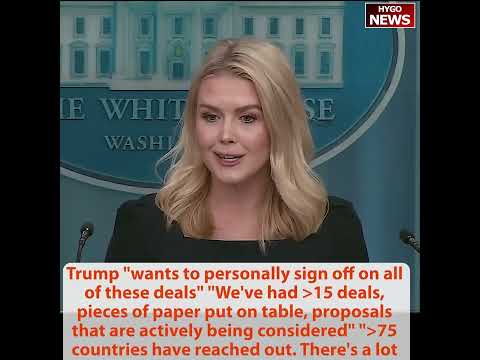
“The president’s deeply involved,” she said. “He has made it clear to his trade team he wants to personally sign off on all of these deals.”
The status: “We’ve had more than 15 deals, pieces of paper put on the table, proposals that are actively being considered.”
The scale: “As we’ve said consistently, more than 75 countries have reached out. So there’s a lot of work to do. We very much understand that, but we do believe that we can announce some deals very soon.”
The “15 deals on the table” was the first specific number the administration had provided for active negotiations. Combined with 75+ countries reaching out, the picture was of a negotiation pipeline that was producing results. The fact that Trump wanted to “personally sign off on all of these deals” suggested that the final terms would be vetted at the presidential level — ensuring that no deal was concluded that didn’t meet the administration’s standards for reducing trade deficits.
Nvidia: “The Trump Effect”
Leavitt delivered the investment announcement that demonstrated the tariff strategy’s effect on corporate decisions.
“President Trump is turning America into a manufacturing superpower again,” she said. “Yesterday there was a monumental announcement by Nvidia, one of the largest companies in the world.”
The details: “For the first time ever, chip-making giant Nvidia will produce AI supercomputers entirely in the United States, as part of its pledge to produce $500 billion worth of AI infrastructure in our country over the next four years.”
The specifics: “With their manufacturing partners, they have commissioned more than a million square feet of manufacturing space to build and test Nvidia Blackwell chips in the great state of Arizona, and AI supercomputers in the great state of Texas.”
Leavitt cited the CEO: “Nvidia’s founder and CEO Jensen Huang touted how the engines of the world’s AI infrastructure are being built in the United States for the first time.”
Her verdict: “This is the Trump effect.”
She cataloged the investment wave: “This follows trillions in other U.S. investments announced already, including $500 billion from Apple in U.S.-based manufacturing and training, $100 billion from TSMC in U.S.-based chip manufacturing, and the $500 billion private investment led by OpenAI, Oracle, and SoftBank in artificial intelligence infrastructure.”
Leavitt concluded: “Under President Trump, we’re going to produce the cars, the chips, the airplanes, minerals, and medicines that we need right here in America, at the hands of American workers.”
Key Takeaways
- Leavitt confirmed Trump is “interested in looking at” banning members of Congress from trading stocks.
- Trump statement on China: “The ball is in their court. They need our money. We don’t have to make a deal with them.”
- 15+ trade deals actively on the table from 75+ countries; announcements expected “very soon.” Trump wants to personally approve each deal.
- Nvidia will produce AI supercomputers “entirely in the United States” for the first time — $500B in AI infrastructure over four years.
- Leavitt: “This is the Trump effect” — following Apple ($500B), TSMC ($100B), and OpenAI/Oracle/SoftBank ($500B) commitments.