 HYGO News
 Trump: One gentlemen said meet in another month or two; Press Sec: Do you accept that as true?
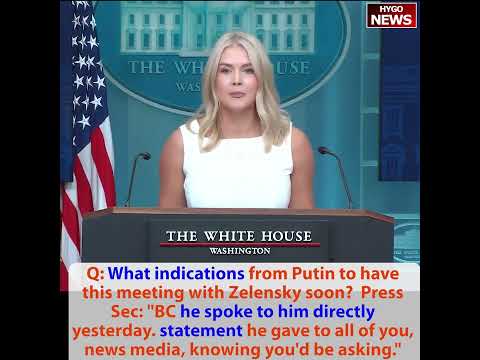
Trump: One gentlemen said meet in another month or two; Press Sec: Do you accept that as true?
Trump described a pivotal moment during the European leaders meeting — one leader suggested waiting a month or two to meet again, and Trump responded that 40,000 more people would die in that window, so he called Putin that same evening. Press Secretary Karoline Leavitt demolished media narratives about the peace process, including confirming that Putin on camera confirmed the war would not have started under Trump. Reporter Jacqui Heinrich: “Probably.” Leavitt then delivered a comprehensive critique of left-wing media rooting against the peace process. Trump: “One of the gentlemen who’s a great guy, but he said, I hope I didn’t insult him. He said, well, let’s meet in another month or two, and let’s see if we can start making some money. He said, a month or two, you’re going to have another 40,000 people dead in a month or two. You have to do it tonight. And I did actually. I called President Putin.” Leavitt: “It’s true. Do you accept that as true?” Heinrich: “Probably.” And Leavitt: “From the beginning of this entire process, much of the left-wing media has been actively rooting against the president of the United States in the pursuit of peace … This is why Americans trust in the mass media is at a lowest point in more than five decades."
"Another Month or Two”
Trump describing the specific diplomatic moment. “And one of the things at the table was one of the gentlemen who’s a great guy, but he said, I hope I didn’t insult him. He said, well, let’s meet in another month or two, and let’s see if we can start making some money.”
That is specific diplomatic friction. A European leader at the table suggested waiting a month or two before the next substantive meeting. Start making money in the interim — meaning, perhaps, resuming specific business engagement with Russia on non-war matters while larger peace deal is developed.
“I hope I didn’t insult him.” Trump’s specific politeness. He does not want to publicly embarrass the specific European leader whose suggestion he is disagreeing with.
“He said, a month or two, you’re going to have another 40,000 people dead in a month or two.”
That is Trump’s specific response. 40,000 people would die during that month or two of waiting. The war’s specific casualty rate means delay has specific lethal consequences. Not abstract delay. 40,000 specific human deaths.
”You Have to Do It Tonight”
“You have to do it tonight. And I did actually. I called President Putin and we’re trying to work out a meeting with President Zelensky.”
“Tonight.” Trump’s specific timeline. Not tomorrow. Not next week. That specific night, after the European leaders meeting. The call would happen immediately.
“I did actually. I called President Putin.” Specific action. Trump did what he said. Called Putin that night. Began working out the Zelensky meeting.
“We’ll see what happens there. And then if that works out, if it works out, then I’ll go to the trilap and close it up.”
The specific sequence. Putin call. Zelensky meeting. If Zelensky-Putin goes well, then trilateral to finalize the deal. Trump’s specific role: “close it up” — move from substantive agreement to final commitment.
”Since the President Often Says”
The briefing continued. Reporter Jacqui Heinrich asked. “Since the president often says that this war would not have started if he were in office and Putin confirmed that.”
Leavitt’s response. “It’s true. Do you accept that as true?”
That is direct challenge. Leavitt asking the reporter whether she accepts the factual claim. Putin on camera confirmed the war would not have started under Trump. Is the reporter willing to acknowledge that confirmation?
Heinrich’s response. “Probably.”
“Probably.” That is the specific reporter answer. Not “yes.” Not “certainly.” Not “I cannot evaluate.” Probably. A qualified acceptance that stops short of full endorsement.
That hesitation matters. The reporter cannot disagree with Putin’s direct confirmation. But she cannot fully accept Trump’s framing. “Probably” is the specific middle ground — acknowledging the evidence while preserving skeptical distance from Trump’s broader framework.
”The European Leaders Do”
“The European leaders do. And President Putin himself said that, by the way. He did say that.”
Leavitt’s point. European leaders accept the framing. Putin himself confirmed the framing. The reporter’s “probably” is notable specifically because every other relevant party — European leaders, Putin, Trump — has converged on the same assessment.
“He did say that.” Repetition. Putin specifically said it. On camera. In public. The factual record is clear.
”Spoke to Him Directly Yesterday”
Another reporter question. “What indications is the president getting from Putin that he wants to have this meeting with Zelensky soon?”
Leavitt’s response. “Because he spoke to him directly yesterday. And he expressed that to him rather than later. He spoke to that directly yesterday and the president put that in his statement that he gave to all of you, the news media, knowing you’d be asking following that conversation in the effort of transparency.”
Trump spoke to Putin directly yesterday. Putin expressed willingness for the Zelensky meeting soon rather than later. Trump immediately communicated that through a statement to the press corps.
“In the effort of transparency.” That is specific framing. The administration is being transparent about the diplomatic process. The press is getting information about what has been discussed directly from the principals.
”One Thing That Has Absolutely Not Changed”
Leavitt pivoting to broader media critique. “However, one thing that has absolutely not changed is the media’s negative and downright false coverage of President Trump and his foreign policy accomplishments. From the beginning of this entire process, much of the left-wing media has been actively rooting against the president of the United States in the pursuit of peace.”
“Actively rooting against” is specific language. Not merely skeptical. Not merely biased. Actively hoping the peace process fails. That is extraordinary characterization of media posture toward a major American diplomatic initiative.
“In the pursuit of peace.” That frames the conflict sharply. Media is rooting against peace because the peace would benefit Trump. Peace matters normatively — ending a war that has killed hundreds of thousands is good. Media rooting against peace because it benefits a Republican president exposes specific partisan priorities over normative concerns.
”Ridiculously Claimed”
“Initially, the media ridiculously claimed that President Trump was somehow beholden to Russia for even agreeing to have a face-to-face discussion with President Putin inside of the United States. The media said President Trump was making a grave mistake by, quote, legitimizing Putin. They were aghast that President Trump would treat another world leader like a world leader.”
The specific framings Leavitt recalls. “Beholden to Russia” — reviving Russia-collusion framing. “Legitimizing Putin” — framing normal diplomatic courtesy as legitimization. “Treat another world leader like a world leader” — framing the basic diplomatic posture Leavitt calls out.
All of those framings were specifically applied to Trump’s Alaska summit. All have been demonstrated as inadequate now that the summit produced specific diplomatic progress confirmed by European leaders and the NATO Secretary General.
”Major Defeat”
“The media relentlessly attacked President Trump and claimed he suffered a, quote, major defeat for not immediately emerging with a final agreement, even though he said heading into that meeting, this was a meeting to listen and to understand how to move the ball forward.”
The specific framing. Media characterized the Alaska summit as “major defeat” because it did not produce final agreement. But Trump himself said before the summit that it would be exploratory — listening, understanding, moving forward. Not producing immediate final agreement.
Media that demanded immediate final agreement from a first summit was applying unrealistic expectations. No major war has ended in a single summit. Peace processes require sequenced diplomatic engagement. Media framing that ignored that basic reality produced distorted coverage.
”Clueless Pundits”
“All weekend following those historic U.S.-Russia bilateral talks, we listened to clueless pundits on television trying but failing to claim that the president had failed.”
“Clueless pundits.” Leavitt’s specific characterization. Commentators without actual knowledge of the diplomacy offering confident assessments that have been specifically disproven by subsequent developments.
“The so-called experts in the foreign policy establishment whose record is nothing but endless wars, trillions of wasted taxpayer dollars, and dead Americans have the nerve to try and lecture President Trump who has solved seven global conflicts in seven months about peace.”
That is the specific comparative framing. Foreign policy establishment experts — whose record includes endless wars (Iraq, Afghanistan, Libya, Syria) and massive spending — are lecturing Trump on peace-making. But Trump has solved seven conflicts in seven months. The record comparison favors Trump overwhelmingly.
“Endless wars, trillions of wasted taxpayer dollars, and dead Americans.” The specific failures of the foreign policy establishment. Iraq War approximately $2 trillion plus 4,500 American KIA. Afghanistan approximately $2 trillion plus 2,400 American KIA. Various other operations producing limited strategic gains and substantial costs.
”Seven Global Conflicts in Seven Months”
Leavitt’s specific count. Seven global conflicts resolved in seven months. The specific list:
- India-Pakistan (May 2025)
- DRC-Rwanda
- Armenia-Azerbaijan
- Cambodia-Thailand
- Israel-Iran
- Plus two others
“This is the same president, by the way, who brokered the Abraham Accords in his first term on top of more than half a dozen other peace deals this year alone.”
The Abraham Accords (2020) under Trump’s first term. Normalization agreements between Israel and UAE, Bahrain, Sudan, Morocco. Previous administrations had not produced such agreements. Trump did.
That track record supports the specific assessment. Trump has demonstrated peace-making capacity across multiple contexts. His current Ukraine engagement is consistent with his broader record, not an anomaly.
European Leaders Flying to Washington
“We also saw yesterday the president of Ukraine and all of the other major leaders of Europe fly across the Atlantic Ocean to meet President Trump at the White House because of the progress that was made.”
The specific indication. Zelensky flew to Washington. Seven European leaders flew to Washington. That collective flight reflects specific assessment that Trump’s progress warrants their specific engagement.
“Because of the progress that was made.” If no progress had been made, European leaders would not have flown to Washington. The flight itself is evidence of progress. Media characterizing the summit as “failure” while European leaders fly to engage with the specific progress produced is self-contradictory.
“If you ask the media, failed meeting, but it was not. It was highly productive and it was successful.”
The specific juxtaposition. Media narrative: failed meeting. Reality: highly productive, successful. The gap between narrative and reality explains the trust collapse.
”Lowest Point in More Than Five Decades”
“This is why Americans trust in the mass media is at a lowest point in more than five decades. Diplomacy is a delicate process, and instead of reporting the facts about what is happening here at this White House and what is happening between this president and other leaders around the world, many outlets in this room continue to try to actively undermine the president and sabotage the efforts towards peace.”
Media trust at 50+ year low. That is factual — Gallup and other polling shows declining public trust in mass media to lowest levels in their polling history. The decline has accelerated during Trump’s presidency.
“Actively undermine the president and sabotage the efforts towards peace.” Specific framing. Media is not merely reporting facts. Media is specifically seeking to undermine Trump and sabotage peace. That characterization aligns with specific examples — the “failed meeting” framing, the “legitimizing Putin” framing, the “Russian asset” framing.
Three Distinct Elements
The specific 40,000-dead framing (urgency of peace). The Putin confirmation admission (specific reporter concession). Leavitt’s media critique (systematic bias documented with specific examples).
Each reflects specific aspects of the current political moment. Trump’s operational urgency driving the specific diplomatic tempo. European leaders and Putin confirming Trump’s specific claims. Media maintaining hostile framing despite specific factual refutation.
Key Takeaways
- Trump on the urgency: “One of the gentlemen … said, ‘Well, let’s meet in another month or two’ … I said, ‘A MONTH OR TWO? You’re going to have another 40,000 people dead in a month or two — you have to do it TONIGHT.’ And I did actually, I called President Putin.”
- The reporter concession: Leavitt: “It’s true. Do you accept that as true?” Heinrich: “Probably” — despite Putin’s on-camera confirmation and universal European leader acceptance.
- Leavitt on media posture: “From the beginning of this entire process, much of the left-wing media has been actively rooting against the president of the United States in the pursuit of peace.”
- Leavitt on establishment experts: “The so-called experts in the foreign policy establishment whose record is nothing but endless wars, trillions of wasted taxpayer dollars, and dead Americans have the nerve to try and lecture President Trump who has solved seven global conflicts in seven months about peace.”
- On trust: “This is why Americans trust in the mass media is at a lowest point in more than five decades … many outlets in this room continue to try to actively undermine the president and sabotage the efforts towards peace.”