 HYGO News
 Trump on vote be FULLY counted by 10PM; Jack Smith is a mean, nasty guy; pardoning J6 defendants
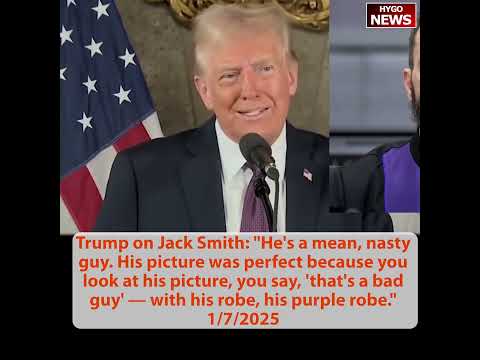
Trump on vote be FULLY counted by 10PM; Jack Smith is a mean, nasty guy; pardoning J6 defendants
During his January 7, 2025, press conference at Mar-a-Lago, President-elect Donald Trump covered a rapid-fire range of topics, from election reform to water pressure regulations to Special Counsel Jack Smith to January 6 pardons to the Panama Canal. The wide-ranging remarks provided a preview of the priorities and governing style that would characterize his second term, with Trump moving fluidly between policy commitments, personal attacks on his political opponents, and historical arguments about American infrastructure.
Election Reform: Votes Counted by 10 PM
Trump announced his intention to reform the vote-counting process, targeting what he characterized as an unacceptable delay in tallying results on election night.
“One of the things we’re going to do is we’ve got to fix the election so that we get honest counts and they get done by 10 o’clock in the evening or something thereabouts,” Trump said. “They have places where they’re still counting votes. These people are crazy. There’s something wrong with them.”
The comment reflected a longstanding grievance among Trump and his supporters about the extended counting periods that have become common in states that process mail-in ballots after polls close. In the 2020 and 2024 elections, several key swing states took days to complete their counts, creating a window of uncertainty that fueled political tensions and conspiracy theories.
Trump’s proposal to require all votes to be counted by 10 PM on election night would represent a significant change to election administration, potentially requiring states to begin processing mail-in ballots well before Election Day or to dramatically expand the resources devoted to counting on the night itself. The feasibility and legality of such a mandate, particularly given that election administration is primarily a state responsibility, would be a subject of considerable debate.
Water Pressure and Deregulation: “It’s Called Rain”
In one of the more colorful moments of the press conference, Trump revisited one of his favorite regulatory grievances: federal water efficiency standards for showerheads and faucets.
“They also want to go back to when you buy a faucet, no water comes out because they want to preserve, even in areas that have so much water you don’t know what to do,” Trump said. “It’s called rain. It comes down from heaven. They want to do no water comes out of the shower. It goes drip, drip, drip.”
Trump described the practical consequences of the regulations in characteristically vivid terms: “So what happens? You’re in the shower 10 times as long. No water comes out of the faucet. You want to wash your hands.”
He noted that he had previously rolled back such standards during his first term: “As you know, I ended that policy. You can have all the water you want. Makes no difference. It comes weird. Especially in certain areas we have so much water. We don’t know what to do with it.”
The comments signaled that the incoming administration would continue its deregulatory approach to environmental and efficiency standards, rolling back Biden-era rules that had restored or strengthened water conservation requirements.
Jack Smith: “A Mean, Nasty Guy”
Trump turned his attention to Special Counsel Jack Smith, who had brought federal charges against him related to the January 6, 2021, Capitol breach and the classified documents case. Smith had resigned before Trump took office, but the president-elect used the press conference to deliver a personal attack.
“They brought this moron out of The Hague,” Trump said, referencing Smith’s prior work at the International Criminal Court. “He’s a mean guy. He’s a mean, nasty guy.”
Trump focused on Smith’s public image: “His picture was perfect because you look at his picture, you say, ‘that’s a bad guy,’ with his robe, his purple robe. And he executes people. He shouldn’t be allowed to execute people because he’ll execute everybody. He’s a nut job.”
The comments reflected Trump’s long-running campaign to discredit the special counsel investigation by personalizing it as the work of a biased individual rather than engaging with the substance of the charges. Smith had resigned in January 2025 in accordance with longstanding DOJ policy against prosecuting a sitting president, though his final report generated additional controversy.
January 6 Pardons: “Major Pardons, Yes”
When asked directly about pardoning January 6 defendants, Trump confirmed his intentions while signaling that the scope would be broad.
“Well, we’re looking at it, and we have other people in there,” Trump said, before pivoting to a broader grievance about the FBI’s role in the events of January 6. “As you see, I guess 24 or 28 people came now from the FBI. That came out very quietly. Nobody reported it. They had people in some form related to the FBI. They had four or five people that were strongly related to the FBI. We have to find out about that.”
When pressed about whether pardons would extend to those charged with violent offenses, Trump did not draw a clear line. “People that were doing some bad things weren’t prosecuted. And people that didn’t even walk into the building are in jail right now,” he said. “So we’ll be looking at the whole thing, but I’ll be making major pardons. Yes.”
The confirmation that “major pardons” were coming represented one of the most significant policy commitments of the transition period. Hundreds of defendants had been charged in connection with January 6, with sentences ranging from probation to decades in prison for those convicted of seditious conspiracy or assaulting law enforcement.
The Panama Canal: 38,000 Lives and Unfair Treatment
Trump also returned to the subject of the Panama Canal, deploying his characteristic combination of historical narrative and grievance to build the case for renegotiating or reclaiming American interests.
“It’s the most expensive structure ever built in the history of our country, relatively,” Trump said. “It would be the equivalent of substantially over a trillion dollars today. We lost 38,000 people. Think of it. 38,000 people. They died from malaria. Mosquitoes. They were unable to stop the mosquitoes. They paid people five times more to take the job. Many of those people died.”
Trump framed the 1977 Carter-Torrijos Treaties, which transferred control of the canal to Panama, as a betrayal of that sacrifice: “We gave it away for a dollar. But the deal was that they have to treat us fairly. They don’t treat us fairly. They charge more for our ships than they charge for ships of other countries. They charge more for our Navy than they charge for navies of other countries.”
He concluded with a characterization of how Panama viewed the arrangement: “They laugh at us because they think we’re stupid. But we’re not stupid anymore.”
Key Takeaways
- Trump pledged to reform election counting so that votes are “fully counted by 10 o’clock in the evening” on Election Night, calling the current extended counting periods unacceptable.
- Trump attacked Special Counsel Jack Smith as “a mean, nasty guy” and “a nut job,” focusing on Smith’s personal image and calling him “a moron.”
- On January 6 pardons, Trump confirmed he would be “making major pardons” and raised questions about FBI involvement in the events, citing “24 or 28 people” connected to the FBI.
- Trump revisited his deregulation of water efficiency standards, mocking federal showerhead regulations with his trademark “drip, drip, drip” line and noting he had rolled back such rules in his first term.
- On the Panama Canal, Trump cited the loss of 38,000 American lives during its construction and accused Panama of charging American ships more than those of other nations, declaring “we’re not stupid anymore.”