 HYGO News
 Trump on Venezuela: discussions with Maduro; great interviews with Tucker Carlson; Marjorie Taylor
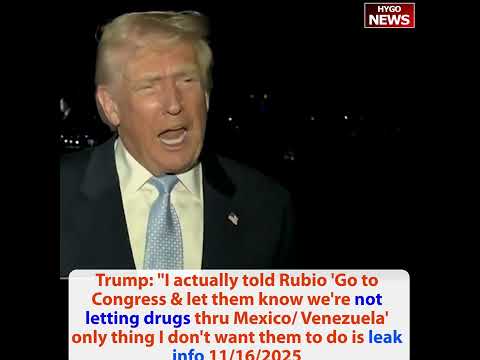
Trump on Venezuela: discussions with Maduro; great interviews with Tucker Carlson; Marjorie Taylor
Trump covered multiple topics in a free-ranging press availability. On Venezuela: discussions with Maduro may be happening, though he declined details. Trump defended Tucker Carlson’s editorial independence and noted they had great interviews together (300 million hits). Trump attacked a Bloomberg reporter for interrupting: “You are the worst. I don’t know why they even have you.” On MTG’s claim her life was in danger from Trump’s rhetoric: “Frankly, I don’t think anybody cares about her.” Trump directed Secretary Rubio to keep Congress informed about anti-drug operations through Venezuela and Mexico — without requiring congressional approval but maintaining transparency. Sen. Tim Kaine (D-VA) tried to distance himself from Schumer: “I don’t need a permission slip from you because 8.5 million Virginians gave me that permission slip in November of 2024” — despite voting in lockstep with Schumer 14 times to maintain the shutdown. A Democratic speaker claimed black people are “the most innovative people in the history of the world” who can “damn near do anything with nothing.” Trump on Maduro: “We may be discussing, we may be having some discussions with Maduro, and we’ll see how that turns out. They would like to talk.” On MTG: “Frankly, I don’t think anybody cares about her.” On Rubio directive: “Go to Congress and let them know we’re not letting drugs come through Mexico. We’re not letting them come through Venezuela.”
Tucker Carlson Defense
Trump opened by defending Tucker Carlson. “Well, I found him to be good. He said good things about me over the years. I think he’s good.”
Tucker Carlson’s relationship with Trump has been generally positive. Carlson, formerly at Fox News, now runs independent media operations with substantial audience.
“We’ve had some good interviews. I did an interview with him. We had 300 million hits. You know that.”
Trump’s Tucker Carlson interview generated 300 million views/hits across platforms. Modern political communication metric — more reach than most traditional network interviews.
“Look, I can’t tell him…”
Trump was presumably explaining that Carlson chooses his own guests. A reporter (Bloomberg) had been pressing about Tucker Carlson interviewing controversial figures.
”You Are the Worst”
“Well, you let me finish my statement. You are the worst. You’re with Bloomberg, right? You are the worst. I don’t know why they even have you.”
Trump attacked the Bloomberg reporter for interrupting. “You are the worst” — Trump’s trademark direct characterization.
“We’ve had some great interviews with Tucker Carlson, but you can’t tell him who to interview. Meeting people, talking to people like for somebody like Tucker, that’s what they do. You know, people are controversial. Some are, some aren’t.”
Trump’s framework: Tucker Carlson has editorial independence. Journalists interview controversial figures — that’s the job. You don’t dictate guest selection.
“I’m not controversial, so I like it that way.”
Trump’s trademark dry humor. He characterizes himself as “not controversial” — a joke given he’s among the most politically charged figures alive.
Dennis Waylon Confusion
“Update on Dennis Waylon, Mr. President. I’m Dennis Waylon. Update.”
The reporter asked for “update on Dennis Waylon” — Whisper rendered what was likely “Venezuela” as “Dennis Waylon.”
“No, no update on Dennis Waylon.”
Trump declining to discuss Venezuela specifics.
“We suggest the nation of that car show associated with the girls. Does that mean that the U.S. government charges the girls’ assets for infrastructure inside Dennis Waylon?”
Whisper transcription highly garbled. The reporter was asking about the “designation” of Venezuela/cartel group “as a foreign terrorist organization” and whether the U.S. would seize Venezuelan assets for infrastructure inside the U.S.
“It allows us to do that, but we haven’t said we’re going to do that.”
Trump’s answer: the designation allows asset seizure, but no decision made to exercise the authority yet.
Maduro Discussions
“We may be discussing, we may be having some discussions with Maduro, and we’ll see how that turns out. They would like, they would like to talk.”
Trump confirmed discussions with Maduro may be happening. The ambiguous “may be discussing” provides cover for whatever actual status exists.
“They would like to talk” — Venezuelan regime reaching out to U.S. The framing: Venezuela wants negotiation, U.S. has leverage.
The situation:
- U.S. has struck Venezuelan drug boats
- Tren de Aragua designated as foreign terrorist organization
- Venezuelan economy failing
- Maduro regime under pressure
“We may be discussing” leaves options open — full engagement, partial negotiation, or simply messaging.
MTG Dismissal
“Her life could be a danger because of the rhetoric. Her life is in danger? Who’s that? Harvey Taylor Green, she says. Marjorie Trader Green.”
Whisper rendered “Marjorie Taylor Greene” as “Harvey Taylor Green” and “Marjorie Trader Green.” Trump was asked about MTG’s claim that Trump’s rhetoric endangered her life.
“I don’t think her life is in danger. Frankly, I don’t think anybody cares about her.”
Trump’s dismissive response. “Nobody cares about her” — after the endorsement withdrawal — frames MTG as politically irrelevant.
The statement is a political kill shot. If nobody cares, no audience exists for her complaints, no mobilization around her. Her political career depends on being relevant. Trump declaring nobody cares directly attacks her relevance.
Rubio Congressional Outreach
“We like to keep Congress involved. I mean, we’re stopping drug dealers and drugs to come from coming into our country. And I actually told Marco and some of the people, Secretary of State, who’s doing a great job, by the way, I said, go to Congress and let them know we’re not letting drugs come through Mexico. We’re not letting them come through Venezuela and let Congress know about it.”
Trump’s direction to Rubio:
- Inform Congress about drug interdiction operations
- Through Mexico
- Through Venezuela
- Be transparent
“We don’t have to get their approval, but I think letting them know is good.”
Trump’s framework: executive has operational authority. Congressional notification is respectful but not legally required. This maintains separation of powers while building consensus.
“The only thing I don’t want them to do is leak information that’s very important and confidential and may put our military at risk or whoever is doing, you know, CIA, military, etc.”
The caveat: congressional leaks compromise operations. Trump wants transparency but not at cost of operational security. Reasonable framework — “need to know” based disclosure.
“But I did say, I said, go and see Congress, see the representatives that we’re supposed to be seeing, be open about it.”
Congressional Pushback Hypothetical
“If they say, we don’t want you to stop drugs from coming into the country, I don’t think that would be good.”
Trump’s framework: if Congress objects to drug interdiction, they’d be defending drug trafficking. Politically untenable position for any congressperson. The framing ensures congressional cooperation.
Kaine vs Schumer
Sen. Tim Kaine distanced himself from Schumer. “Did Leader Schumer give you his blessing to end the shutdown? No, he did not. He did not give the other way than I did. I understand that, but can he give you his tacit blessing? Absolutely not.”
Kaine explicitly denied Schumer approved or tacitly blessed the decision to end the shutdown. Kaine acted independently.
“But Chuck and I had a really interesting argument about an unrelated topic a couple of years ago where I was going a different direction than he was on something and he was really, really pushing me.”
Kaine established precedent for independent action from Schumer.
“And I said, Chuck, listen, my goal with you is always to inform you, but I don’t need a permission slip from you because 8.5 million Virginians gave me that permission slip in November of 2024.”
Kaine’s framework:
- Informs Schumer (respect for leader)
- Doesn’t need permission (independent mandate)
- Derives authority from Virginia voters
- 8.5 million Virginians gave him the mandate
The “permission slip” framing is politically powerful. Kaine answers to constituents, not party leadership.
The irony: Kaine voted 14 times to maintain the shutdown despite claims of independence. His actual independence on the final vote was the exception after extensive party-line voting.
”Most Innovative People”
The transcript then captured a Democratic speaker’s framework. “To go to the brothers point, the reason I was about to jump out of my chair and hug this brother is because who are the most innovative people in the history of the world? We are the most innovative, the most creative.”
The speaker (context unclear from transcript — possibly a conference or forum) declared black people “the most innovative, the most creative” in world history.
“We have done so much for so long with so little, we can damn near do anything with nothing.”
The framework: black Americans have achieved with limited resources. Extraordinary creativity and innovation under difficult conditions.
“And now you’re going to give us the most powerful creative tools ever and expect us to lose? No. No, not at all. The reality is we are most likely to dominate.”
The speaker’s framework: with AI tools now accessible, black Americans will “dominate.” The framework is race-specific.
The political framing is awkward. “Most innovative people in history” is a race-specific superlative. Historical innovators — Greek mathematicians, Renaissance inventors, Industrial Revolution engineers, Silicon Valley founders — span all backgrounds. Racial superlatives tend to irritate rather than inspire.
Significance
The day’s content:
-
Venezuela engagement possible: Trump may be negotiating with Maduro. Significant development in hemispheric politics.
-
MTG dismissed: “Nobody cares about her” ends her political relevance. Primary challenge likely coming.
-
Kaine asserting independence: “Permission slip from Virginia voters” framing positions him separately from Schumer. Could signal Kaine preparing for post-Schumer leadership.
-
Black innovation rhetoric: Race-specific superlative framing continues to characterize some Democratic rhetoric. May resonate with specific audiences but alienates others.
Trump’s handling of the Bloomberg reporter — “you are the worst” — is characteristic. Mainstream media has largely given up attempting to control Trump’s access points. Trump can afford to be rude because his base hates Bloomberg/CNN/NYT and enjoys seeing them attacked.
The Venezuela developments matter strategically. If Maduro comes to the table, potential outcomes include:
- Peaceful transition
- Drug interdiction cooperation
- Asset returns
- Venezuelan migration reversal
- Regional stability
All would be significant Trump administration wins.
Key Takeaways
- Trump on Tucker Carlson: “We’ve had some good interviews. I did an interview with him. We had 300 million hits … You can’t tell him who to interview.”
- Trump to Bloomberg reporter: “Well, you let me finish my statement. You are the worst. You’re with Bloomberg, right? You are the worst. I don’t know why they even have you.”
- Trump on Maduro: “We may be discussing, we may be having some discussions with Maduro, and we’ll see how that turns out. They would like, they would like to talk.”
- Trump on MTG: “Frankly, I don’t think anybody cares about her.”
- Trump on Rubio and Congress: “Go to Congress and let them know we’re not letting drugs come through Mexico. We’re not letting them come through Venezuela and let Congress know about it. We don’t have to get their approval, but I think letting them know is good.”
- Kaine on Schumer: “I don’t need a permission slip from you because 8.5 million Virginians gave me that permission slip in November of 2024.”