 HYGO News
 Trump on USAID: RADICAL LUNATICS, getting them out; Rubio: foreign aid policy isn't apolitical
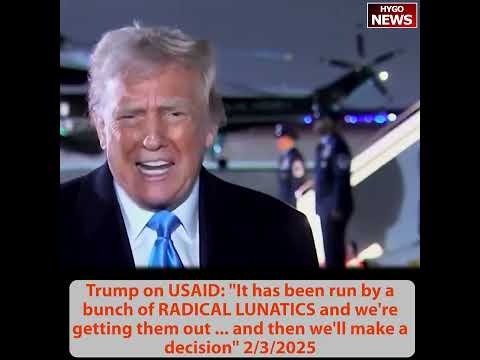
Trump Calls USAID Staff “Radical Lunatics” as Rubio Declares Foreign Aid Must Serve American Interests
In early February 2025, the Trump administration launched its most aggressive assault yet on the United States Agency for International Development, with President Trump declaring the agency had been “run by a bunch of radical lunatics” and Secretary of State Marco Rubio assuming direct control as acting director. Speaking from El Salvador, Rubio delivered a detailed and forceful case for why USAID’s longstanding culture of autonomy from presidential authority had to end — and why he believed the agency’s workforce had brought the confrontation on itself through years of insubordination.
Trump Sets the Tone
President Trump’s characterization of USAID personnel was characteristically blunt and left no room for ambiguity about the administration’s posture toward the agency.
“It has been run by a bunch of radical lunatics and we’re getting them out,” Trump said, “and then we’ll make a decision.”
The statement signaled that the administration viewed the USAID situation not as a policy disagreement to be negotiated but as an institutional problem to be solved through personnel action. The phrase “and then we’ll make a decision” suggested that the future structure and mission of USAID itself was on the table — not just the identity of the people running it.
Rubio’s Case Against USAID: Two Decades of Frustration
While Trump provided the headline, it was Rubio who provided the substantive argument. Speaking to reporters in El Salvador, the Secretary of State laid out a critique of USAID that he said predated his cabinet appointment by years.
“My frustration with USAID goes back to my time in Congress,” Rubio said. “It’s a completely unresponsive agency. It’s supposed to respond to policy directives at the State Department and it refuses to do so.”
Rubio’s framing was significant because it positioned the conflict not as a Trump-era invention but as a longstanding institutional failure that multiple administrations had struggled with. He claimed the dysfunction had persisted “for almost a quarter century and multiple administrations,” suggesting that the problem transcended partisan politics.
The core of Rubio’s complaint was straightforward: USAID, which is statutorily required to align its programs with foreign policy directives from the Secretary of State, the National Security Council, and the President, had instead operated as what Rubio called “a global charity separate from the national interest.”
The Insubordination Problem
Rubio was particularly pointed about what he described as active resistance from USAID employees to the new administration’s oversight efforts. He said staff had been “unwilling to cooperate with people who are asking simple questions about what does this program do, who gets the money, who are our contractors, who’s funded.”
“That sort of level of insubordination makes it impossible to conduct the sort of mature and serious review that I think foreign aid writ large should have,” Rubio said.
The characterization of USAID resistance as “insubordination” rather than mere bureaucratic inertia was deliberate. It implied that employees were not simply slow to respond but were actively obstructing lawful oversight by political appointees who had been confirmed by the Senate and authorized by the President.
Rubio expanded on this point by noting that the problem extended beyond Washington headquarters. “If you go to mission after mission and embassy after embassy around the world, you will often find that in many cases USAID is involved in programs that run counter to what we’re trying to do in our national strategy with that country or with that region,” he said. “That cannot continue."
"Taxpayer Dollars, Not Donor Dollars”
The rhetorical centerpiece of Rubio’s remarks was his distinction between taxpayer funding and private charity — a framing designed to undercut the argument that foreign aid should operate on its own principles, independent of political direction.
“These are not donor dollars. These are taxpayer dollars, and we owe the American people the assurances that every dollar we are spending abroad is being spent on something that furthers our national interest,” Rubio stated.
He drove the point further when asked about Elon Musk’s characterization of USAID as a “terrorist organization.” Rather than endorsing or rejecting the inflammatory label, Rubio pivoted to his core argument about accountability.
“American foreign policy isn’t apolitical,” he said. “American foreign policy is to further the interests of the United States. If someone wants to spend apolitical dollars, they should spend private dollars. Go start a charity and you can fund anyone you want. But if you’re going to spend taxpayer money, then you need to spend it in furtherance of the national interests of the United States.”
The statement represented a direct rejection of the institutional culture that USAID had cultivated over decades — one in which career development professionals viewed their work as fundamentally humanitarian rather than geopolitical, and resisted attempts by political appointees to redirect programs toward strategic objectives.
Congressional Stonewalling
Rubio also drew on his experience as a senator to illustrate the depth of the problem. He described attempting to exercise basic congressional oversight of USAID programs and being rebuffed.
“We would ask them questions — who does this program fund, who gets the money — we won’t tell you, don’t need to tell you, we’re apolitical,” Rubio recalled. The claim that a taxpayer-funded agency told elected members of Congress that it did not need to answer their questions about how public money was being spent is, if accurate, an extraordinary assertion of bureaucratic autonomy.
Rubio characterized this posture as fundamentally incompatible with democratic governance. “That’s exactly what I said at my confirmation hearing. And this is not my frustration. This frustration has existed now for almost a quarter century and multiple administrations that have gone through this challenge. It’s going to stop and it’s going to end.”
The Structural Takeover
The practical dimension of the administration’s move was Rubio’s assumption of the role of acting director of USAID, effectively placing the agency under direct State Department control.
“I’m the acting director of USAID. I’ve delegated that authority to someone, but I stay in touch with him,” Rubio said. The move bypassed the traditional independent leadership structure of USAID and placed its operations under the authority of a Senate-confirmed cabinet secretary who had made clear that alignment with national strategy was non-negotiable.
The decision to have the Secretary of State personally take the reins, even nominally, sent a signal that the administration viewed USAID reform not as a secondary administrative matter but as a foreign policy priority of the highest order.
The Broader Implications for Foreign Aid
The Trump administration’s confrontation with USAID represented the most significant challenge to the American foreign aid establishment in decades. The agency, which administered tens of billions of dollars annually in programs spanning global health, food security, democracy promotion, and disaster relief, had long operated with a degree of independence that its defenders viewed as essential to effective development work and its critics viewed as unaccountable empire-building.
Rubio’s argument — that every dollar must demonstrably serve American national interests — raised fundamental questions about programs that had been justified on humanitarian or developmental grounds rather than strategic ones. Whether the resulting realignment would produce a more effective foreign aid apparatus or simply dismantle one of America’s primary tools of soft power remained an open question, but the administration’s direction was unmistakable.
Key Takeaways
- President Trump called USAID leadership “radical lunatics” and said the administration was “getting them out,” signaling personnel-level action rather than mere policy reform.
- Secretary of State Marco Rubio assumed the role of acting USAID director, placing the agency under direct State Department authority for the first time in its modern history.
- Rubio said his frustration with USAID “goes back to my time in Congress” and described the agency as “completely unresponsive” to policy directives, with staff who “simply refused to cooperate” with oversight requests.
- Rubio drew a sharp line between taxpayer-funded foreign aid and private charity, stating that “American foreign policy isn’t apolitical” and that anyone wanting to spend “apolitical dollars” should “go start a charity.”
- The confrontation was framed as the culmination of “almost a quarter century” of failed reform attempts across multiple administrations, not as a uniquely Trump-era initiative.