 HYGO News
 Trump: 'Very Close' to Ukraine Minerals Deal; $350B Was Biden's Fault; 'We're Winning Too Much, Sir!'
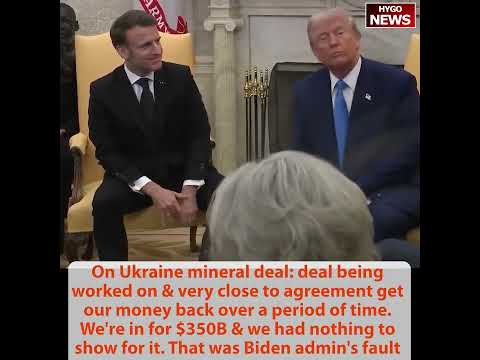
Trump: “Very Close” to Ukraine Minerals Deal; $350B Was Biden’s Fault; “We’re Winning Too Much, Sir!”
On the day of his summit with French President Macron in February 2025, President Trump provided the most detailed update yet on the Ukraine minerals deal, saying “we’re getting very close to getting an agreement where we get our money back over a period of time” and quantifying total American spending on Ukraine at “$350 billion.” Treasury Secretary Scott Bessent confirmed from the room that the deal was “very close.” Trump blamed the Biden administration for the spending, praised Europeans for acknowledging the burden-sharing imbalance, greeted Macron warmly in the Oval Office, and closed the day with his signature “winning” riff that brought down the house.
”$350 Billion — Biden’s Fault”
Trump framed the minerals deal in the context of the enormous financial commitment the United States had made to Ukraine under Biden.
“It looks like we’re getting very close,” Trump began. “The deal is being worked on, and we’re getting very close to getting an agreement where we get our money back over a period of time.”
He emphasized the mutual benefit: “It also gives us something where I think it’s very beneficial to their economy, to them as a country.”
Then he provided the number that quantified the stakes. “But we’re in for $350 billion. How we got there, I don’t know, but that’s a lot of money,” Trump said. “A lot of money invested, and we had nothing to show for it.”
He placed the blame squarely: “It was the Biden administration’s fault.”
The $350 billion figure was Trump’s most specific estimate of total American spending on the Ukraine conflict, encompassing military aid, economic assistance, and other support. The characterization of it as “nothing to show for it” reflected the administration’s view that the Biden approach had spent enormous sums without achieving a diplomatic resolution, recovering economic value, or establishing a framework for ending the conflict.
Europeans: “Great on This Issue”
In a departure from his typical criticism of European allies for under-contributing, Trump praised the European response to the burden-sharing conversation.
“The Europeans are in for about $100 billion, and they do it in the form of a loan,” Trump noted, reiterating the structural difference between American grants and European loans.
But then he offered an olive branch: “The Europeans have been great on this issue. They understood it wasn’t fair, and we were able to work something out.”
The praise suggested that behind-the-scenes negotiations had produced an agreement in which European nations would increase their share of the financial burden. Trump’s willingness to publicly credit the Europeans was notable given his previous sharp criticisms — it signaled that cooperation was being rewarded with public acknowledgment.
Bessent Confirms: “Very Close”
Trump turned to Treasury Secretary Scott Bessent, who was present in the room, for confirmation of the deal’s status.
“With the Ukrainians, I think I can say that we’re very close,” Trump said. “Scott’s around here someplace, and I think we can say that we’re very high, Scott. Do you have something to say about that, Scott?”
Bessent confirmed: “We are very close.”
Trump quipped: “Good. One yard line.”
The football metaphor — being on the one-yard line — conveyed that the deal was essentially done except for final details. Bessent’s direct confirmation from the room lent credibility to Trump’s optimism; this was not campaign rhetoric but a Cabinet-level assessment of active negotiations.
The minerals deal would give the United States equity stakes in Ukraine’s vast reserves of rare earth elements, lithium, titanium, and other critical minerals. In exchange, Ukraine would receive American investment in developing those resources and a long-term economic partnership that provided both revenue and an implicit security guarantee. The framework was designed to transform the Ukraine relationship from one of donor and recipient to one of business partners with mutual interests.
Macron in the Oval Office
Trump greeted Macron in the Oval Office before their working lunch, offering warm remarks about the alliance.
“Today is a big day in that we had a G7, and President Macron was a very special man in my book,” Trump said. “We were together. We did it together. And I think a lot of progress has been made.”
He summarized the diplomatic trajectory: “We’ve had some very good talks with Russia. We’ve had some very good talks with others, and we’re trying to get the war ended with Russia and Ukraine. And I think we’ve come a long way in a short period of weeks, and the President’s been very helpful also.”
Trump noted that the agenda extended beyond Ukraine: “We’re also talking about trade, various trade deals that we will be doing with France.”
He concluded with the personal warmth that characterized his relationship with Macron despite their policy differences: “The relationship’s been very special with France and very special with this gentleman on my right. And we look forward to keeping that going for a long period of time.”
The Oval Office meeting was followed by a working lunch with the full French delegation, setting the stage for the joint press conference later in the day. The diplomatic choreography — G7 call in the morning, bilateral meeting, lunch, press conference — demonstrated the intensity of the administration’s engagement with European allies on the Ukraine peace process.
”We’re Winning Too Much, Sir!”
Trump closed the day’s events with the signature riff that had been a crowd favorite since his 2016 campaign and that had evolved into a second-term victory lap.
“They’re going to come and say to me, ‘Sir, sir, we’re winning too much, sir. We can’t take it anymore. We have to stop winning, sir. We can’t do it. We’re not used to winning in our country,’” Trump said, performing the scene with the theatrical flair that his audiences loved.
He continued the role-play: “And each one of them is going to say, every single one, ‘Sir, please, please, you’re destroying our country. We’re winning too much. Our country isn’t prepared for this. They’re not used to winning, sir.’”
Trump delivered the punch line: “And I’ll say, ‘No, no, Linda and everybody, we’re not going to stop winning. The people of our country want us to keep on winning, and we’re going to go win like never, ever before.’”
The “winning too much” bit was more than entertainment. It functioned as a statement of philosophy: the administration would not moderate its pace, its ambitions, or its confrontational style in response to criticism. The message to supporters was that the aggressive approach they had voted for was producing results, and the administration would not dial it back regardless of the opposition it generated.
The inclusion of a specific name — “Linda” — personalized the monologue and was likely a reference to a cabinet member or adviser present in the room, adding a spontaneous quality to what was otherwise a well-rehearsed routine.
Key Takeaways
- Trump said the Ukraine minerals deal was “very close,” with Treasury Secretary Bessent confirming from the room. Trump compared the status to being on the “one-yard line.”
- He quantified total U.S. spending on Ukraine at $350 billion, calling it “Biden’s fault” and saying “we had nothing to show for it.”
- Trump praised Europeans for being “great on this issue” of burden-sharing, saying “they understood it wasn’t fair and we were able to work something out.”
- He greeted Macron warmly in the Oval Office, crediting the French president for being “very helpful” on Ukraine and discussing trade deals between the two nations.
- Trump closed with his signature “winning too much” riff, promising supporters “we’re not going to stop winning.”