 HYGO News
 Trump: Corporate Tax Cut '40% to 21% to 15% -- IF Made in USA'; 100% Expensing Retroactive to Jan 20; GE Aerospace: $1 Billion This Year
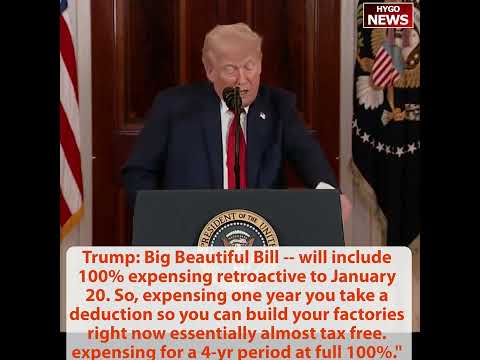
Trump: Corporate Tax Cut “40% to 21% to 15% — IF Made in USA”; 100% Expensing Retroactive to Jan 20; GE Aerospace: $1 Billion This Year
President Trump announced the centerpiece of the Big Beautiful Bill’s business provisions at a White House manufacturing event in May 2025: a corporate tax rate of 15% for companies that build in America. “We cut your taxes from almost 40% down to 21%,” Trump said. “Now, we’re bringing your taxes down from 21% to 15% — IF you build your product, make your product in the USA. The lowest scale for a large country, by far.” He also revealed 100% expensing retroactive to January 20: “You can build your factories right now, essentially almost tax-free. Four years at full 100%.” GE Aerospace CEO Lawrence Culp announced $1 billion in investment “across 16 states” and described the F-110 engine powering 70% of the Air Force’s newest F-15s and F-16s.
”40% to 21% to 15%”
Trump traced the arc of corporate tax reform across his two terms.
“We cut your taxes from almost 40% down to 21%,” Trump said, referencing the 2017 Tax Cuts and Jobs Act.
He announced the next step: “Now we’re bringing your taxes down from 21% to 15%. If you build your product, make your product in the USA.”
He described the result: “So if you make it in the USA, those chips, those beautiful chips, you’re going to be all the way down to 15%.”
He assessed the competitive position: “I think there’s never been anything like it. So now we’re at the lowest scale for a large country, by far the lowest scale.”
The 15% conditional corporate tax rate was the most significant business tax incentive in American history. By conditioning the lowest rate on domestic manufacturing, Trump created a two-tier system: companies that built in America paid 15%, while companies that manufactured abroad and imported into the United States paid 21% plus tariffs. The gap between the two rates made the economic case for domestic manufacturing overwhelming.
The progression from 40% to 21% to 15% told the story of Trump’s reshoring strategy in three numbers. Under Obama, America had one of the highest corporate tax rates in the developed world — making it more expensive to operate a business in America than in almost any other country. Trump’s first-term cut to 21% made America competitive. The second-term cut to 15% for domestic manufacturers made America the most attractive manufacturing location in the world.
”100% Expensing — Retroactive”
Trump described the capital investment incentive that would accelerate factory construction.
“Our Big Beautiful Bill will include 100% expensing retroactive to January 20th,” Trump announced. “So that’s all the way back to just about the beginning of the year.”
He explained the mechanism: “Expensing — one year you take a deduction so you can build your factories right now, essentially almost tax-free if you think about it.”
He contrasted with his first term: “Last time we made it one year, and you had the deductions going from 100% to 80% to 60% to 40% to 20% to zippo.”
He described the improvement: “Now what we’re going to do is keep it at that level. We’re going to have it for four years.”
He cited the first-term result: “I believe that was one of the reasons that we had such unbelievable growth.”
The 100% expensing provision was a factory-building accelerant. Normally, when a company built a factory, it deducted the cost over decades through depreciation. With 100% expensing, the entire cost could be deducted in the year it was spent — meaning the government effectively subsidized factory construction through tax savings.
Making it retroactive to January 20 meant that every factory investment made since inauguration day qualified. Companies that had committed billions in the first 100 days — TSMC, Samsung, NVIDIA, and dozens of others — could immediately deduct those investments from their tax bills. The retroactivity rewarded early movers and encouraged others to commit quickly.
The four-year extension at 100% was a critical improvement over the first-term version, which had phased down from 100% to zero over five years. The declining schedule had created a rush to invest in the first year followed by a slowdown as the benefit diminished. Four years at full 100% gave companies a stable planning horizon for major capital projects that often took years to complete.
Repatriation Redux
Trump recalled the first-term success in bringing corporate money back to America.
“We allowed you to bring money back from outside of the country,” Trump said. “It was impossible. You had to have 15 different law firms representing you. So complicated.”
He described the old regime: “The tax rate was 65%.”
He explained the reform: “I lowered the rate substantially, still a lot. We shouldn’t hold your money hostage.”
He cited the result: “We took in trillions of dollars. Apple brought in a tremendous amount. A lot of the companies here brought in a lot of money.”
The first-term repatriation had been one of the most successful corporate tax provisions in history. American companies had accumulated trillions of dollars overseas because the tax cost of bringing it home was prohibitive. By creating a one-time repatriation pathway at reduced rates, Trump had unlocked capital that funded domestic investment, share buybacks, and dividend payments.
”Tariff Rate Is Zero”
Trump stated the ultimate incentive in its simplest form.
“The businesses represented today clearly understand that if you build your factory in the United States, your tariff rate is zero. Zero.”
The three-part incentive structure was now complete: 15% corporate tax rate for domestic manufacturers, 100% expensing for four years on capital investment, and zero tariffs on domestically produced goods. The combined effect made building in America not just competitive but overwhelmingly advantageous compared to any alternative.
GE Aerospace: “$1 Billion This Year”
GE Aerospace CEO Lawrence Culp provided the corporate response.
“It’s an honor to be here representing all of my colleagues at GE Aerospace,” Culp said. “We are today 125 years old, but we are inventing the future of flight.”
He described the company’s footprint: “We power three-quarters of the world’s commercial airlines and nearly two-thirds of the U.S. military combat jets and helicopters.”
He connected to Trump’s Michigan visit: “The F-110 powers 70% of the newest Air Force F-15s and the F-16s. This is the engine that will be under wing on the F-15EX Eagle II that the Michigan Air National Guard will soon be flying.”
He announced the investment: “We’re investing a billion dollars this year, as the president said, across 16 states, not only in our manufacturing footprint, but with so many of the small and mid-sized businesses that constitute our supply chain.”
He thanked the president: “Thank you for what you’re doing, not only to revitalize U.S. manufacturing, but helping ensure that the U.S. aerospace industry, one of our biggest net exporters, continues to lead the world in innovation.”
Key Takeaways
- Trump announced 15% corporate tax rate for companies manufacturing in the USA — down from 40% (Obama) to 21% (Trump 1st term) to 15% (conditional on domestic production).
- 100% expensing retroactive to January 20, extended for four years at full 100% — “build factories essentially tax-free.”
- Zero tariff for domestically produced goods: “If you build your factory in the United States, your tariff rate is zero.”
- GE Aerospace CEO: $1 billion investment across 16 states; company powers 75% of commercial airlines and 65% of U.S. military jets.
- Trump: “The lowest scale for a large country, by far. There’s never been anything like it.”