 HYGO News
 Trump on tariffs pay down debt, lot of money coming in; nuclear submarines face Russia; Dem on BBB
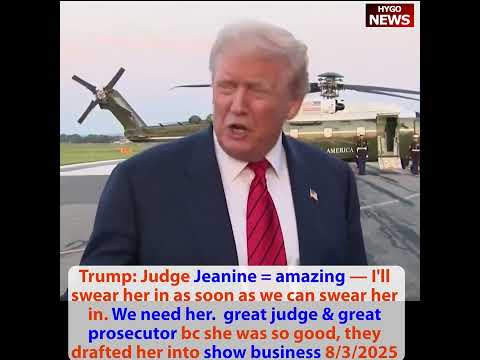
Trump on tariffs pay down debt, lot of money coming in; nuclear submarines face Russia; Dem on BBB
Five distinct items from a press cycle. Trump on tariff revenue: “We’re going to pay down debt. We have a lot of money coming in — much more money than the country’s ever seen, by hundreds of billions of dollars … we should’ve done this many years ago.” Asked whether the two U.S. nuclear submarines had been deployed in response to the Russia nuclear threat, Trump confirmed: “They are in the region, yeah — where they have to be.” On Russia avoiding sanctions: “Get a deal where people stop getting killed.” NEC Director Kevin Hassett sharply rebutted an Andrew Ross Sorkin line about him not having a role at the Fed — “I’m sure POTUS Trump is going to rush out to fire me today because he has such high regard for Chuck Schumer.” And Rep. Hakeem Jeffries continued to characterize the One Big Beautiful Bill as stealing “food from the mouths of children” — while the bill in fact provides historic middle-class tax relief and maintains food-security protections for vulnerable populations.
”Pay Down Debt”
Trump on the use of tariff revenue. “We’re going to pay down debt. We have a lot of money coming in — much more money than the country’s ever seen, by hundreds of billions of dollars.”
That is the specific commitment. Tariff revenue flowing into the Treasury will be directed toward reducing federal debt. Not toward new spending. Not toward tax refunds (though a rebate has been considered). Toward debt paydown.
“Much more money than the country’s ever seen, by hundreds of billions of dollars.” The tariff revenue is entering the Treasury at rates that dwarf any previous tariff-revenue period in American history. $300-700 billion annualized is the scale Lutnick has projected. That is new money.
“We should’ve done this many years ago.”
The counterfactual. If tariffs had been imposed decades earlier, the U.S. would have collected substantial revenue, slowed manufacturing offshoring, and strengthened the domestic industrial base. The failure to do so — across multiple administrations of both parties — produced the current situation. Trump is, in effect, catching up on missed revenue.
”They Are in the Region”
The reporter’s direct question. “Have those nuclear submarines been deployed yet to face Russia?”
Trump’s answer. “They are in the region, yeah — where they have to be.”
“In the region.” That is the specific geographic confirmation. The two nuclear submarines Trump mentioned in the earlier segment are now in position within the region where a Russian nuclear threat originated. That region is presumably the North Atlantic, Arctic, or adjacent waters where Russian submarines and nuclear assets also operate.
“Where they have to be.” That is the strategic logic. Submarines position to respond to specific threats. If Russia threatens, U.S. submarines position to respond. The Medvedev rhetoric triggered the repositioning. The submarines are now positioned.
”Get a Deal Where People Stop Getting Killed”
The follow-up question. “Is there anything [Russia] can do to avoid sanctions at this point?”
Trump’s answer. “Yeah, get a deal where people stop getting killed.”
That is the ceasefire framework. Russia avoids the secondary tariffs (and other potential sanctions) by accepting a deal that ends the Ukraine war. The deal doesn’t have to be favorable to Russia in all dimensions. It has to stop the killing.
“Get a deal where people stop getting killed” is also Trump’s general theory of war termination. The specific terms matter less than the cessation of active hostilities. A ceasefire that holds is better than a perfect diplomatic agreement that never gets implemented.
For Russia, the choice is clear. Continue the war and face secondary tariffs plus the ongoing international isolation. Or accept a deal and preserve economic relationships. Trump is presenting the option.
Hassett on Sorkin
NEC Director Kevin Hassett had a sharp exchange with CNBC’s Andrew Ross Sorkin. Sorkin: “Interestingly, you don’t have a role at the Fed, but that’s a separate matter.”
Sorkin’s comment is pointed. Hassett has been mentioned as a potential Fed chair replacement when Powell’s term ends in May 2026. Sorkin is implicitly noting that Hassett currently does not have that role — a small dig.
Hassett’s response. “Yeah… I’m sure POTUS Trump is going to rush out to fire me today because he has such high regard for Chuck Schumer.”
That is Hassett deploying sarcasm effectively. Sorkin’s implication — that Hassett’s Fed prospects are complicated — gets the sarcastic counter. The reference to Schumer is the barb. Democrats like Schumer would prefer Hassett not have a Fed role. Sorkin’s framing aligns with that Democratic preference. Hassett is calling out the alignment.
“Because he has such high regard for Chuck Schumer.” The clear sarcasm is that Trump has very low regard for Schumer. If Trump’s decisions were driven by Schumer’s preferences, Hassett would indeed be fired. Since Trump’s decisions are not driven by Schumer’s preferences, Hassett is safe in his current role — and potentially on track for the Fed chair position despite Sorkin’s framing.
Jeffries on the Big Beautiful Bill
Rep. Hakeem Jeffries continued the Democratic framing of the OBBB. The bill, per Jeffries, is a “tax cut for billionaires that steals food from the mouths of children.”
That is the Democratic caricature. The characterization has been repeated across multiple Democratic voices. The specific framing: the bill benefits the wealthy while harming the vulnerable.
The factual basis of the Jeffries framing is weak. The OBBB’s core provisions are:
- Extension of the 2017 tax cuts for all income brackets (including middle-class protection)
- No Tax on Tips (benefits service workers)
- No Tax on Overtime (benefits hourly workers)
- No Tax on Social Security (benefits retirees)
- Enhanced child tax credit (benefits families with children)
- Senior deduction expansion ($6,000 individual, $12,000 couples)
- Trump Accounts ($1,000 for every newborn)
- SNAP work requirements that exempt children, seniors, disabled Americans, and mothers with children
That package does not “steal food from the mouths of children.” It enhances benefits for children’s families (through child tax credits, senior protections for grandparents, tip and overtime tax elimination for working parents). The SNAP work requirements apply only to able-bodied adults without dependent children.
For Jeffries to continue characterizing the bill as stealing food from children after the bill’s specific provisions are documented requires either intentional misrepresentation or a framework in which any reduction to Biden-era spending levels counts as stealing from children regardless of actual impact on children.
”Historic Tax Relief”
The counter-framing from the administration. The OBBB provides “historic tax relief for working and middle class Americans and PROTECTS food for our vulnerable.”
“Historic tax relief” is documented. The $13,000 average tax savings for typical families that Speaker Johnson cited earlier. The multiple provisions targeting specific middle-class categories (tips, overtime, Social Security, child tax credit).
“Protects food for our vulnerable.” The SNAP program continues. Food assistance to children, seniors, disabled Americans, and mothers with children continues. The work requirements target only the specific category of able-bodied adults who could work but do not.
Whether the Jeffries or the administration framing resonates with voters depends on which voters hear which framing and how the specific provisions affect their lives. For a retiree who benefits from the senior deduction, Jeffries’s characterization is irrelevant. For a service worker whose tip income is no longer taxed, Jeffries’s characterization is incorrect. For a family whose child tax credit increased, the bill helps rather than harms.
Five Items, One Frame
Debt paydown from tariffs. Nuclear submarines positioned against Russia. Russia’s avoid-sanctions option is ceasefire. Hassett defending his position with Sorkin. Jeffries continuing Democratic misrepresentation of the Big Beautiful Bill.
The common thread: the administration is executing on multiple fronts simultaneously. Fiscal (tariff revenue to debt reduction). Military (submarine positioning). Diplomatic (Russia ceasefire pressure). Personnel (Hassett stability signaling). Policy communication (pushing back on Jeffries framings).
Each thread contributes to the broader narrative. Tariffs are producing revenue that is strengthening the fiscal position. Military posture is calibrated to specific threats. Diplomacy is using leverage to pursue peace. Senior personnel are stable and aligned. Opposition attacks are being consistently rebutted with specific facts.
The Hassett-Sorkin Dynamic
The Hassett-Sorkin exchange is worth noting as a micro-example of the broader media-administration dynamic. Sorkin, as a CNBC anchor, has specific editorial framing. Hassett, as NEC director, has specific policy positions. When they engage, Sorkin’s framing operates as subtle editorial commentary (e.g., “you don’t have a role at the Fed”). Hassett’s response — sharp, sarcastic, attributing the framing to its political source (Schumer) — rebuts effectively.
That kind of exchange is happening daily across business and political media. The administration’s senior officials are increasingly willing to push back against framings they consider editorially loaded. That pushback changes the rhetorical environment. Journalists who expect cooperative Q&A instead get pointed counter-framings. The media product that emerges has more edge, more visible tension, and more honest representation of the actual policy positions.
Key Takeaways
- Trump on tariff revenue direction: “We’re going to pay down debt. We have a lot of money coming in — much more money than the country’s ever seen, by hundreds of billions of dollars.”
- Asked if the two nuclear submarines had been deployed to face Russia: “They are in the region, yeah — where they have to be.”
- On Russia avoiding sanctions: “Get a deal where people stop getting killed.”
- NEC Director Kevin Hassett rebuffed Andrew Ross Sorkin: “I’m sure POTUS Trump is going to rush out to fire me today because he has such high regard for Chuck Schumer.”
- Rep. Hakeem Jeffries continued characterizing the One Big Beautiful Bill as a “tax cut for billionaires that steals food from the mouths of children” — despite the bill providing historic middle-class relief and protecting food assistance for vulnerable populations.