 HYGO News
 Trump on Sovereign Wealth Fund: 'Pay Off Debt First, Then Do the Fund'; Announces F-55 with Two Engines, F-22 Super; Military Pay Raises
Trump on Sovereign Wealth Fund: “Pay Off Debt First, Then Do the Fund”; Announces F-55 with Two Engines, F-22 Super; Military Pay Raises
President Trump delivered a wide-ranging address to troops in May 2025, touching on fiscal policy, military modernization, and compensation. On sovereign wealth funds: “I want to make a lot of money, pay off debt, and then you do a fund. These people have no debt. I’d rather pay the debt off and then do the fund after debt’s paid off.” He announced new aircraft programs: “We’re doing an F-35 upgrade, but also an F-55 — it’ll be two engines because F-35 has a single engine. I don’t like single engines. And then we’re going to do an F-22 Super — the most beautiful fighter jet in the world.” On pay: “My 2026 budget includes across-the-board substantial pay raises for each and every one of you. I will always fulfill my duty to you."
"Pay Off Debt First”
Trump explained his fiscal philosophy on sovereign wealth funds.
“Howard likes the idea,” Trump said, referring to Commerce Secretary Lutnick. “I want to really make a lot of money, pay off debt, and then you do it to fund.”
He described the Gulf state model: “These people have no debt. It’s nice to have a fund.”
He explained his preference: “I say to Howard, we’re a little early because we have debt. Really, it sounds like a lot, but relative to the kind of income and everything that we have, it’s not really that much. But it’s still a lot.”
He stated the principle: “I’d rather pay the debt off and then do the fund after the debt’s paid off, to me. The fund is just paying off debt.”
He cited the fiscal turnaround: “We’re making a lot of money. We had a situation six months ago. We were losing $5 billion a day on trade. Now we’re making money on trade.”
He described the China situation: “Don’t forget, we were losing a trillion dollars to China. So we essentially went cold turkey with China for a period of a month. Therefore, we weren’t losing a trillion dollars.”
The sovereign wealth fund question had been a recurring policy discussion. Gulf states like Saudi Arabia and Qatar had built massive sovereign wealth funds from oil revenues — pools of capital that could be invested globally to generate returns for their citizens. Some advisers had suggested the United States establish a similar fund, pooling tariff revenue and other receipts into an investment vehicle that could generate long-term returns.
Trump’s response was fiscally conservative in a way that surprised some observers. Gulf states had the luxury of sovereign wealth funds because they had minimal debt. The United States, with approximately $36 trillion in national debt, was in a different position. Every dollar going to a wealth fund was a dollar not going toward debt reduction — meaning interest costs would continue accumulating at rates that dwarfed potential investment returns.
The logic was straightforward. If the debt carried a 4% interest rate and the wealth fund generated 6% returns, the net gain was only 2%. But using the same dollar to pay down debt eliminated the 4% interest cost entirely — a risk-free return. For a country as indebted as the United States, debt reduction was the smartest use of marginal dollars until the debt was substantially reduced.
”Cold Turkey with China”
Trump’s “cold turkey” description of U.S.-China trade during the 145% tariff period was striking.
The phrase captured what had actually happened. For approximately one month, the 145% tariff rate had effectively eliminated U.S.-China trade. Goods that had flowed in both directions stopped flowing. The trade deficit — which had been running at approximately $500 billion annually with China alone — dropped to near zero because there was virtually no trade to generate a deficit.
From a pure deficit-reduction perspective, this was a victory. The United States stopped “losing a trillion dollars” in the sense that the trade deficit collapsed. But the cost was substantial disruption to supply chains, consumer prices, and business planning. Companies dependent on Chinese inputs scrambled to find alternatives. Consumers faced shortages or higher prices on Chinese-made products.
The subsequent Geneva agreement that reduced tariffs to 10% for 90 days represented a calibration. The 145% rate had been too high to sustain; the relief to 10% allowed trade to resume while preserving the ability to escalate if negotiations failed. The “cold turkey” month had demonstrated American willingness to endure economic pain to force Chinese concessions — leverage that continued even at lower tariff levels.
F-55: “Two Engines”
Trump announced a new fighter aircraft program.
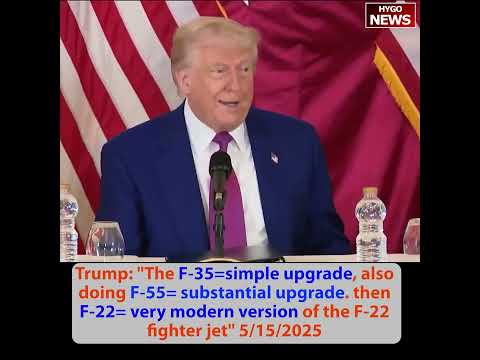
“One of the things for the people that are interested in the military that I asked to look into — the F-35,” Trump said. “We’re doing an upgrade, a simple upgrade, but we’re also doing an F-55.”
He explained the distinction: “It’s going to be a substantial upgrade, but it’s going to be also with two engines because an F-35 has a single engine.”
He stated his preference: “I don’t like single engines. Even this man, he’s the best in the world at engines.”
He explained his reasoning: “But on occasion — I know you won’t admit this — if an engine goes out, it’s nice to have two, three, or four. That’s why I like the 747. It’s got four.”
He acknowledged the countervailing logic: “But today they’re getting very big and it’s a little more cost saving to have two very, very big ones.”
He addressed potential objections: “But no matter how good — you know, they tell me, Larry, the engine will never go out. Well, I think it goes out on occasion. Very rarely.”
He described the procurement: “And we’re going to do an F-55. I think if we get the right price, we have to get the right price. And that’ll be two engines and a super upgrade on the F-35.”
The single-engine versus two-engine debate was genuine in aviation. The F-35 Lightning II used a single Pratt & Whitney F135 engine, while aircraft like the F-15 and F-22 used twin engines. Single-engine designs were generally lighter and cheaper; twin-engine designs provided redundancy if one engine failed.
The F-35 had experienced multiple incidents involving engine issues since entering service. Pilots forced to eject from stricken F-35s had no backup propulsion — a single-engine failure meant inevitable loss of the aircraft. Twin-engine fighters in similar situations had sometimes been able to return to base on the remaining engine.
Trump’s F-55 concept — essentially a twin-engine variant of the F-35 airframe with substantial upgrades — would address this vulnerability while leveraging existing F-35 technology. Whether this was engineering feasible at reasonable cost would be the practical question, but the concept reflected genuine military aviation concerns about single-point failure in single-engine designs.
F-22 Super
Trump also announced plans for an upgraded F-22.
“And then we’re going to do the F-22,” Trump said. “I think the most beautiful fighter jet in the world is the F-22.”
He described the plan: “But we’re going to do an F-22 Super. It’ll be a very modern version of the F-22 fighter jet.”
The F-22 Raptor was widely considered the most capable air superiority fighter in the world, but production had ended in 2011 after only 187 aircraft were built. The decision to stop F-22 production had been widely criticized by military aviation experts who argued that the F-35 — optimized for ground attack and stealth — could not replicate the air superiority capabilities of the F-22.
An “F-22 Super” program would restart F-22 production with modern systems, addressing the fundamental capability gap. The United States Air Force had been requesting additional F-22s or a similar air superiority aircraft for years; Trump was committing to deliver that capability.
”Real Strength Comes from People”
Trump transitioned from hardware to the human element.
“But the real strength of our military doesn’t come from its fighter jets,” Trump said. “It really comes from our people. That’s you. It comes from our people. Your unbelievable people.”
He praised their technical capabilities: “The aptitude and all of the things you have to do to do what you do. I look at some of those engines and I’m a pretty smart cookie. I would tell you I’m Bruce. And I look at you and you take those engines apart and put them back together, blindfolded and fix them up. It’s amazing what you’re able to do. And then they fly ‘em. Just incredible.”
He stated the foundation for the pay raise: “But you’re a very special group of people. That’s why my 2026 budget includes across-the-board substantial pay raises for each and every one of you.”
He offered a humorous option: “But you don’t have to take it. Look, for the good of the country, you don’t have to take it. You can go to your commanding officer and say, ‘Sir, rather than take that pay entry, I love my country, sir. I refuse to take it. Anybody here raise your hand please if you refuse to take it.’”
When presumably no hands went up: “Let’s say, yeah. At least we have smart people. That’s good.”
He stated the reciprocal duty: “So you do your duty for us, and as commander in chief, I will always do and fulfill my duty to you. That’s what I’m doing.”
The “across-the-board substantial pay raises” was the most concrete commitment to military compensation in years. Service members had long complained about pay that lagged civilian alternatives, particularly in technical specialties where private employers could offer significantly more for the same skills. The across-the-board structure meant everyone from private to general would see pay increases — not just high-priority specialties that might typically receive targeted raises.
Key Takeaways
- Trump on sovereign wealth fund: “Pay off debt first. These people [Gulf states] have no debt. After debt is paid, then do the fund.”
- “We went cold turkey with China for a period of a month — no more losing a trillion dollars.”
- F-55: new twin-engine variant of F-35 concept. “I don’t like single engines. If an engine goes out, it’s nice to have two.”
- F-22 Super program announced: “The most beautiful fighter jet in the world — a very modern version.”
- “Across-the-board substantial pay raises for each and every one of you” in 2026 budget.