 HYGO News
 Trump on SCOTUS Birthright Citizenship: 'It's About Slavery -- Not Tourists Touching a Piece of Sand'; Meloni: 'Make the West Great Again'
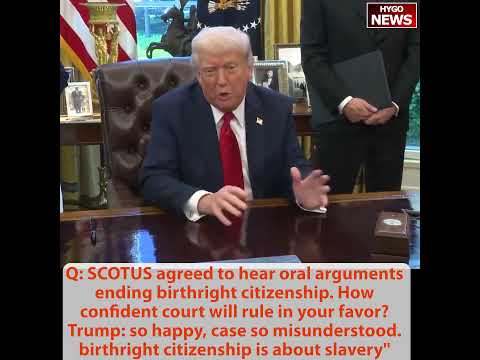
Trump on SCOTUS Birthright Citizenship: “It’s About Slavery — Not Tourists Touching a Piece of Sand”; Meloni: “Make the West Great Again”
President Trump reacted with enthusiasm to the Supreme Court’s decision to hear oral arguments on his executive order ending birthright citizenship in April 2025. “I am so happy,” Trump said. “Birthright citizenship is about slavery. If you look at the details of it, the signings of it, everything else, that case is all about slavery. That’s not about tourists coming in and touching a piece of sand and all of a sudden they’re citizens.” Italian PM Giorgia Meloni offered her vision: “With Europe, the goal for me is to make the West great again. And I think we can do it together.” Trump replied: “We can.” Trump was also presented with a garland signifying royalty in American Samoan culture, joking: “Does that mean I’m royalty?"
"Birthright Citizenship Is About Slavery”
When a reporter informed Trump that the Supreme Court had agreed to hear oral arguments on his birthright citizenship executive order, his reaction was immediate.
“Well, you just telling me that for the first time,” Trump said. “I am so happy.”
He then laid out his argument: “I think the case has been so misunderstood. That case, birthright citizenship is about slavery.”
He elaborated: “If you look at the details of it, the signings of it, everything else, that case is all about slavery. If you view it from that standpoint, people understand it.”
He criticized the legal establishment: “But for some reason, the lawyers don’t talk about it. The news doesn’t talk about it.”
He drew the contrast: “That’s not about tourists coming in and touching a piece of sand and all of a sudden there’s, you know, they’re citizens. That is all about slavery.”
He cited the historical timeline: “Even look at the dates on which it was signed. It was right at that era, during, right after the Civil War.”
He stated his conclusion: “If you look at it that way, the case is an easy case to win.”
He urged his legal team: “I hope the lawyers talk about birthright citizenship and slavery because that’s what it was all about. And it was a very positive. It was meant to be positive.”
Trump’s argument was rooted in constitutional history. The Fourteenth Amendment, which contained the citizenship clause — “All persons born or naturalized in the United States, and subject to the jurisdiction thereof, are citizens of the United States” — was ratified in 1868, three years after the Civil War. Its primary purpose was to guarantee citizenship to formerly enslaved people and their descendants, overturning the Supreme Court’s notorious Dred Scott decision that had held Black Americans could not be citizens.
The argument that the amendment was designed to address the specific injustice of slavery — not to create a universal system of birthright citizenship for anyone who happened to be born on American soil — was a textual and historical claim that constitutional scholars had debated for decades. The phrase “subject to the jurisdiction thereof” was the key qualifier. Trump’s position was that illegal immigrants and tourists were not “subject to the jurisdiction” of the United States in the way the amendment’s framers intended.
The Modern Exploitation
Trump described how the original intent of the amendment had been distorted.
“They use it now instead, not for slavery,” he said. “They use it for people that come into our country and they walk in and all of a sudden they become citizens and they pay a lot of money to different cartels and others.”
He repeated: “It’s all about slavery. And if you look at it that way, we should win that case.”
The “birth tourism” industry that Trump referenced was a multi-billion-dollar operation in which pregnant women from China, Russia, and other countries traveled to the United States specifically to give birth, securing American citizenship for their children. Additionally, illegal immigrants who crossed the border and had children on American soil created “anchor babies” — children whose citizenship then became the basis for chain migration that brought extended families into the country.
Neither of these scenarios bore any resemblance to the Fourteenth Amendment’s original purpose of securing citizenship for freed slaves. The amendment’s framers could not have imagined a world in which cartels charged thousands of dollars to smuggle pregnant women across the border so their children could claim citizenship, or in which wealthy foreigners flew to Miami to give birth in luxury hospitals.
Trump’s argument was that returning the amendment to its original meaning — protecting the descendants of enslaved people — was not radical but restorative. It was the modern interpretation that was radical: transforming a post-Civil War justice provision into an unlimited entitlement for anyone born within geographic borders.
The Supreme Court’s Decision to Hear the Case
The Supreme Court’s agreement to hear oral arguments was itself significant. Lower courts had blocked Trump’s executive order, with multiple federal judges issuing injunctions based on the prevailing interpretation that the Fourteenth Amendment guaranteed birthright citizenship to all persons born in the United States regardless of their parents’ immigration status.
By accepting the case, the Supreme Court signaled that at least four justices believed the legal question was worth examining — that the lower courts’ interpretation was not so obviously correct as to be beyond review. This was the first time the modern Supreme Court had agreed to consider whether the Fourteenth Amendment’s citizenship clause applied to the children of illegal immigrants.
The case had the potential to be one of the most consequential constitutional rulings in decades. If the Court sided with Trump’s interpretation, it would fundamentally reshape immigration law and remove one of the primary incentives for illegal border crossing.
Meloni: “Make the West Great Again”
Italian PM Giorgia Meloni delivered a line that instantly became the most quoted remark of the joint appearance.
“So with Europe, the goal for me is to make the West great again,” Meloni said. “And I think we can do it together.”
Trump’s response was simple and affirming: “We can.”
Meloni added: “And we will keep on working on that. I’m going to do it.”
The “Make the West Great Again” formulation was a deliberate expansion of Trump’s “Make America Great Again” philosophy to encompass the entire Western civilization. Meloni was not merely echoing a slogan; she was articulating a vision in which the conservative populist movements in America and Europe were part of a single civilizational project.
The implication was that the challenges facing America — immigration, deindustrialization, cultural erosion, loss of national sovereignty to multinational institutions — were the same challenges facing Europe. And the solutions — border enforcement, trade reform, cultural restoration, national sovereignty — were equally applicable on both continents. Trump and Meloni were not just allies; they were co-leaders of a Western renewal.
”Does That Mean I’m Royalty?”
The press availability ended with a lighter moment when an American Samoan delegate presented Trump with a garland.
“It signifies royalty in our culture,” the delegate explained.
Trump’s response was characteristic: “Does that mean I’m royalty?”
“You are royalty,” the delegate confirmed. “You just got blessed.”
Trump signed off with warmth: “Thanks for everything. Send me some tuna.”
“Definitely,” came the reply. “You’re welcome.”
The exchange — a president being honored by Pacific Islanders whose fishing rights he had just restored — captured the personal connections that Trump built with communities that felt overlooked by previous administrations. American Samoa, with a population of roughly 55,000, rarely received presidential attention. The fishing executive order and the cultural exchange demonstrated that the administration’s “America First” agenda included Americans in every territory, not just the continental states.
Key Takeaways
- Trump on SCOTUS birthright citizenship case: “I am so happy. Birthright citizenship is about slavery — not tourists touching a piece of sand.”
- He urged lawyers to make the historical argument: “Look at the dates. It was right after the Civil War. If you view it from that standpoint, it’s an easy case to win.”
- Meloni declared: “The goal for me is to make the West great again. I think we can do it together.” Trump: “We can.”
- Trump described modern exploitation: “They use it for people who walk in and become citizens. They pay cartels. It’s not what the amendment was about.”
- An American Samoan delegate presented Trump with a garland of royalty; Trump joked: “Does that mean I’m royalty?” and asked them to “send me some tuna.”