 HYGO News
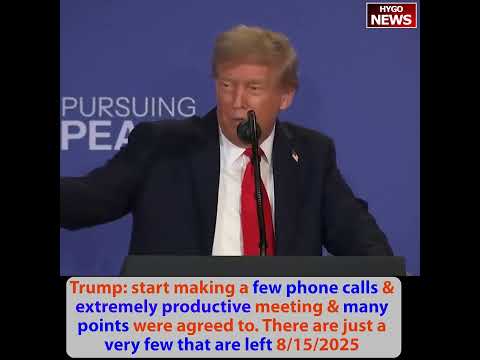
 Trump on press hope mistake breaking news bad thing; extremely productive many agreed very few left
Trump on press hope mistake breaking news bad thing; extremely productive many agreed very few left
Trump made a playful observation about press dynamics before delivering a substantive summary of the Alaska summit with Putin, declaring the meeting “extremely productive” with “many points agreed to” and only “a very few” remaining unresolved. Trump: “It’s almost like a competition. It’s like winning at golf. They’re coming in, every question is a kill. They hope you’re going to make a mistake … When I leave if there’s breaking news. That’s a bad thing. That means they got me on something.” On the summit results: “We had an extremely productive meeting and many points were agreed to and there are just a very few that are left. Some are not that significant. One is probably the most significant. But we have a very good chance of getting there.” On the human stakes: “We’re gonna stop really five six seven thousand thousands of people a week from being killed and President Putin wants to see that as much as I do.” On the next steps: “I will call up NATO in a little while … of course call up President Zelensky and tell him about today’s meeting … our next meeting will have President Zelensky, President Putin, and probably me.” On his operational posture: “It’s not for me to negotiate a deal for Ukraine but I can certainly set the table to negotiate the deal."
"Every Question Is a Kill”
Trump’s press dynamics observation. “Do you like doing those things? It’s almost like a competition. It’s like winning at golf. You know, they’re coming in every question is a kill. They hope you’re gonna make a mistake.”
“Every question is a kill.” That is Trump’s specific characterization of press questioning. Each question is a potential takedown. Reporters are hunting for a specific misstep that can become the day’s political story.
“They hope you’re gonna make a mistake.” That is the operational premise. Reporters are not primarily seeking information. They are seeking specific quotes that can be used to produce negative coverage. Mistake-hunting rather than fact-finding.
“It’s like winning at golf” — Trump’s competitive framing. He enjoys the press engagement as competition. The goal: avoid the mistake reporters are seeking while delivering the message he wants to deliver. Winning the exchange requires both defense (no mistake) and offense (message delivered).
”Field Day with Biden”
“They’re looking and they had a lot of they had a field day with bite.”
“Bite” is Whisper’s rendering of “Biden.” Reporters “had a field day with Biden” — meaning they produced extensive coverage of Biden’s verbal missteps, wandering statements, confused moments.
That characterization is politically significant. Trump is acknowledging that during the Biden administration, press coverage of Biden’s verbal issues was extensive. The implicit comparison: Trump’s press engagement — active, verbose, quip-filled — is qualitatively different from Biden’s typically brief, cautious interactions.
“That’s why you didn’t do it, but you’re making a news there every I don’t think so nothing I always go out. I say is there breaking news?”
Trump’s specific practice. He always asks reporters “is there breaking news?” as he exits engagements. The “news” framing: if reporters have a breaking story, Trump wants to know before it becomes public. If they do not, Trump’s day was successful.
”Breaking News Is a Bad Thing”
“Otherwise what I leave if there’s breaking news. That’s a bad thing That means they got me on something Let’s go after you.”
That is Trump’s specific mental model. Successful press engagement produces no breaking news. Breaking news after a Trump event means Trump made a mistake that became the story. That is what reporters were hunting for, and they succeeded.
“Let’s go after you” — Trump’s follow-up framing. When reporters produce a “gotcha” story, the administration’s response is to challenge the framing. Attack the reporter’s framing. Provide the actual context. Not capitulate to the hostile framing.
“He’s a good guy for everybody just to put it very quickly” — Trump complimenting someone (unclear referent) before transitioning to the substantive summit update.
”Extremely Productive Meeting”
Trump’s summit summary. “I’m gonna start making a few phone calls and tell them what happened but we had an extremely productive meeting and many points were agreed to and there are Just a very few that are left some are not that significant one is probably the most significant But we have a very good chance of getting there We didn’t get there, but we have a very good chance of getting there.”
“Extremely productive.” That is Trump’s specific characterization. Not merely “productive.” Extremely productive — the strongest positive framing available.
“Many points were agreed to.” The specific outcome. Substantive agreement on multiple negotiating points. Not a procedural success with no substance. Actual points of agreement.
“Just a very few that are left.” Small number of unresolved points. Most of the agenda has been addressed. Remaining items are the residual questions.
“Some are not that significant. One is probably the most significant.” Among the remaining points, most are minor. One is significant. That is a specific characterization — not all remaining points are equally important. The significant one is presumably territorial or security-related (the hardest questions).
”Very Good Chance of Getting There”
“But we have a very good chance of getting there. We didn’t get there, but we have a very good chance of getting there.”
The specific assessment. The summit did not produce final agreement. But it produced substantial progress. The remaining work — especially on the one most significant point — has a “very good chance” of resolution.
“Very good chance” is Trump’s specific probability language. Not certain. Not unlikely. Very good — perhaps 70-80% probability in Trump’s vocabulary. That is substantial optimism following a Putin meeting that did not produce final agreement.
”Thank You, President Putin”
“I would like to thank President Putin and his entire team whose faces who I know in many cases Otherwise other than that whose whose faces I get to see you all the time in the newspapers You’re almost as famous as the boss especially this one right over here.”
Trump’s thank-you to Putin’s delegation. Putin’s senior team — Lavrov (Foreign Minister), Peskov (Press Secretary), various security and economic officials. All have been on video frequently during the negotiation process. Trump’s joke: their faces are in newspapers regularly, making them almost as famous as Putin himself.
”Stop Five, Six, Seven Thousand People a Week”
“But we had some good meetings over the years right good productive meetings over the years And we hope to have that in the future, but let’s do the most productive one right now We’re gonna stop really five six seven thousand thousands of people a week from being killed and president Putin wants to see that as much as I do so again, mr. President I’d like to thank you very much and we’ll speak to you very soon and probably see you again very soon Thank you very much Vladimir and thank you all. Thank you. Thank you.”
Five, six, seven thousand people per week. Consistent with Trump’s earlier “7,011 last week” figure — weekly casualty rates in that range across combined Ukraine-Russia military and civilian deaths.
“President Putin wants to see that as much as I do.” Trump’s characterization of Putin’s motivation. Putin wants the killing to stop. Russian soldiers are dying. Russian economic and social costs continue. Putin has internal pressures to end the war on acceptable terms.
Whether that characterization is accurate is the diplomatic question. Putin’s acceptance of a ceasefire depends on what “acceptable terms” mean. If Russia can retain seized territory, Putin likely accepts. If Russia must withdraw from seized territory, Putin’s calculation is different.
”There’s No Deal Until There’s a Deal”
“There’s no deal until there’s a deal I will call up NATO in a little while I will call up the various people that I think are appropriate and of course call up President Zelensky and tell him about today’s meeting.”
“There’s no deal until there’s a deal.” That is Trump’s specific vocabulary. The summit produced progress but not final agreement. “Progress” is not a deal. “Agreement on many points” is not a deal. A deal is a deal — when all the terms are accepted by all the parties.
The specific callout list. NATO. “Various people that I think are appropriate.” Zelensky. That is the stakeholder coordination. Each stakeholder learns specifically what was discussed and what was agreed.
”Marco and Steve and Scott and John Ratcliffe”
“It’s all so ultimately up to them and I have to agree with what Marco and Steve and some of the great people from the Trump administration who’ve come here Scott and John Ratliff Thank you very much, but we have some of our really great leaders.”
The administration delegation. Marco Rubio (Secretary of State). Steve Witkoff (special envoy, close Trump ally). Scott Bessent (Treasury Secretary). John Ratcliffe (CIA Director). Each is a specific senior administration official who participated in the summit.
“They’ve been doing a phenomenal job.” Trump’s positive characterization of his delegation. Each has performed specifically well in the summit preparation and execution.
”Hottest Country Anywhere in the World”
“We also have some tremendous Russian business representatives here And I think you know everybody wants to deal with us We’ve become the hottest country anywhere in the world at a very short period of time.”
Russian business representatives at the summit. That is specific. Major Russian business figures — energy (Rosneft, Gazprom), banking, industrial — present at the summit. Their presence suggests economic normalization as part of the potential Ukraine resolution. If the war ends, Russian business returns to U.S. markets. That is leverage for Putin (his elite base wants that return) and for Trump (U.S. businesses can sell to Russia once sanctions lift).
“We’ve become the hottest country anywhere in the world.” Trump’s framing of the U.S. global position. Countries want to deal with the U.S. The U.S. is attractive for trade, investment, diplomacy. That framing supports the administration’s “America first” narrative — America is succeeding, others want to join.
”Not for Me to Negotiate a Deal for Ukraine”
“Today, I’ve it’s not for me to negotiate a deal for Ukraine but I can certainly set the table to negotiate the deal and our next meeting will have President Zelensky President Putin and Probably me.”
“Not for me to negotiate a deal for Ukraine.” That is Trump’s specific role definition. He is not Ukraine’s negotiator. Zelensky is. Trump cannot accept terms on Ukraine’s behalf.
“Set the table to negotiate the deal.” Trump’s role is to create the conditions. Get Putin to engage. Create the framework. Assemble the stakeholders. Then let Zelensky and Putin negotiate directly with Trump as mediator/facilitator.
“Our next meeting will have President Zelensky, President Putin and Probably me.” The structure for the next step. Trilateral. Zelensky and Putin as principals. Trump as facilitator. That is the format Trump has been foreshadowing across multiple press engagements.
”I’d Like to Focus on Doing Our Country”
“I’d like to focus on doing our country, but you know I get these interruptions. We’ve I’ve solved six wars in six months when you think about it.”
“I’d like to focus on doing our country, but you know I get these interruptions.” Trump’s casual framing of his role. His preferred focus is domestic. Foreign crises become “interruptions” that require his attention. He would rather be working on U.S. domestic issues — tariffs, deportations, DC crime, economic policy.
“I’ve solved six wars in six months when you think about it.” The specific count. Six wars resolved. Six months. That is a remarkable diplomatic record.
Key Takeaways
- Trump on press dynamics: “Every question is a kill. They hope you’re going to make a mistake … When I leave if there’s breaking news. That’s a bad thing. That means they got me on something.”
- On the Alaska summit: “We had an extremely productive meeting and many points were agreed to and there are just a very few that are left … One is probably the most significant. But we have a very good chance of getting there.”
- On the stakes: “We’re gonna stop really five six seven thousand thousands of people a week from being killed and President Putin wants to see that as much as I do.”
- On next steps: “I will call up NATO in a little while … of course call up President Zelensky and tell him about today’s meeting … our next meeting will have President Zelensky, President Putin and probably me.”
- On Trump’s role: “It’s not for me to negotiate a deal for Ukraine but I can certainly set the table to negotiate the deal … I’d like to focus on doing our country, but you know I get these interruptions.”