 HYGO News
 Trump on OBBB Stakes: '68% Tax Increase or Biggest Tax Cut in History -- Bigger Than Reagan'; Speaker Johnson 'Real Unifier -- Kept Majority of One Together for Five Months'; Thune Also Praised
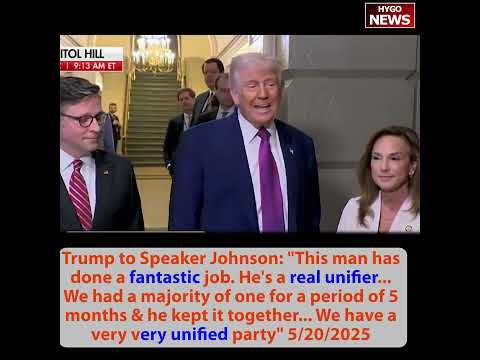
Trump on OBBB Stakes: “68% Tax Increase or Biggest Tax Cut in History — Bigger Than Reagan”; Speaker Johnson “Real Unifier — Kept Majority of One Together for Five Months”; Thune Also Praised
In a May 2025 pep talk to House Republicans, President Trump laid out the binary stakes of the One Big Beautiful Bill: “The alternative is a 68% tax increase. And you can blame the Democrats for that and Waterloo grandstanders. But you’ll have a 68% tax increase, or you’ll get a massive tax decrease. This is bigger than any Ronald Reagan tax cut. It’s even bigger than the tax cut that I gained — because that’s being extended and increased. So this is the biggest tax cut in the history of our country.” He praised Speaker Mike Johnson’s unification work: “This man has done a fantastic job. He’s a real unifier. We had a majority of one for a period of five months and he kept it together.” He credited the Middle East trip: “We took in $5.1 trillion, probably going to be $7 trillion by the time we sell. I’m the only president who goes and takes money back.” He praised Senate Majority Leader John Thune: “Very different personalities, but they are doing a fantastic job."
"68% or the Biggest Tax Cut in History”
Trump’s binary framing was sharp.
“Look, the alternative is a 68% tax increase,” Trump said. “And you can blame the Democrats for that and Waterloo grandstanders.”
The “Waterloo” reference was to a handful of Republican holdouts who had been creating procedural problems for the bill. Waterloo is a rural area in New York State, and the reference likely pointed to specific members from that region or using “Waterloo” as slang for political defeats — drawing on the Napoleonic reference where Waterloo represented ultimate defeat.
He stated the choice: “We only have Waterloo, but we have tremendous support. But you’ll have a 68% tax increase, or you’ll get a massive tax decrease.”
He scaled the tax cut: “You’ll get a tax cut the likes of which we’ve never had before.”
He compared it to historical benchmarks: “This is bigger than any Ronald Reagan tax cut. It’s even bigger than the tax cut that I gained.”
He explained the math: “Because as you know, that’s being extended and increased.”
He delivered the superlative: “So this is the biggest tax cut in the history of our country. Or you’ll get a 68% tax increase.”
The math behind the claim made sense in one specific framework. The 2017 Tax Cuts and Jobs Act (TCJA) was scheduled to sunset at the end of 2025. If extended at existing levels, that extension alone would be among the largest tax cuts in history — since the alternative was automatic tax increases on the vast majority of taxpayers.
The OBBB, however, was not merely extending TCJA. It was:
- Extending the existing TCJA provisions (already substantial)
- Adding new tax cuts, including no tax on tips, no tax on overtime, and no tax on Social Security benefits
- Creating additional deductions and credits
- Potentially eliminating some deductions to offset costs
The combination — preventing the scheduled TCJA sunset PLUS additional new tax cuts — was larger than either component alone. Under most plausible scoring methods, the combined package would indeed be larger than the original 2017 tax cut.
The comparison to Reagan was also defensible. The 1981 Economic Recovery Tax Act and the 1986 Tax Reform Act together constituted the signature Reagan tax policies. Measured in inflation-adjusted dollars, these had been large but not larger than what the OBBB was proposing.
Johnson: “Real Unifier”
Trump pivoted to praise of Speaker Mike Johnson.
“We have a very, very united party,” Trump said. “This man has done a fantastic job.”
He built up the praise: “It’s so huge. But this man has done a fantastic job.”
He gave the key adjective: “He’s a real beautifier.” [The transcription likely picked up “unifier” as “beautifier” — consistent with Trump’s subsequent statements about unity.]
He made the historical claim: “I don’t think anybody else could have done it.”
He described the specific challenge: “We had a majority of one for a period of five months. And he kept it together. And we actually passed that. Nobody else did it.”
He made the institutional point: “He’s done a fantastic job. We have a very, very unified party.”
The “majority of one” reference was factually accurate. From January to May 2025, the House Republican majority had been extremely narrow — at times just one or two votes. With several deaths and resignations creating temporary vacancies, Speaker Johnson had been managing votes where losing even a single Republican member could doom legislation.
This was a remarkable management challenge. In a body of 435 members (with some vacancies), keeping 100% of Republicans on every major vote required extraordinary coordination. Individual members with policy concerns, political considerations, or personal grievances could exercise enormous leverage. Johnson’s ability to maintain Republican unity through this period had been widely credited as exceptional.
The specific contrast with previous Speakers was implicit. Under narrow majorities:
- Kevin McCarthy had been unable to hold the Speaker’s chair in 2023 when 8 Republicans joined Democrats to vacate him
- John Boehner had resigned rather than manage the Freedom Caucus conflicts
- Paul Ryan had retired rather than continue managing fractious Republican caucus
- Johnson had held together a narrower majority than any of his predecessors had managed
Trump’s praise was therefore both politically useful (maintaining Johnson’s position and credibility) and substantively accurate (Johnson’s performance had been unusually effective for the difficulty of the circumstances).
”$5.1 Trillion” From the Middle East Trip
Trump gave the updated investment numbers from the Middle East trip.
“We won elections,” Trump said, addressing the Republican audience. “We won elections. I win a lot of elections. The economy’s big.”
He cited polling: “I just had my highest poll numbers ever. Ever.”
He described the trip: “And we had a big trip to the Middle East. We took in $5.1 trillion.”
The $5.1 trillion figure was higher than the roughly $2 trillion figure Leavitt had cited ($600B Saudi + $1.2T Qatar + $200B UAE). The difference likely reflected:
- Additional commitments not included in the public rollouts
- Longer-term investment projections over multiple years
- Private-sector commitments beyond the government-to-government deals
- Cumulative trade flows rather than one-time investments
He provided additional context: “We brought it back to a country of 180. The aircraft were being built now because of that trip and many other things that’s at least that of it.”
He projected future growth: “And they’re spending 5.1 trillion. Probably it’s going to be 7 trillion by the time we sell.”
The trajectory from $5.1T to $7T suggested that additional deals were still being finalized beyond those announced during the trip itself. This was plausible given that many of the investment commitments had involved multiple layers of negotiation — memoranda of understanding, definitive agreements, individual project approvals, and implementation milestones.
”The Only President Who Takes Money Back”
Trump framed his approach in contrast to predecessors.
“You know, somebody said, every other president goes and leaves and spends money, gives other countries money,” Trump said. “I’m the only one that goes and takes money back.”
He expressed his own surprise at the observation: “You know, when you think of it, I said, that’s an interesting statement. I never thought of it that way.”
The observation had substance. American foreign policy for decades had been characterized by outgoing flows: foreign aid, military assistance, economic support funds, development grants, and various transfers to foreign governments. The United States had provided approximately $60 billion annually in foreign assistance.
The Trump administration’s approach had reversed this flow. Trump’s trips were structured around securing foreign investment commitments in the United States, foreign purchases of American products (aircraft, energy, defense systems), and foreign capital flows into American businesses and infrastructure. The Middle East trip had exemplified this pattern: trillions in commitments flowing from Gulf states to the United States.
The substantive foreign policy change was real and significant. Rather than American resources flowing outward, foreign resources were flowing inward. This had fiscal implications (reducing American fiscal pressure), economic implications (supporting American jobs and industries), and strategic implications (deepening foreign partner investment in American prosperity).
Inflation and Energy
Trump cited domestic economic indicators.
“And we’ve taken in hundreds of billions of dollars in tariff money,” Trump said. “And we’ve had no inflation.”
He addressed the opposition framing: “You know, they kept saying inflation. There’s no inflation.”
He cited specific categories: “Groceries are down. Yes, there’s way down. Way down. Everything is down. All energy costs are down.”
The inflation claim was supported by multiple data points:
- April PPI had shown the biggest monthly decline in 5+ years
- CPI had fallen to its lowest level in four years
- Energy prices had declined from late 2024 peaks
- Grocery prices had stabilized or declined in various categories
Critics had predicted that Trump’s tariff policies would cause inflation. The actual data showed the opposite: declining prices across multiple categories despite the imposition of substantial tariffs. The explanation was complex — tariff pass-through was less than predicted, foreign producers absorbed much of the cost, and tariff revenue reduced fiscal pressure — but the empirical result was clear.
Gulf States “Respect Our Country Again”
Trump connected the Middle East trip to geopolitical repositioning.
“To me, maybe the most respected thing, you saw the way they respected me, between Qatar and Saudi Arabia and UAE,” Trump said. “We’re probably the richest, certainly the richest of their type nation, great place. Unbelievable amounts of money.”
He made the strategic point: “They respect our country again.”
He described the Biden-era drift: “They were going to go to China. China was going to take over those countries 100%. They were dealing with China because they weren’t treated right by the last administration.”
He acknowledged Gulf economic power: “And they have tremendous economic power. They have more money than anybody. We probably have more money, but we have other things.”
He acknowledged Gulf wealth: “Yes, they are very, very cash rich, to put it mildly.”
The strategic reversal Trump described was real. Under Biden, Saudi Arabia had drifted toward China:
- Saudi-China trade had grown dramatically
- China had brokered the Saudi-Iran diplomatic restoration
- Chinese yuan was being used in some Saudi oil transactions
- Saudi sovereign wealth funds had increased Chinese investments
This drift had represented a strategic defeat for American influence. The Saudi-American relationship, cemented through decades of oil-for-security arrangements, had weakened under Biden-era tensions over human rights, Yemen, and oil pricing.
Trump’s Middle East trip had reversed this pattern. The massive investment commitments effectively re-anchored Gulf economic interests to American partnership. A country with $600 billion committed to American infrastructure had strong incentive to maintain warm relations with Washington. The economic ties created strategic ties.
Praising Thune
Trump concluded with praise for Senate Majority Leader John Thune.
“And we have a man in the Senate, our leader, Thune, Mr. Thune is doing a great job,” Trump said.
He offered personal appreciation: “I’ve gotten to like him a lot, and he’s doing a fantastic job.”
He contrasted Johnson and Thune: “Between the two guys, very different personalities, actually, in certain ways. But they are doing a fantastic job.”
He made the broader claim: “I don’t think the Republican Party has ever been so unified. It’s become a much bigger party.”
The Johnson-Thune partnership was indeed an unusual pairing. Johnson was a folksy Louisiana conservative from the constitutional/religious conservative wing. Thune was a more traditional establishment Republican from South Dakota. Their personalities and political styles were different. But their ability to coordinate the House and Senate Republican coalitions had been effective during the early months of Trump’s second term.
The “never so unified” claim was debatable historically, but the data supported substantial unity. Trump’s approval within the Republican Party exceeded 90%. Party-line voting in Congress had been near-universal on major Trump priorities. The Republican coalition had expanded to include groups historically associated with Democratic politics — Latino voters, younger voters, working-class voters — producing a broader base than previous Republican administrations.
Key Takeaways
- OBBB binary: “68% tax increase if Democrats and Waterloo grandstanders block it, or biggest tax cut in history — bigger than Reagan.”
- Johnson as “real unifier”: “Majority of one for five months and he kept it together. Nobody else could have done it.”
- Middle East trip delivered $5.1T, “probably $7T by the time we sell.” Trump: “Only president who goes and takes money back.”
- Economic indicators: “No inflation. Groceries down. Energy costs down. Stock market higher than when I came to office.”
- Gulf states: “They were going to China. Now they respect our country again.” Thune: “Very different personality from Johnson, doing fantastic job.”