 HYGO News
 Trump on palace-like renovations, very luxurious; Sen Scott: lower interest rates; Bessent: $100B
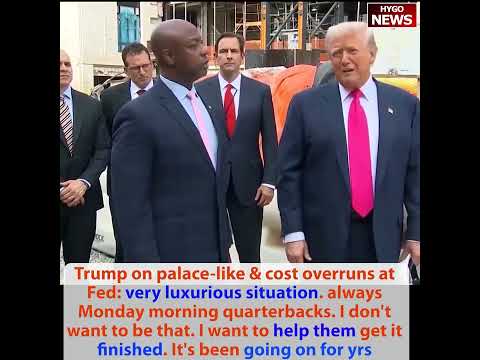
Trump on palace-like renovations, very luxurious; Sen Scott: lower interest rates; Bessent: $100B
A continuation of the Fed site visit, with President Trump bringing his developer eye to the specific cost-driving decisions in the renovation — and Treasury Secretary Scott Bessent raising the underlying institutional question: “One can ask, was it a good idea to start the renovations for an enterprise that’s losing $100 billion a year?” Trump on the basement excavation: “When you open up a basement, first of all, it’s the worst space … the most expensive space to build, especially here because you have a water line … they have to build what’s called a reverse bathtub.” Senator Tim Scott connected the Fed’s rate posture to the housing market: “Americans deserve to become first-time homebuyers … The one thing that would make it better is lower interest rates.” FHFA Director Bill Pulte: “In his first term, people were able to buy a mortgage for 3%. These days after Biden’s inflation and what happened with rates, now you’re looking at 7% mortgages.” Bessent argued Powell’s non-monetary expansions are themselves threatening Fed independence on monetary policy.
”A Very Luxurious Situation”
Trump’s diagnostic. “Well, I see a very luxurious situation taking place. Let’s put it that way. I was given a very nice tour by the head of construction.”
“Very luxurious” is Trump’s developer assessment. The phrase signals the kind of finishes, fixtures, and design decisions that drive costs beyond what functional institutional work requires. Marble, stone, custom glazing, premium hardware, elaborate interior architectural features — the “luxurious” category is the category that exceeds function.
“I was given a very nice tour by the head of construction” — that detail matters. Trump got the in-person walkthrough from the actual project manager. He is speaking from direct observation, not from paperwork. When Trump says “luxurious,” he saw it.
The Basement Problem
“And you know, look, if you look over here, they’re trying to open up the basement. When you open up a basement, first of all, it’s the worst space. Always a basement is the worst space in a building. And it’s also the most expensive space to build, especially here because you have a water line.”
Trump on basement excavation. In commercial real estate, basements are expensive for the amount of usable space they create. Excavation, soil disposal, structural support, moisture barriers, mechanical systems — the cost per square foot of basement space typically exceeds upper-floor space.
“Especially here because you have a water line. You know, they’re going down into the water, so they have to build what’s called a reverse bathtub. The water has to be kept out. It’s very expensive construction.”
“Reverse bathtub” is Trump’s term for the waterproofing structure needed when a basement extends below the water table. The water wants to flow in. The structure has to be built to keep it out — like the reverse of a bathtub that holds water in. These engineering solutions are expensive, labor-intensive, and produce ongoing maintenance obligations.
”Would Have Been Good If They Didn’t Build It”
“So it would have been good if they didn’t build it. It would have been good if they didn’t do certain other things.”
That is the developer critique. The Fed chose to excavate a basement in a location with groundwater challenges, knowing it would be expensive and difficult. They did it anyway. A more cost-conscious approach would have concluded the functional benefits did not justify the cost premium.
“If you look at the kind of protection in the hall, have you been able to get in the hall? You saw the protection apply with, I mean, that was a lot of money just to protect it for a period of time.”
The “protection apply” is construction-site language — plywood and plastic sheeting protecting existing finishes, historic architectural features, or artwork during the renovation. Trump is saying the Fed spent money on elaborate protection that could have been done more simply.
“I would have done it very gingerly and easily and not have just spent, you know, millions of dollars on protection. There are things that could have been different.”
“Millions of dollars on protection” for a renovation project is itself a data point. In simpler renovation projects, protection budgets are a minor line item. For the Fed, protection reached the “millions” threshold that Trump can cite as excess.
”I Don’t Want to Be Monday Morning Quarterback”
“Look, look, there’s always Monday morning quarterbacks. I don’t want to be that. I want to help them get it finished. It’s been going on for years and I want to help them get it finished.”
Trump is not demanding the project stop. He is not calling for Powell’s immediate removal. He is offering constructive framing: let’s finish this project, but let’s also learn from the decisions that drove up costs.
“I want to help them get it finished” is the diplomatic close. Trump is in character as a businessman who sees an ongoing project that needs completion and is offering help. Whether the “help” is welcome is a separate question.
Tim Scott on Housing
Senator Tim Scott pivoted to the policy argument. “Bottom line is this, that Americans deserve to become first time home buyers. President Trump has created the best economy in the world. The one thing that would make it better is lower interest rates.”
Scott, as Senate Banking Committee chair, is the senator most directly responsible for oversight of Fed policy on the Senate side. His framing connects Fed policy to working American quality-of-life concerns — specifically, the ability of first-time homebuyers to afford mortgages.
“Full employment is even more possible. Wages rise faster as interest rates come down when your employment is at 4.1 percent because of your leadership.”
4.1% unemployment. Labor market at what economists call full employment. Wages rising. All the pre-conditions for continued Fed-rate cuts are, in Scott’s framing, already met.
“We have revenues coming in at record breaking. Maybe last month, even more revenue coming in than bills going out, which is remarkable. They found 25, $26 billion. They said, where did that come from? Nobody, I think that’s been many, many decades since that happened. I can’t remember that. They found 26 billion last month and they said, where did that come from? I said, why don’t you try the tariffs?”
The $26 billion surplus — up from earlier $25-27 billion references — is the fiscal data point. Scott is attributing it to tariffs. Scott is not a tariff-policy advocate naturally; his background is as a conservative free-trader. His willingness to attribute the surplus to tariffs reflects the clarity of the fiscal data.
”Why Don’t You Try the Tariffs”
“Said it was true. We took in, we’re taking in hundreds of billions of dollars and our country is doing great and we have no inflation and the numbers, the job, everything is good. The one thing we have to do is get housing prices down and the interest rates down so people can buy the house because they’re all making money, but they can’t get the interest rate down. We have to.”
“Housing prices down and the interest rates down” — two distinct but connected asks. Housing prices need to come down via increased supply (easier permitting, more construction, more inventory). Interest rates need to come down via Fed policy. Both would combine to make homes affordable.
“Amen. All right.”
That is Scott’s conversational close. He has made the case. The Fed should cut.
Bessent: “$100 Billion a Year”
Treasury Secretary Scott Bessent then introduced the institutional critique that goes deeper than individual cost items. “And he’s been my friend for a long time. I don’t really understand what’s going on with the size, the scope, the cost of the building renovations. One can ask, was it a good idea to start the renovations for an enterprise that’s losing $100 billion a year?”
$100 billion a year in losses. That is the Fed’s current operational situation. The Fed’s portfolio of Treasury and mortgage-backed securities, purchased during the QE era at low yields, is now generating losses because the Fed’s interest expense (on its deposits to banks and reverse repo participants) exceeds the income from the old portfolio.
The Fed has not received appropriations for this loss. It is recording the losses as a “deferred asset” — effectively a claim on future Fed income. But from a financial reporting perspective, the Fed is losing $100 billion a year. An institution in that financial position undertaking a $3.1 billion luxurious headquarters renovation is, in Bessent’s framing, an institution with misaligned priorities.
“$100 billion because of a mismatch in the bond portfolio from the short term rates.”
The “mismatch” is the technical description. The Fed’s bond portfolio earns fixed yields (locked in when purchased). The Fed pays variable yields on bank reserves (which move with short-term rates). When short-term rates exceed the weighted average yield on the bond portfolio, the Fed loses money.
”Internal Review”
“I think that the Fed should undertake an internal review because I think all the other operations are endangering its independence of monetary policy. As I said, monetary policy should be kept independent. It’s a jewel box. It should be walled off, but by undertaking all these other activities, then you come in for criticism, just like you’re seeing here, that might impinge on monetary independence.”
That is Bessent’s sophisticated argument. Fed independence on monetary policy is a legitimate principle. That independence is threatened — not by Trump’s criticism, but by the Fed’s own non-monetary expansions. Building renovations, regulatory initiatives, climate research, diversity programs, financial stability research — each of those expansions puts the Fed in the political arena. Each political arena engagement then invites political pressure, which creates the institutional risk that the monetary-policy independence the Fed wants to preserve gets compromised.
“Jewel box” is Bessent’s metaphor. Monetary policy should be the single protected core of the Fed. Everything else should be critically examined.
Pulte on Housing
FHFA Director Bill Pulte addressed the specific housing-market impact. “I think he’s a builder. He cares about the cost. The cost have gotten out of control.”
“And then separately, you know, we run, the president runs Fannie Mae and Freddie Mac. In his first term, people were able to buy a mortgage for 3%. These days after Biden’s inflation and what happened with rates, now you’re looking at 7% mortgages.”
The 3% vs. 7% mortgage comparison is the single clearest data point on how Fed policy affects ordinary Americans. A 3% mortgage on a median-priced home produces a monthly payment that is viable for a wide range of American incomes. A 7% mortgage on the same home produces a payment that excludes large swaths of potential buyers from the market.
“So this is of great concern to the president."
"A Builder and President”
Pulte’s close. “But I view them very differently as two different things. You can’t help be a builder and be the president of the United States and see these cost overruns and not ask a bunch of questions.”
That frames Trump’s approach. A president who spent a career in construction and development sees a $3.1 billion renovation with multiple-year cost overruns and cannot stop himself from asking the questions. That is not overreach. It is the natural consequence of a builder’s perspective applied to an out-of-control project.
Key Takeaways
- Trump on Fed renovation: “A very luxurious situation taking place” — including a basement excavation requiring a “reverse bathtub” to keep out groundwater, and “millions of dollars on protection” during construction that could have been done “gingerly and easily.”
- Trump: “There are things that could have been different … I want to help them get it finished. It’s been going on for years.”
- Sen. Tim Scott tied Fed policy to housing: “Americans deserve to become first-time homebuyers … The one thing that would make it better is lower interest rates” — citing 4.1% unemployment and record tariff revenue.
- Treasury Secretary Scott Bessent: “One can ask, was it a good idea to start the renovations for an enterprise that’s losing $100 billion a year?” — arguing Fed non-monetary expansions are themselves endangering the monetary-policy independence they should preserve.
- FHFA Director Bill Pulte: “In his first term, people were able to buy a mortgage for 3%. These days after Biden’s inflation and what happened with rates, now you’re looking at 7% mortgages.”