 HYGO News
 Trump: on nobody's side Ukraine-Russia, very unhappy with Russia; NATO: pay for it totally logical
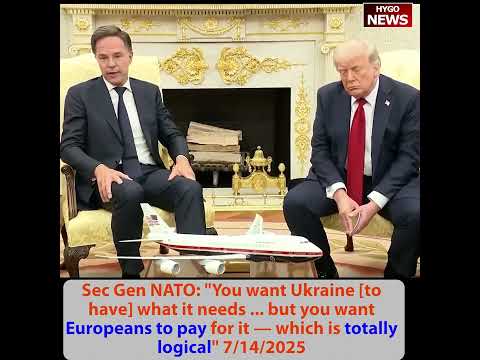
Trump: on nobody’s side Ukraine-Russia, very unhappy with Russia; NATO: pay for it totally logical
One of the sharpest Russia statements Trump has made this term: “We are very, very unhappy with [Russia], and we’re going to be doing very severe tariffs if we don’t have a deal in 50 days. Tariffs at about 100% you’d call them secondary tariffs.” Asked whose side he was on, Trump rejected the framing: “I’m on nobody’s side … I want the killing to stop in the Ukraine-Russia war. That’s the side I’m on.” He ratified the new funding architecture — “We, the United States will not be having any payment made. We’re not buying it, but we will manufacture it and they’re going to be paying for it” — with NATO Secretary General Mark Rutte calling it “totally logical” for Europeans to pay. Germany, Finland, Denmark, Sweden, Norway, the UK, Netherlands, and Canada signed on for the first wave. Peter Navarro reported $5 billion in weekly tariff revenue, $100 billion collected since inauguration, and $3 trillion in new investment commitments flowing into the country.
”I’m on Nobody’s Side”
The reporter’s question was framed to pin Trump down. “Are you on Ukraine’s side now?”
Trump’s answer rejected the binary. “No, I’m on nobody’s side. I’m on the side. You know who the side I’m on? Humanity side. I want to stop the killing of thousands of people a week. I want to stop the killing. I want the killing to stop in the Ukraine-Russia war. That’s the side I’m on.”
That is the frame the administration has been pushing since the inauguration. The war is a tragedy producing mass casualties. The United States’ interest is in stopping the killing. The question of “which side are you on” — Ukraine’s or Russia’s — is, in Trump’s framing, the wrong question. Both sides have human cost. The American priority is ending it.
Whether that frame is operationally coherent is another question. Stopping a war requires either one side’s capitulation, a negotiated settlement, or a military outcome that changes facts on the ground. Trump’s pitch has been that negotiated settlement is possible if both parties are leveraged appropriately. Russia’s leverage point, in his framing, is economic — the secondary tariffs.
”Very Severe Tariffs If We Don’t Have a Deal in 50 Days”
Trump delivered the clearest ultimatum of his second term’s Russia posture. “One of the reasons that you’re here today is to hear that we are very unhappy I am with Russia. But we’ll discuss that maybe a different day. But we’re very, very unhappy with them and we’re going to be doing very severe tariffs if we don’t have a deal in 50 days.”
“Tariffs at about 100% you’d call them secondary tariffs. You know what that means. But today we’re going to talk about something else.”
Secondary tariffs are the key concept. They do not target Russian exports directly — most of which have already been sanctioned or priced out of the U.S. market. They target the exports of third countries that continue to do substantial business with Russia. China, India, Turkey, the UAE, and others who have absorbed Russian oil and imported Russian equipment would face 100% tariffs on their U.S. exports if Russia does not come to a deal.
That is economic coercion applied through the supply chain. It doesn’t require Russia to export to the U.S. It forces Russia’s continued trading partners to choose between access to Russian supply and access to the U.S. market. Most would choose the U.S. market.
”50 Days”
The 50-day timeline is the operational concrete of the threat. Trump gave Russia a deadline. Fifty days from the statement to decide whether a deal — whatever the deal looks like — is acceptable, or the secondary-tariffs mechanism activates.
Deadlines are rare in U.S. foreign policy. The Biden administration’s Ukraine posture was open-ended — “as long as it takes” was the framing. Trump’s posture inverts that: a defined window, a defined consequence. The deal is not specified (Trump has left the contours of what would satisfy him unstated), but the penalty for non-agreement is.
”$350 Billion” and “Not My War”
Trump repeated the framing that has become his Ukraine signature. “As you know we’ve spent $350 billion approximately on this war with Russia and Ukraine. And we’d like to see it end. It wasn’t my war, it was Biden’s war. It’s not my war. I’m trying to get you out of it.”
The “$350 billion” figure is the cumulative U.S. spending since 2022. The “Biden’s war” framing assigns responsibility for the conflict’s initiation period to the prior administration — when the invasion happened, when the response was formulated, when the aid flow was structured. Trump is positioning himself as the administrator of the exit, not the owner of the entry.
“And we want to see it end.” That is the consistent Trump position. The method has evolved — from direct talks with Putin to NATO-funded weapons shipments to secondary-tariff threats — but the end-state goal has remained constant: stop the war.
”I’m Disappointed in President Putin”
The most personal note. “And I’m disappointed in President Putin because I thought we would have had a deal two months ago but it doesn’t seem to get there. So based on that we’re going to be doing secondary tariffs if we don’t have a deal in 50 days. It’s very simple. And there’ll be at 100%. And that’s the way it is.”
“I’m disappointed in President Putin” is a line Trump has been building toward for several cycles. Earlier in the term, the administration’s posture toward Russia was softer, with expectations that Trump’s personal rapport with Putin could deliver. The current posture — disappointment, sanctions, tariffs, Patriots — reflects that the rapport has not delivered.
“I thought we would have had a deal two months ago but it doesn’t seem to get there” is as close to an admission of diplomatic miscalculation as Trump gets. Whatever was negotiated, attempted, or signaled in April and May, the deal Trump expected did not come together. June and July have been the months of recalibration.
NATO’s Rutte: “Totally Logical”
NATO Secretary General Mark Rutte was present for the announcement, and his framing of the new arrangement was unusually direct. “You called me on Thursday that you had taken a decision. And the decision is that you want Ukraine, what it needs to have to maintain to be able to defend itself against Russia. So you want Europeans to pay for it, which is totally logical.”
“Totally logical” from the head of NATO — the alliance that has spent three years coordinating European support for Ukraine — is a significant endorsement of the Trump-administration financing model. Rutte is saying, on camera, that it is logical for Europeans to pay for the defense of European territory from a European aggressor.
“And this is building on the tremendous success of the NATO summit. The 5%. But also the decision to keep Ukraine strong and the decision to increase our defense industrial production. So based on that, this is, that was Europe stepping up. This is again, Europeans stepping up.”
The 5% reference is the new NATO defense spending target — 5% of GDP — that the alliance committed to at the recent summit. That was Europeans accepting a dramatically higher burden. The current arrangement, in Rutte’s framing, is Europeans continuing to step up by financing U.S.-made weapons for Ukraine.
The First Wave of Contributors
Rutte laid out the initial group of contributing nations. “So I’ve been in contact with many countries. I can tell you that at this moment, Germany, massively, but also Finland and Denmark and Sweden and Norway, we have Kingdom and Netherlands, Canada. They all want to be part of this. And this is only the first wave. There will be more.”
Eight countries in the first wave. Germany “massively” — reflecting Germany’s dramatic shift on defense policy since the invasion, including the Zeitenwende commitment and the subsequent increases in German defense spending. Finland, Denmark, Sweden, Norway — the Nordic bloc, with Finland and Sweden having joined NATO specifically in response to Russian aggression. The UK, Netherlands, and Canada round out the initial contributors.
“This is only the first wave” is the forward-looking signal. More nations will join. The financing mechanism is designed to scale.
Trump: “We Make the Best Equipment”
Trump returned to the commercial framing. “We make the best equipment, the best missiles, the best of everything. The European nations know that. And we’ve made a deal today. And I’m going to have Mark speak about it. But we’ve made a deal today where we are going to be sending them weapons that they’re going to be paying for.”
“We, the United States will not be having any payment made. We’re not buying it, but we will manufacture it and they’re going to be paying for it. We’re very pleased with where we are right now.”
That is as clean a statement of the new arrangement as has been made in public. U.S. defense contractors build. European nations pay. Ukraine receives. American taxpayers are removed from the payment chain. The arrangement is structured to outlast individual administrations because it does not depend on continuing congressional appropriations — it depends on European national-treasury transfers to U.S. defense firms.
Navarro: $5 Billion a Week
Peter Navarro, the administration’s trade adviser, delivered the supplementary tariff-revenue update. “We’re collecting about $5 billion in tariffs a week and the numbers are going up. We’ve collected over $100 billion of tariffs since President Trump took office. Those help us cut our taxes, reduce our debt, and they act as a tariff wall to bring home investment.”
Five billion dollars a week. At that run rate, annualized tariff revenue approaches $260 billion — a substantial fiscal input that the administration is using to offset tax cuts, pay down debt, and subsidize domestic reinvestment.
“I don’t know if you know this, Kena, but we’ve had commitments of over $3 trillion of new investment coming into this country because of a combination of the tariff wall we’ve put up, as well as very attractive investment opportunities for countries around the world.”
$3 trillion in new investment commitments. That is a subset of the cumulative $15 trillion figure Trump cited elsewhere — the administration’s broader tally of capital commitments — focused specifically on the new investments driven by the tariff wall and the domestic opportunity set.
A Choreographed Announcement
The event was clearly a choreographed announcement. Trump outlined the policy. Rutte arrived to confirm European buy-in. The weapons arrangement was announced simultaneously with the secondary-tariff ultimatum on Russia. Navarro closed with the revenue math.
That choreography sends a specific signal to Moscow. This is not a unilateral American announcement that Russia can dismiss as posturing. This is a coordinated U.S.-NATO action — financing architecture on one track, escalation threat on another, with eight European countries publicly committed to the first wave of the new weapons flow. Russia’s options shrink in the face of that coordination.
The 50-day clock is running.
Key Takeaways
- Trump issued a 50-day ultimatum: “We are very, very unhappy with [Russia], and we’re going to be doing very severe tariffs if we don’t have a deal in 50 days. Tariffs at about 100% you’d call them secondary tariffs.”
- On taking sides: “I’m on nobody’s side … I want the killing to stop in the Ukraine-Russia war. That’s the side I’m on” — while acknowledging: “I’m disappointed in President Putin because I thought we would have had a deal two months ago.”
- NATO Secretary General Mark Rutte called the arrangement “totally logical”: European nations pay for U.S.-made weapons to Ukraine — with Germany “massively,” plus Finland, Denmark, Sweden, Norway, the UK, Netherlands, and Canada in the first wave.
- Trump stated the funding framework cleanly: “We, the United States will not be having any payment made. We’re not buying it, but we will manufacture it and they’re going to be paying for it.”
- Peter Navarro reported $5 billion in tariffs collected weekly, over $100 billion since inauguration, and $3 trillion in new investment commitments “because of a combination of the tariff wall we’ve put up, as well as very attractive investment opportunities.”