 HYGO News
 Trump on Jerome Powell: 'He'll Leave -- He's Always Too Late'; Bessent: Tariff Talks with Big 15 Economies, Japan 'Fantastic'
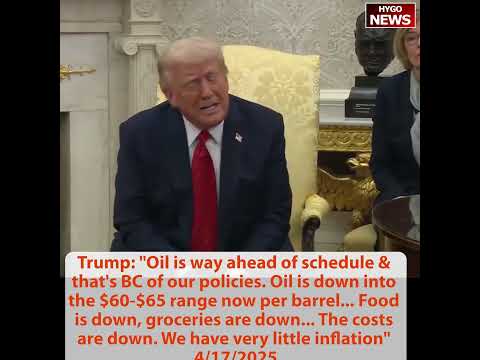
Trump on Jerome Powell: “He’ll Leave — He’s Always Too Late”; Bessent: Tariff Talks with Big 15 Economies, Japan “Fantastic”
President Trump escalated his public criticism of Federal Reserve Chairman Jerome Powell in April 2025, telling reporters: “Oh, he’ll leave. If I ask him to, he’ll be out of there. He’s too late, always too late, a little slow, and I’m not happy with him.” Trump cited falling prices as evidence that rate cuts were overdue: “Oil is down into the $65 range now per barrel. Food is down, groceries are down. We have very little inflation.” Treasury Secretary Scott Bessent then outlined the administration’s trade strategy, revealing they were “working on the big 15 economies” — with a “fantastic meeting with Japan,” the EU already engaged, South Korea coming next week, and India “moving very quickly."
"He’ll Leave — He’s Always Too Late”
A reporter set the stage with a direct question: “You said the termination of Powell cannot come fast enough. He says he won’t leave even if you ask him to.”
Trump’s response was unambiguous: “Oh, he’ll leave. If I ask him to, he’ll be out of there.”
He laid out the case: “But I don’t think he’s doing the job. He’s too late, always too late, a little slow, and I’m not happy with him.”
He added the threat: “I let him know it and if I want him out, he’ll be out of there real fast, believe me.”
The Trump-Powell conflict was the most consequential institutional dispute in American economic policy. The Federal Reserve’s independence — the principle that the central bank should make monetary policy decisions without political pressure — had been a cornerstone of American economic governance. But Trump’s argument was that Powell was using that independence not to serve the economy but to serve himself — maintaining high interest rates to avoid the appearance of bowing to presidential pressure, even when economic conditions warranted cuts.
The “always too late” characterization had historical support. Powell had been slow to raise rates during the Biden-era inflation surge, allowing prices to spiral before acting. Now, Trump argued, Powell was making the opposite mistake — being too slow to cut rates as inflation subsided, unnecessarily constraining economic growth. The pattern was the same: Powell reacting months after the data demanded action, turning the Fed from a stabilizing force into a destabilizing one.
The Economic Case for Rate Cuts
Trump presented what he viewed as overwhelming evidence that inflation was conquered and rates should come down.
“Oil is great. Oil is way ahead of schedule and that’s because of our policies,” Trump said. “Oil is down into the $65 range now per barrel.”
He cited the consumer impact: “And I told you in certain states we have less than $2 for gasoline. And food is down, groceries as we call it are down.”
He acknowledged one holdout: “Other than interest rates, everything’s down. Interest rates are pretty flat. It’s not that they’re up, but we should be better than flat.”
He made the connection: “If he would lower the interest rate, I think we’d have a good impact on that too.”
He stated the conclusion: “But the costs are down. We have very little inflation. I would say we have essentially no inflation.”
He explained the mechanism: “Hard to have inflation when oil goes down.”
Trump contrasted his results with Biden’s: “When Biden came in, oil went through the roof. That’s what caused our problem. That and his very dumb spending.”
He projected forward: “But if they had won, oil right now would be at $7 or $8 because of their policy. And we’re going to be at about $2. It could be even a little bit less than that.”
The economic data supported Trump’s argument. Oil prices had fallen from over $80 per barrel to the mid-$60s under Trump’s energy production policies. Gasoline prices in many states were below $2.50, with some approaching $2.00. Grocery prices had begun declining after years of increases. The inflation rate had dropped to levels that, under any previous Fed chairman, would have prompted rate cuts.
Powell’s reluctance to cut rates in this environment created a peculiar situation: every other economic indicator was moving in the right direction — energy down, food down, manufacturing up — while the one indicator controlled by the Fed remained stubbornly high. Trump’s argument was that Powell was the obstacle to a complete economic recovery.
Bessent: “Working on the Big 15”
Treasury Secretary Scott Bessent provided the most detailed public outline of the tariff negotiation strategy.
“We’re working on the big 15 economies,” Bessent said. “We had a fantastic meeting with Japan yesterday.”
He continued the rundown: “I believe that they’ve called with the EU already. And then we have South Korea coming in next week. And I believe India is also talking, moving very quickly.”
Trump had set the frame: “We’re doing very well with negotiations, I think, with all countries. We have a lot of countries that want to make a deal. Frankly, they want to make deals more than I do.”
The “Big 15” strategy revealed the administration’s systematic approach to trade negotiations. Rather than attempting to negotiate with every country simultaneously, Bessent was prioritizing the fifteen largest economies — the countries whose trade relationships had the most impact on the American economy. Japan, the EU, South Korea, and India were identified as the first wave, with each at a different stage of engagement.
The sequence was strategic. Japan — America’s closest Asian ally and the world’s third-largest economy — was first. A successful deal with Japan would establish a template and create momentum. The EU was already in contact, suggesting Brussels recognized that delay would only increase the tariff pressure. South Korea and India were both “moving very quickly,” indicating that the tariff shock had accelerated engagement that might otherwise have taken months.
The “they want to make deals more than I do” formulation was Trump’s way of signaling that the United States held the leverage. The tariffs had created urgency for trading partners while the administration could afford patience. This asymmetry — America needed access to foreign goods less than foreign producers needed access to American consumers — was the foundation of the entire negotiation strategy.
”European Parasites” — A Denial
A foreign reporter attempted to confront Trump with an incendiary claim.
“Have you ever said that Europeans are parasites?” the reporter asked. “Have you said it?”
Trump was definitive: “No, I haven’t said it. I don’t even know what you’re talking about.”
The exchange illustrated the media’s recurring tactic of attributing inflammatory statements to Trump and then demanding he respond to the attribution. Whether the “parasites” claim originated from a misquote, a hostile translation, or outright fabrication, Trump’s flat denial put the burden back on the accuser.
The Fed Independence Debate
Trump’s public pressure on Powell raised the perennial question of Federal Reserve independence. Critics argued that presidential interference in monetary policy would undermine market confidence and lead to politically motivated rate decisions. The argument was that an independent central bank was essential to price stability.
But the counterargument was equally compelling. The Federal Reserve had presided over the worst inflation in forty years during 2021-2023, maintaining near-zero interest rates while the Biden administration spent trillions in fiscal stimulus. If that was “independence,” it was independence to make catastrophic mistakes without accountability. Trump’s position was that the Fed chairman, like any government official, should be competent — and that a president who saw incompetence had a responsibility to address it.
The question of whether Powell would actually leave if asked remained unresolved. The legal framework surrounding the termination of a Fed chair was ambiguous. Powell had publicly stated he would not resign under pressure. But Trump’s confidence — “he’ll be out of there real fast” — suggested the administration had a legal theory or a practical approach that would make continued resistance untenable.
Key Takeaways
- Trump on Powell: “He’ll leave. If I ask him to, he’ll be out of there. He’s always too late, a little slow, and I’m not happy with him.”
- Economic data cited: oil at $65/barrel, gasoline under $2 in some states, groceries down, “essentially no inflation.”
- Treasury Secretary Bessent revealed the “Big 15” trade strategy: Japan (“fantastic meeting”), EU (already in contact), South Korea (next week), India (“moving very quickly”).
- Trump: “We have a lot of countries that want to make a deal. Frankly, they want to make deals more than I do.”
- On the “European parasites” claim: “I haven’t said it. I don’t even know what you’re talking about.”