 HYGO News
 Trump on his phone call with Newsom; Pelosi: On Jan 6th, we begged National Guard. He wouldn't do it
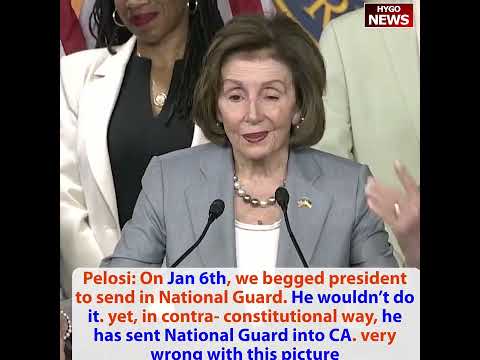
Trump on his phone call with Newsom; Pelosi: On Jan 6th, we begged National Guard. He wouldn’t do it
The California National Guard controversy produced two competing narratives in a single news cycle, and both came from men and women who have stood at the apex of American political power. President Donald Trump, pressed in the Oval Office about a phone call with California Governor Gavin Newsom, offered a blunt characterization of the exchange — one he says is corroborated not by political spin but by phone company records. Former Speaker Nancy Pelosi, meanwhile, drew a line directly from January 6, 2021 to the current federal deployment in Los Angeles, arguing the inconsistency between those two moments reveals something deeply wrong with how the executive branch is using the Guard. Together, the two statements capture the constitutional fracture running through the present moment: who gets to call out the Guard, under what conditions, and whether the Constitution binds the president as he himself has said it does.
Trump Recounts A 16-Minute Call: “I Told Him To Get His Act Together”
Trump wasted no time disputing the premise of the question he was asked. Reporters framed the phone call with Newsom as something from “a day ago,” and the president corrected the timeline immediately: “Well, I gave him, it wasn’t a day ago, it was a little longer than that. And I presented the phone conversation to Fox News, John Roberts and Molly Lyne at Fox News because they were the ones that said it.” The correction matters because Trump’s entire case for his California posture rests on the idea that he gave Newsom warning, gave him time, and gave him a specific admonition — and that the governor failed to respond.
The president then offered the detail he has repeatedly returned to: the call’s precise length. “And we actually spent 16.0 something minutes on the phone and I told him he’s got to get his act together because you’re going to have some bad times in Los Angeles if he doesn’t.” Sixteen minutes is not a pocket call, not an accidental dial, not a voicemail. It is a substantive political conversation, and Trump is using that duration as implicit proof that the warning was heard, digested, and either ignored or mishandled by the governor.
The Phone Company As Witness
What makes Trump’s account distinctive is the evidence he cites for it. “We had a pleasant conversation. The proof was from the phone company. It was from the phone company.” In an era of deepfakes, selective leaks, and competing press statements, Trump is pointing at an unusual arbiter: the telecom record. Phone company billing data shows a connected call and its duration. It cannot reveal what was said. But Trump is clearly comfortable letting the length speak for itself, because a 16-minute call with the President of the United States is not something a governor accepts unless there is genuine business to discuss.
“So I spoke to him at a certain time. I’m sure you all saw it. You saw it. But why would you ask me that question if you saw it?” The frustration in that line is real. Trump is exasperated at what he views as a game being played by the press — reporters who cite the call in one breath and then frame it as though its content is uncertain in the next. “You know, I mean, he asked me a question and then he says, yeah, I saw that you spoke to him. Yeah, I spoke to him for over 16 minutes."
"He Hasn’t Been Able To Do That”
Trump’s verdict on Newsom is harsh and unambiguous. “I spoke to him for over 16 minutes and I told him to get his act together, but he hasn’t been able to do that.” The phrasing matters. Trump does not say Newsom “refused” to act — he says Newsom was “not able” to act. It is a characterization that positions the governor as overmatched rather than defiant, as a political figure without the capacity to control his own city. Whether that framing is accurate or unfair, it is strategic. Defiance invites sympathy from the governor’s base. Incompetence does not.
The president then pivots to what is arguably his strongest argument for intervention: the calendar. “I mean, the men, really, we could have a great, you know, we have an Olympics coming up. We have to put the right foot forward. We have to do a job. We have a lot of people all over the world watching Los Angeles.” The 2028 Summer Olympics are scheduled for Los Angeles. The city will host an estimated global audience in the billions. A Los Angeles that cannot maintain civic order in 2025 is, in Trump’s framing, a Los Angeles that cannot be trusted to host the world three years later.
”This Guy Allowing This To Happen”
The president’s concluding line on Newsom is among the sharpest. “We’ve got the Olympics, so we have this guy allowing this to happen.” The verb is deliberate. Trump is not accusing Newsom of causing the unrest or orchestrating it. He is accusing him of allowing it — of standing back, declining to intervene, failing to impose the kind of order that a state chief executive is obligated to impose. In Trump’s political grammar, passive enablement is as damning as active support, because the office of governor exists precisely to prevent situations from devolving.
The Traffic Detail: A Window Into Logistics
Before turning to Pelosi’s counterargument, Trump offered a small but telling anecdote about the cost of the current disruption. “Mind you, for whatever they had planned for the weekend, they had blocked off a whole lane of traffic. So it’s what takes eight minutes to take a half an hour to get here.” This is not a sweeping geopolitical point. It is a logistical complaint — the kind a commuter might voice. But it is effective precisely because it is small. When the president of the United States notices that a Los Angeles commute has ballooned from eight minutes to half an hour, his audience understands that the disruption is not abstract. It is affecting the rhythm of daily life.
Pelosi’s Counter: The January 6 Analogy
If Trump’s argument is that Newsom was warned and failed, Pelosi’s argument is that Trump himself has established, by his own past conduct, that he lacks the authority he is now exercising. Her framing is devastating because it does not require her to litigate the facts of Los Angeles. It requires her only to remind the country of what Trump said four years ago.
“The president has said he couldn’t, he can’t send in the guard without the governor’s agreement permission.” Pelosi is referencing Trump’s own statements about the limits of executive power over the National Guard in a state-declared emergency. The Guard is a state-controlled force absent federal mobilization, and governors are ordinarily the first officers in the chain. Pelosi’s point: Trump himself articulated that constraint, and he is now ignoring the constraint he articulated.
”I Don’t Know If I Have To Obey The Constitution”
Pelosi’s next line is the one that will dominate clips. “The president has said, I don’t know if I have to obey the Constitution. I hope the president would read Article 10 of…” Her sentence is cut off in the transcript, but the reference is clear: Article IV of the Constitution and the statutory architecture of the Insurrection Act and Title 10 of the U.S. Code, which govern the federalization of the National Guard and the conditions under which the president can deploy troops within a state.
The political force of Pelosi’s line does not come from the statute. It comes from the contrast between a president who, by her account, has admitted he does not know whether the Constitution binds him, and the same president who is now exercising one of the most consequential unilateral powers in American law.
The January 6 Comparison
Pelosi’s comparison to January 6 is the sharpest edge of her argument. “In a bipartisan way, on January 6th, we begged the president of the United States to send in the National Guard. He would not do it. That day, he didn’t do it. He forgave those people. Now his people want to raise money for them.” The word “bipartisan” is important. Pelosi is insisting, for the record, that the request on January 6 was not a partisan ask. It came from Democratic and Republican leaders alike, and it was — by her account — denied.
The force of the comparison is the contrast: a president who would not send the Guard when Democratic lawmakers asked him to during an attack on the Capitol, but who will send the Guard into a Democratic-governed state over that governor’s objection. Pelosi’s audience is meant to feel the dissonance.
”Contra-Constitutional” — Pelosi’s Sharpest Term
“And yet, and yet, in a contra-constitutional way, he has sent the National Guard into California. Something is very wrong with this picture.” The word “contra-constitutional” is a choice. Pelosi did not say “unconstitutional,” which would be a formal legal judgment the courts would have to confirm. She said “contra-constitutional” — against the spirit, against the grain, against what the constitutional order contemplates. It is a rhetorical term, not a litigation term, and it is aimed at public opinion.
”Inconsistent In His Actions”
Pelosi’s closing line is the analytical summary of her case. “Inconsistent in his actions, contrary to his own statement that he couldn’t… of a year ago that he couldn’t send anyone in without the governor’s consent, anyplace.” Inconsistency is the engine of her argument. She is not claiming Trump lacks any authority. She is claiming he himself said he lacked this specific authority, and that his current posture cannot be squared with what he said then.
The “Nation Of Immigrants” Frame
Pelosi also made a gesture toward the broader narrative that has animated the California protests. “We understand that we are a nation of immigrants. We want people to have a facilitation of their status. And you know this to be true, and I haven’t seen it really reflected so much in the press.” She is frustrated that the coverage, as she sees it, has lost sight of the underlying issue — the immigration enforcement operations that set off the unrest in the first place — and has concentrated too exclusively on the federal-state power struggle.
Two Competing Frames, One Country
The news cycle captured by this video is effectively two frames colliding. Trump’s frame: a warned governor who failed to act, a city whose reputation is on the line, an Olympics in view, and a phone company record to back up his account. Pelosi’s frame: a president who denied the Guard when Democrats begged for it, who has admitted uncertainty about whether the Constitution binds him, and who is now acting against the terms he himself articulated. Both frames will be tested in court, in Congress, and in the court of public opinion. Neither frame fully captures the other’s argument, and the country is going to have to decide which weighs more.
Key Takeaways
- Trump says the Newsom call lasted over 16 minutes and that “the proof was from the phone company,” using the call’s duration as evidence the warning was substantive.
- Trump’s summary verdict on Newsom: “I told him to get his act together, but he hasn’t been able to do that” — framing the governor as overmatched, not defiant.
- Pelosi contends Trump “has said, I don’t know if I have to obey the Constitution,” and calls the California deployment “contra-constitutional.”
- On January 6, Pelosi says “in a bipartisan way…we begged the president of the United States to send in the National Guard. He would not do it” — a deliberate contrast with the current California posture.
- The 2028 Los Angeles Olympics are central to Trump’s argument: “We have a lot of people all over the world watching Los Angeles. We’ve got the Olympics, so we have this guy allowing this to happen.”