 HYGO News
 Trump on Fed Gov Lisa Cook: fire her if she doesn't resign; John Bolton lowlife don't want to know
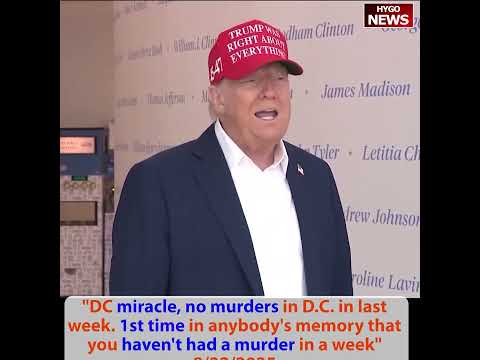
Trump on Fed Gov Lisa Cook: fire her if she doesn’t resign; John Bolton lowlife don’t want to know
Trump addressed four distinct major stories. Federal Reserve Governor Lisa Cook facing mortgage fraud allegations — Trump said he’ll fire her if she doesn’t resign. John Bolton facing an FBI raid that morning — Trump characterized Bolton as a “lowlife” while maintaining operational distance from the specific enforcement action. DC’s specific crime reduction — “no murders in DC in the last week.” And Trump’s Ukraine diplomacy update — comparing Putin and Zelensky to “oil and vinegar.” Trump on Cook: “You’re going to fire her if she doesn’t resign, you know? What she did was a bet. So I’ll fire her if she doesn’t resign.” On Bolton: “I’m not a fan of John Bolton. He’s a real sort of a lowlife. When I hired him, he served a good purpose … He’s not a smart guy, but he could be a very unpatriotic guy.” On not being briefed: “I know nothing about it. I just saw it this morning … I tell Pam and I tell the group. I don’t want to know about it.” On DC: “There have been no murders in DC in the last week. That’s the first time in anybody’s memory that you haven’t had a murder in a week.” On the Ukraine war: “They’re losing 7,000 people on average a week. Mostly soldiers.”
Lisa Cook: Mortgage Fraud Resign or Fire
Trump’s response to the question about firing Federal Reserve Governor Lisa Cook. “You’re going to fire Lisa Cook, the Fed governor over her mortgage? You’re going to fire her if she doesn’t resign, you know? What she did was a bet. So I’ll fire her if she doesn’t resign.”
Lisa Cook — Federal Reserve Governor appointed by Biden — faces specific mortgage fraud allegations. Documents indicate Cook may have claimed primary residence status on multiple properties simultaneously for tax and mortgage benefit purposes. That is the specific pattern Schiff was also accused of — similar alleged misconduct by Democratic officials.
“What she did was a bet.” Whisper’s transcription. Trump’s meaning: what Cook did was bad. “A bet” likely transcription error for “bad” or “a problem.”
“I’ll fire her if she doesn’t resign.” That is specific consequence framework. Cook’s options:
- Resign voluntarily (preferred)
- Be fired involuntarily
Trump’s legal authority to fire a Federal Reserve Governor for cause is subject to specific legal framework. The Federal Reserve Act establishes specific removal procedures. Whether mortgage fraud allegations meet the removal standards is a specific legal question.
The political pressure is clear. Cook faces specific reputational damage from the allegations. Resignation preserves her legacy. Firing for cause produces additional legal consequences.
Bolton: “Real Sort of a Lowlife”
Trump on John Bolton. “No, I don’t know about it. I saw it on television this morning. I’m not a fan of John Bolton. He’s a real sort of a lowlife.”
The specific context. The FBI raided John Bolton’s residence earlier that morning. Trump saw the news on television. He is not being formally briefed on the specific law enforcement action.
“Real sort of a lowlife.” That is specific Trump characterization. Not merely opposed politically. Morally below. Trump’s specific language for specific individuals he views as both politically hostile and personally flawed.
”Forced Bush to Do the Ridiculous Bombings”
“When I hired him, he served a good purpose, because as you know, he was one of the people that forced Bush to do the ridiculous bombings in the Middle East, the Bolton. He wants to always kill people.”
Specific Trump framing of Bolton’s historical role. Bolton was Under Secretary of State for Arms Control and International Security from 2001-2005 and UN Ambassador in 2005-2006 under George W. Bush. During that period, Bolton was a significant voice supporting specific military actions.
“Forced Bush to do the ridiculous bombings.” Trump’s framing of Bush-era Middle East military actions. “Ridiculous bombings” characterizes those actions as unjustified. Bolton as specifically responsible for pushing Bush toward those decisions.
“He wants to always kill people.” That is specific Trump framing of Bolton’s foreign policy preferences. Bolton consistently advocates military responses to international challenges. Trump’s framing: Bolton specifically wants military actions regardless of strategic justification.
”Very Bad at What He Does”
“He’s very bad at what he does, but he worked out great for me because every time he doesn’t talk, he’s like a very quiet person, except on television, he could say something bad about Trump, he’ll always do that, but he really doesn’t talk.”
That is specific Trump analysis. Bolton is “very bad” at his job but “worked out great” for Trump because of a specific pattern — Bolton was typically quiet in private meetings with foreign leaders.
“Except on television, he could say something bad about Trump, he’ll always do that.” Bolton is specifically vocal in media criticism of Trump. But in actual diplomatic meetings, Bolton was quiet. That silence, per Trump, served specific diplomatic purposes.
”Foreign Country Would Give Me Everything”
“And I’d walk into a room with him, with a foreign country, and the foreign country would give me everything because they said, oh, no, they’re going to get blown up because John Bolton is there. He’s not a smart guy, but he could be a very unpatriotic guy.”
Specific Trump analysis of Bolton’s intimidation value. Foreign leaders feared Bolton. When Bolton attended Trump meetings with foreign counterparts, those counterparts accommodated Trump’s demands more readily because they feared Bolton would push for specific military action if negotiations failed.
That is specific diplomatic leverage. “Good cop bad cop” dynamics. Trump as more reasonable. Bolton as more extreme. Foreign leaders negotiating with Trump to avoid Bolton’s specific advocacy.
“He’s not a smart guy, but he could be a very unpatriotic guy.”
“Very unpatriotic guy.” That is serious charge. Specifically framing Bolton as against American interests rather than merely having different views. If Bolton faces specific legal consequences from the FBI raid — potentially involving classified material or other national security matters — the “unpatriotic” framing aligns with specific potential charges.
”I Don’t Want to Know About It”
“We’re going to find out. I know nothing about it. I just saw it this morning. They did a raid. Do you expect the DOJ to brief you on this? Yeah, they’ll be. They’ll brief me, probably today, sometime. And more Mr. Lowe. I don’t want to tell them and I tell the group. I don’t want to know, but just you have to do what you have to do. I don’t want to know about it. It’s not necessary. I could know about it. I could be the one starting it. I’m actually the chief law enforcement officer, but I feel that it’s better this way.”
That is specific operational distance. Trump is not directing specific law enforcement actions against Bolton. Trump told his team — Pam Bondi (AG) and the broader team — that he does not want to know about specific enforcement actions. The team should do what is necessary.
“I could know about it. I could be the one starting it. I’m actually the chief law enforcement officer, but I feel that it’s better this way.”
Trump’s specific legal framework. The President is the chief law enforcement officer of the United States. Trump could direct specific enforcement actions. But Trump specifically chose to maintain distance from specific cases involving political opponents. That distance serves specific purposes:
- Protects investigations from appearing politically directed
- Preserves prosecutorial independence perception
- Reduces political liability for specific prosecutorial decisions
- Lets Justice Department operate on specific legal merits
That is a substantial shift from Trump’s first-term approach. Trump’s second term appears to be building specific institutional norms around prosecutorial independence despite political pressure for direct presidential involvement.
”DC Is a Miracle”
Trump pivoting to DC. “Look, DC is a miracle what’s happened. I mean, they can come up with fake numbers like the mayor is doing. Oh, no, it was going down for 20 years. You didn’t live here. Have you been mugged? DC was a hellhole, and now it’s safe.”
Specific Trump framing. DC as “miracle” — transformation within short time. Mayor Bowser’s alternative framing (crime has been declining) is rejected as “fake numbers.”
“You didn’t live here. Have you been mugged?” That is specific Trump challenge. Mayor Bowser’s statistical claims should be tested against lived experience. DC residents have been victimized. Those who were not personally victimized have friends or family members who were.
“DC was a hellhole, and now it’s safe.” Binary characterization. Previous state: hellhole. Current state: safe. The federalization produced the transformation within the specific short time frame.
”No Murders in DC in the Last Week”
“And in fact, I put it out this morning. I said, I hate to say this because it doesn’t sound very good, but there have been no murders in DC in the last week. That’s the first time in anybody’s memory that you haven’t had a murder in a week.”
Specific statistic. No DC murders in the last week. Trump acknowledged the specific pattern on social media.
“I hate to say this because it doesn’t sound very good” — Trump’s framing. The absence of murders is obviously good. But the previous consistency of DC murders (producing baseline expectations) makes “no murders in a week” sound like it might be cherry-picked rather than accurate.
“First time in anybody’s memory.” That is specific timeline framing. DC residents who have lived in the city for years cannot remember a comparable murder-free week. The federalization produced a specific outcome that was previously unimaginable to DC residents.
Mayor Bowser “Has to Get on the Ball”
“And I think the mayor has to get on the ball because she’s a nice woman, but I’ll tell you what, she’s got to get on the ball. I don’t want to see phony numbers. DC hit an all-time high last year of absolute total crime, and it continued pretty bad. And then we put some strength into it. Got the numbers down a little bit, but we brought in the DC National Guard, and we coupled them with the police, and it has been amazing.”
Trump’s specific Bowser framing. “Nice woman” — personal politeness. “Has to get on the ball” — specific performance critique.
“DC hit an all-time high last year of absolute total crime.” That is factual claim. Specific DC crime statistics for 2024 reached historical peaks. That specific context justifies the specific federalization response.
“Brought in the DC National Guard, and we coupled them with the police, and it has been amazing.” The specific operational formula. National Guard + MPD. Combined capacity. “Amazing” results.
”Putin and Zelensky … Oil and Vinegar”
Trump pivoting to Ukraine diplomacy. “We’re going to see if Putin and Zelensky will be working together. That’s like oil and vinegar a little bit. They don’t get along too well for obvious reasons, but we’ll see.”
“Oil and vinegar.” That is Trump’s specific analogy. Putin and Zelensky do not naturally mix. They have specific legitimate reasons to dislike each other — Putin invaded Zelensky’s country, killed Zelensky’s citizens. Zelensky has specifically mocked Putin across multiple forums.
“But we’ll see.” Trump’s openness. Despite the specific animosity, a deal may still be possible. The specific personal dynamics may be navigable if the specific substantive terms are acceptable.
”I’d Rather Not Be There”
“And then we’ll see whether or not I would have to be there. I’d rather not. I’d rather have them have a meeting and see how they can do.”
Trump’s specific preference. He prefers Putin and Zelensky to meet without him. His presence would center him in the specific negotiation. Their direct engagement allows specific ownership of the outcome by the specific warring parties.
“See how they can do.” That is specific framework. Testing whether Putin and Zelensky can directly negotiate. If they can, the deal is more durable because the specific principals are committed. If they cannot, Trump will step in to mediate specifically.
”7,000 People a Week”
“But in the meantime, they continue to fight and they continue to kill people, which is very stupid because they’re losing 7,000 people now. I used to tell you five now, they’re losing 7,000 people a day. 7,000 people a week. They’re losing, think of that, they’re losing 7,000 people on average a week. Mostly soldiers.”
Trump updating the casualty figures. Previously citing 5,000 per week. Now 7,000 per week. That is substantial escalation — 40% higher weekly casualty rate.
“7,000 people a day” — Trump briefly said “day” then corrected to “week.” Daily rate would be extraordinary (50,000 per week). Weekly 7,000 is already substantial.
“Mostly soldiers.” Military casualties dominate the total. Civilian casualties exist but are smaller fraction of the 7,000. That matters because military casualties primarily affect specific populations (young men of military age) rather than broad populations.
”I’ve Stopped Seven Wars”
“So we want to see if we can stop. I’ve stopped seven wars. I’d like to make this. This one I felt would have been in the middle of the pack in terms of difficulty, and it’s turning out to be the most difficult.”
Seven wars stopped. Ukraine remains. “Middle of the pack in terms of difficulty” — Trump’s initial expectation. “Most difficult” — actual experience.
The specific complication. Russia-Ukraine war involves:
- Large nuclear powers (U.S. and Russia on opposite sides)
- NATO implications (European allies directly concerned)
- Territorial questions (specific Russian gains, Ukrainian sovereignty)
- Internal politics of multiple countries
- Economic integration questions (sanctions, trade, reconstruction)
Each specific dimension adds complexity. Trump addresses each through specific diplomacy. The cumulative complexity has made Ukraine harder than expected despite Trump’s specific engagement.
Four Distinct Stories
Lisa Cook mortgage fraud (Federal Reserve governance challenge). John Bolton FBI raid (political opponent investigation with Trump maintaining operational distance). DC crime reduction miracle (specific operational success). Ukraine diplomacy progress (7,000 weekly casualties driving urgency).
Each reflects specific administration dimension. Financial governance reform. Political opponent accountability. Public safety operational success. Foreign policy peace-making.
Key Takeaways
- Trump on Federal Reserve Governor Lisa Cook: “You’re going to fire her if she doesn’t resign, you know? What she did was a bet. So I’ll fire her if she doesn’t resign.”
- On John Bolton: “I’m not a fan of John Bolton. He’s a real sort of a lowlife … He’s very bad at what he does, but he worked out great for me because … foreign countries would give me everything because they said, oh, no, they’re going to get blown up because John Bolton is there.”
- On maintaining investigation distance: “I know nothing about it. I just saw it this morning … I tell Pam and I tell the group. I don’t want to know about it. It’s not necessary … I’m actually the chief law enforcement officer, but I feel that it’s better this way.”
- On DC’s transformation: “There have been no murders in DC in the last week. That’s the first time in anybody’s memory that you haven’t had a murder in a week.”
- On Ukraine: “They’re losing 7,000 people on average a week. Mostly soldiers … I’ve stopped seven wars. I’d like to make this. This one I felt would have been in the middle of the pack in terms of difficulty, and it’s turning out to be the most difficult.”