 HYGO News
 Trump: Daylight Savings '50-50'; Assassination Report 'Next Week'; De-Nuclearization 'Would Be Incredible'
Trump: Daylight Savings “50-50”; Assassination Report “Next Week”; De-Nuclearization “Would Be Incredible”
In a free-wheeling March 2025 exchange with reporters, President Trump covered topics ranging from daylight savings time to nuclear disarmament. He called the daylight savings debate “a 50-50 issue” that was “hard to get excited about.” He revealed that a report on the Butler assassination attempt would be delivered “next week” and expressed suspicion about the shooter’s “three apps, two of which were foreign” and the second would-be assassin’s “six cell phones.” And in the most consequential segment, Trump called for global de-nuclearization, saying “the power of nuclear weapons is crazy” and that he had been “very close to having a program with Russia” on de-nuclearization before the 2020 election.
Daylight Savings: “A 50-50 Issue”
A reporter asked when Trump would eliminate daylight savings time — a perennial topic that had gained new energy as the spring time change approached.
“So this should be the easiest one of all, but it’s a 50-50 issue,” Trump said. “And if something’s a 50-50 issue, it’s hard to get excited about it.”
He described the split: “I assume people would like to have more light later. But some people want to have more light earlier, because they don’t want to take their kids to school in the dark.”
Trump’s assessment was candid: “It’s very much a 50-50 issue. And it’s something I can do, but a lot of people like it one way, a lot of people like it the other way. It’s very even.”
The daylight savings answer was a rare example of Trump acknowledging that an issue didn’t have a clear right answer. The president who had charged into tariff wars, expelled a foreign leader from the White House, and declared a national energy emergency was admitting that the clocks-changing question stumped him because public opinion was genuinely divided.
The honest assessment was refreshing precisely because it was so unusual for Trump. On most issues, he projected total confidence. On daylight savings, he was willing to say the public was split and that the split made action difficult. The response also demonstrated a kind of political wisdom: not every issue warranted presidential intervention, and forcing a resolution on a 50-50 question would alienate half the country for no strategic gain.
The Assassination Report: “Suspicious”
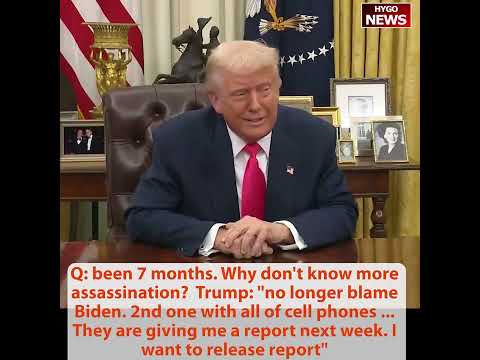
A reporter noted that seven months had passed since the Butler assassination attempt and pressed Trump on why more information had not been released about the shooter.
Trump’s response revealed both frustration and genuine suspicion about unanswered questions.
“Yeah, and the second one with all of his cell phones,” Trump said, referencing the second assassination attempt at his Florida golf course. “I want to find the answers. I told them, in fact, today I said, I want to find out. We can no longer blame Biden for that one.”
He confirmed a report was imminent: “They are giving me a report next week sometime. And I do believe I’ll be releasing — I want to release the report.”
Trump then cited specific details that fed his suspicion. About the Butler shooter: “You had one who had three apps, two of which were foreign, supposedly. And who has the biggest white-shoe law firm in Pennsylvania, even though they don’t live in necessarily a white-shoe area. What’s that all about?”
About the second would-be assassin: “The other one had seven or six cell phones. I don’t have six cell phones. Why would somebody have six cell phones?”
When a reporter asked whether the lack of information and the suspicious data points suggested something more than a lone-wolf attack, Trump was cautious but candid: “It could be. It makes other people think that. It makes me think it a little bit too.”
He identified specific red flags: “When you have three apps and two of them are foreign, you had an FBI that wouldn’t report on it — they didn’t want to say why. I would say that could be suspicious.”
Trump committed to transparency while noting potential limitations: “I would be willing to release it. Maybe there’s a reason that we shouldn’t. So I don’t want to get too far ahead of my skis. But yeah, I would be very willing to release that. I’d like to see it myself.”
The assassination investigation revelations — foreign apps, multiple cell phones, a prestigious law firm connection, and FBI reluctance to report — added new dimensions to the Butler story that had not been publicly explored. Trump’s willingness to release the report signaled that the investigation would not be quietly buried.
De-Nuclearization: “The Power Is Crazy”
In the most substantive policy segment, Trump made a sweeping call for global nuclear disarmament.
“It’d be great if everybody would get rid of their nuclear weapons,” Trump said. “Russia and us have by far the most. China will have an equal amount within four or five years.”
He stated his aspiration directly: “It would be great if we could all de-nuclearize, because the power of nuclear weapons is crazy. It is crazy.”
Trump then revealed the progress he had made during his first term before it was interrupted. “I was very far along the process with Russia, despite the Russia-Russia-Russia hoax, which didn’t make it easy,” he said. “But despite that, I was very close to having a program with Russia, a de-nuclearization.”
He described the intended scope: “And we were going to get China. I spoke to President Xi about it, and he would have been very happy to have gone along with it.”
Trump attributed the interruption to the 2020 election: “But bad things happened. Like an election that was rigged happened. And so we had to come back four years later.”
He expressed determination to resume the effort: “I would very much like to start those talks. The de-nuclearization would be incredible.”
The de-nuclearization vision was the most ambitious element of Trump’s foreign policy agenda — more ambitious than the Ukraine peace deal, the tariff realignment, or the China trade negotiations. A trilateral nuclear disarmament agreement involving the United States, Russia, and China would be the most consequential arms control achievement since the end of the Cold War, potentially eliminating the existential threat that had defined international relations for eight decades.
Trump’s revelation that he had been “very close” to a de-nuclearization program with Russia during his first term — and that Xi had been willing to participate — suggested that the framework for such talks already existed and merely needed to be reactivated. The Ukraine peace negotiations, which were already producing results, could serve as the diplomatic foundation for the larger nuclear conversation.
The four-to-five-year timeline for China reaching nuclear parity with Russia and the United States added urgency. If China achieved equality in nuclear arsenals before a disarmament framework was established, the negotiating dynamics would become dramatically more complex. The window for meaningful de-nuclearization talks was closing, and Trump was signaling his intent to use it.
Key Takeaways
- Trump called daylight savings “a 50-50 issue” that was “hard to get excited about,” acknowledging that “a lot of people like it one way, a lot of people like it the other way.”
- He confirmed an assassination report would come “next week” and expressed suspicion about the Butler shooter’s “three apps, two foreign” and the second attacker’s “six cell phones.”
- Trump called for global de-nuclearization, saying “the power of nuclear weapons is crazy” and that he had been “very close to a program with Russia” during his first term.
- He revealed China would reach nuclear parity with the U.S. and Russia “within four or five years,” making trilateral disarmament talks urgent.
- Trump committed to releasing the assassination report publicly: “I want to release the report. A lot of people have asked that question.”