 HYGO News
 Trump on Biden's Mental Decline: 'Country at Stake -- Press Was Holding Back'; Tiffany's Baby; 'N-Word' (Nuclear); Gaza Starvation; China Would Have 'Broken Apart'
Trump on Biden’s Mental Decline: “Country at Stake — Press Was Holding Back”; Tiffany’s Baby; “N-Word” (Nuclear); Gaza Starvation; China Would Have “Broken Apart”
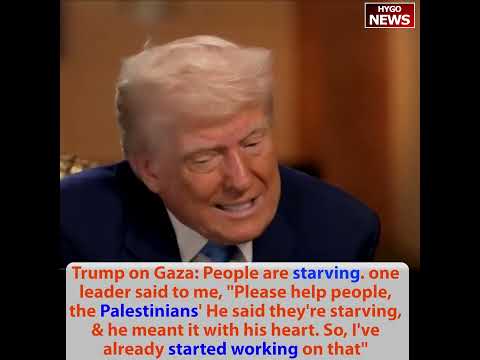
In a wide-ranging Bret Baier interview during the May 2025 Middle East trip, President Trump covered Biden’s mental decline, his new grandson, nuclear threats, Gaza starvation, and the China deal. On Biden: “I know people that are 89, 90, 92, 93 years old that are literally perfect, but Joe was not one of them. They did a lot of hiding. You can’t have a man in that condition. Everybody was holding back, including the press.” On Tiffany’s baby Alexander: “The baby is perfect. I’ll let you know about it in 21 years.” On nuclear: “The N-word used in a nuclear sense — that’s the worst thing that can happen.” On Gaza: “People are starving. One of the three great leaders said ‘Please help the Palestinians.’ I’ve already started working on that.” On China: “If I didn’t do that deal with China, I think China would have broken apart."
"Joe Was Not One of Them”
Trump opened with a pointed contrast between functional elderly people and Biden’s cognitive state.
“I know people that are 89, 90, 92, 93 years old that are literally perfect,” Trump said. “But Joe was not one of them.”
He made the accusation specific: “And they did a lot of hiding. They were really playing games. And you know, you can’t do that.”
He stated the stakes: “Our country is just saying, you see even a thing like this, there’s so many decisions for billions and billions, but then you have even more important decisions. You have decisions for life. You can’t have a man in that condition.”
He named the press as complicit: “And everybody was holding back, including the press, including the media.”
The “holding back” accusation was timely. In May 2025, Jake Tapper and Alex Thompson’s book “Original Sin” had been released with extensive new reporting on how Biden’s inner circle had concealed his cognitive decline from the press, the public, and even senior Democratic officials. The book documented specific incidents where Biden had failed to recognize longtime acquaintances, had struggled to complete basic sentences, and had required extensive staff management to appear functional in public settings.
Trump’s framing that decisions “for life” had been made by a compromised president raised the underlying accountability question. If Biden was impaired during his presidency, then every executive order, every military decision, every Supreme Court nomination, every legislative signing had been executed by someone whose capacity was questionable. This was not merely political commentary — it was an argument that the Biden presidency had been illegitimate in a fundamental sense, with unelected aides making decisions in the president’s name.
The press criticism was the sharpest part of the statement. The argument was not that Biden had deceived journalists — it was that journalists had been part of the deception, choosing not to report what they observed because of political preference. Trump’s claim was that the media had functioned as protectors of the Biden administration rather than as independent observers.
Tiffany’s Baby Alexander
Trump pivoted to personal news with characteristic humor.
“And you have a lot of threats on becoming a grandfather for the 11th time,” Trump said, referring to the baby’s birth.
He named them: “Most importantly, Tiffany, baby Alexander.”
He praised the couple: “They’re a really good couple, great couple, I think.”
He delivered the assessment: “And the baby is perfect. I’ll let you know about it in 21 years.”
He finished: “But the baby is good. So I’m happy about that. I look forward to seeing the baby.”
Tiffany Trump’s baby with Michael Boulos — named Alexander — was the President’s 11th grandchild. The “21 years” line was classic Trump delivery: the acknowledgment that newborns couldn’t really be assessed for character or capability until they had lived some years and developed as people. The humor was self-aware, recognizing the absurdity of making firm judgments about someone who was hours old.
The “really good couple” assessment of Tiffany and Michael Boulos reflected genuine parental approval. Michael Boulos was the son of Massad Boulos, a Lebanese-American businessman whom Trump had subsequently appointed as a Middle East adviser. The marriage had connected the Trump family to Lebanese-American business networks and had been widely seen as a happy match.
”The N-Word” — Nuclear
Trump’s riff on the “N-word” was linguistically provocative but substantively clear.
“The next one’s going to be, you know what?” Trump said. “The N-word.”
He paused for effect, then clarified: “You know what the N-word is, right? Nuclear.”
Someone responded with relief: “Thank you. Thank you for the clarification.”
Trump repeated: “No, it’s the N-word. That’s a very nasty word, right? In a lot of ways. The N-word used in a nuclear sense. That’s the worst thing that can happen.”
The wordplay was characteristic Trump showmanship. By deliberately creating ambiguity about which “N-word” he meant, he generated momentary tension that he then immediately resolved with a clarification. The underlying point — that nuclear weapons represented the ultimate civilizational threat — was entirely serious.
The “worst thing that can happen” framing of nuclear proliferation was important context for Trump’s Iran policy. Throughout the Middle East trip, Trump had been delivering increasingly urgent warnings about Iranian nuclear development. The “N-word” framing cast Iran’s nuclear ambitions in existential terms: this was not a negotiation over trade preferences or diplomatic recognition. This was an effort to prevent what Trump considered the worst possible outcome for humanity.
Gaza: “People Are Starving”
Trump described the Gaza humanitarian crisis with real emotional force.
“I think Iran is right now the big problem,” Trump said. “That’s also a problem. Amaz is big.”
He pivoted to Gaza: “And we want to take care of the people. Look, people are starving. You know, you see what’s going on right now. People are starving.”
He described the personal conversation: “One of the things that one of the three great leaders that I saw two nights ago said to me, please help the people, the Palestinians.”
He recounted his response: “I said, other than the Abbas, what do you mean by that? He said they’re starving. And he meant it with his heart. They’re starving.”
He stated his commitment: “So I’ve already started working on that.”
He acknowledged the complexity: “It’s a deep problem, but we’ll get it solved.”
The “three great leaders” reference pointed to Trump’s meetings with Saudi Arabian, Qatari, and UAE leaders during the trip. All three had emphasized the Gaza humanitarian situation as a priority concern. The Gulf states, while maintaining their formal normalization or approach-to-normalization with Israel under the Abraham Accords, were also constrained by public opinion in their own populations, which was intensely sympathetic to Palestinian civilians.
The “meant it with his heart” phrasing indicated that the appeal had not been formulaic diplomatic language but rather a genuine personal plea. Trump was signaling that he had been moved by the appeal and that his response was substantively rather than merely rhetorically engaged.
The “already started working on that” claim suggested active diplomacy with Israel to expand humanitarian aid flows into Gaza. The mechanism was unclear from the short statement, but the direction was clear: Trump was using American influence to push for expanded aid access.
India-Pakistan and Iran
Trump connected Gaza to his recent India-Pakistan success.
“A very immediate and a very big problem is, you know, I’m so proud of what we were able to do with India and with Pakistan,” Trump said. “Well, it’s a potential problem like that that we have here.”
He stated his commitment: “I’ll get it solved. And one way or the other, I’ll get it solved. It’s either going to be done nicely or it’s going to be done violently. And 99.9% want to do it nicely if we can.”
The India-Pakistan reference was to the ceasefire Trump had brokered between the two nuclear-armed neighbors earlier in May. Operation Sindoor — India’s retaliation for the Pahalgam terror attack — had led to direct military exchanges between India and Pakistan, with the situation approaching the threshold of full-scale war. American mediation, with Trump personally engaged, had produced a ceasefire that defused the immediate crisis.
The “done nicely or done violently” formulation applied to Iran was a clear warning. Trump was publicly signaling that military action remained on the table if diplomacy failed. The “99.9%” preference for peaceful resolution indicated that force was the last resort, not the first option — but it was an option that would be exercised if necessary.
China Would Have “Broken Apart”
Trump’s assessment of the China deal was characteristically dramatic.
“The market was really happy with the China situation and the sit-down with the Treasury Secretary,” Trump said, referring to Bessent’s Switzerland meetings.
He made the claim: “If I didn’t do that deal with China, I think China would have broken apart.”
He clarified direction: “Not us, them. We weren’t going to break. We’re not going to break. They would have broken apart.”
He credited the 2024 election: “You know, our country has a lot of spirit. And you know why? Because of November 5th. Because our country has spirit again.”
The “China would have broken apart” claim was bold but not implausible. At 145% tariffs, Chinese exports to the United States had effectively stopped. American consumer purchases of Chinese goods had dropped to near zero in the affected categories. Chinese export-dependent provinces — particularly coastal manufacturing hubs like Guangdong and Zhejiang — had faced severe economic stress. Youth unemployment in China had been rising. The combination of factors had created genuine regime stability concerns.
Whether China actually would have “broken apart” absent a deal was unknowable, but the direction of pressure was real. Trump’s claim that the U.S. side was not at risk of breaking — “we weren’t going to break” — reflected his confidence that American economic resilience was greater than Chinese resilience under trade war conditions.
”I Think It’s Genetics”
Trump closed with a personal reflection on his schedule.
“It’s a pretty grueling schedule,” Trump said. “A lot of people said, how the hell do you do it?”
Bret Baier echoed: “By the way, how the hell do you do it?”
Trump’s response: “I don’t know. I think it’s genetics.”
He described his parents: “I had a father who was very strong. And I had a mother who was very strong. They lived to ripe old ages and they were great people.”
He described the actual schedule: “And it’s meeting after meeting. And not only that, it’s speech after speech.”
He gave a specific example: “Like last night, Muhammad, he got up and made a beautiful speech. I wasn’t taught I even had a speech to make. So I had to make a speech off the cuff. Do you think Biden could do that? I don’t think so. Actually, it was a pretty good speech. I looked at it. It was pretty good. I didn’t know I was doing it.”
He stated the bigger picture: “But it’s meeting after meeting with the highest level people. These are great people. They love us again. They were not feeling love at all. They were going to China. They’re not going to China anymore.”
The “genetics” explanation circled back to the Biden comparison that had opened the interview. Trump at 78 was performing at an energy level that Biden at 82 had been unable to match. Trump’s claim was that this was partly inherited physical constitution — his parents had been strong and long-lived — and partly the kind of work he was doing, which he found energizing rather than draining.
The “they were going to China, they’re not going to China anymore” observation about the Gulf states was the strategic summary of the trip. Biden-era diplomatic neglect had pushed Saudi Arabia, UAE, and Qatar toward closer relationships with China. Trump’s trip had reversed that direction, reattaching the Gulf states to the American economic and strategic orbit through massive investment commitments and military cooperation.
Key Takeaways
- Trump on Biden’s mental decline: “People 89-93 are literally perfect, but Joe was not one of them. They were hiding. Press was holding back.”
- Tiffany’s baby Alexander (Trump’s 11th grandchild): “The baby is perfect. I’ll let you know about it in 21 years.”
- Nuclear threat: “The N-word — used in a nuclear sense. That’s the worst thing that can happen.”
- Gaza: “People are starving. One of the three great leaders said ‘please help the Palestinians.’ I’ve already started working on that.”
- China: “If I didn’t do that deal, China would have broken apart. Not us, them.”