 HYGO News
 Trump on BBB signing 5:00PM, B-2s & F-22s & F-35s flying over WH; Patriot Games; Melania & kids
Trump on BBB signing 5:00PM, B-2s & F-22s & F-35s flying over WH; Patriot Games; Melania & kids
Trump announced the specific ceremonial arrangements for the One Big Beautiful Bill signing on July 4th — a 5:00 PM ceremony with B-2 Spirit bombers, F-22 Raptors, and F-35 Lightning IIs flying in formation over the White House. The Iran-strike B-2 bombers that had become the administration’s signature would fly over the ceremony that signed the bill representing the signature first-year legislative accomplishment. Trump also announced the “Patriot Games” as part of the America 250 celebration — a nationally televised high school athletic competition led by HHS Secretary RFK Jr. And First Lady Melania Trump visited Children’s National Hospital in Washington, delivering gifts and decorating with young patients ahead of the holiday.
”We’re Signing At About 5:00”
Trump opened with the specific timing. “They’re going to be very proud tomorrow. So we’re signing at about five o’clock. And at about five o’clock, we’re going to have B2s and F22s and F35s flying right over the White House.”
The 5:00 PM timing is specific. Bill signings typically occur at various times of day based on logistics and ceremonial preferences. Trump’s choice of 5:00 PM allows the signing to coincide with other July 4 celebrations while avoiding the midday heat that would affect outdoor events.
The aircraft formation is significant. Three specific types:
B-2 Spirit bombers — the platforms that flew the Iran strike mission. Having these aircraft fly over the bill signing links the administration’s most prominent foreign policy achievement to its most prominent domestic policy achievement.
F-22 Raptor — America’s premier air-superiority fighter. The F-22 represents unmatched air-to-air combat capability.
F-35 Lightning II — the multi-role fighter that has become the backbone of American and allied air forces. The F-35 represents the future of Western military aviation.
Having all three fly in formation over the White House during the signing is a ceremonial statement about American military capability paired with American legislative capability.
The Political Theater
The timing and imagery are not accidental. Presidents routinely choose ceremonial elements that reinforce their political narratives. Trump’s choice of flyover aircraft matches specific political messages:
Signing the bill on July 4th frames it as a legislative Independence Day — Americans gaining economic freedom through the bill’s provisions.
The B-2s connect to the Iran operation, validating the administration’s foreign policy credibility.
The F-22s and F-35s connect to ongoing American military dominance, which the bill’s defense provisions support.
Each ceremonial element reinforces a specific narrative. Viewers who watch the signing see the imagery and absorb the associated messages.
”The Speaker, John Thune, Most Republican Senators”
Trump listed the specific participants. “And the Speaker and I and John Thune were all there together with, I think, most Republican senators and congressmen and women.”
Speaker Mike Johnson. Senate Majority Leader John Thune. Most Republican senators and representatives. The comprehensive attendance signals Republican unity on the bill’s passage and signing.
Republicans who voted for the bill — which means most Republicans given the narrow margins — can be present at the signing to share credit. Voters in their districts see their specific senators and representatives standing with the president at this signature moment.
The political value of the photograph flows to everyone present. Voters identify the bill with their specific elected officials. Elected officials benefit from association with the administration’s accomplishment. Everyone who voted yes is on the team.
”Biggest Tax Cut In History”
Trump’s substantive summary of the bill. “I think when you go over the bill, it was very easy to get them through, yes. So we went over that bill. The point after point, biggest tax cut in history, great for security, great on the southern border. Immigration is covered. We cover just about everything. Again, it’s the biggest bill ever signed of its kind.”
“Biggest tax cut in history” is Trump’s claim. Historical comparisons are complicated by how the measurement is defined (absolute dollars, percent of GDP, percent of federal budget). Several prior tax cuts — Reagan 1981, Bush 2001-2003, Trump 2017 — were also major. The current bill’s combination of scope and specific provisions arguably places it among the largest.
“Great for security” references the defense provisions. “Great on the southern border” references the immigration enforcement funding. “Immigration is covered” includes the broader enforcement infrastructure. “We cover just about everything” captures the bill’s comprehensive scope.
“The biggest bill ever signed of its kind” is the historical claim. Whether the claim holds depends on what “of its kind” means. As a comprehensive fiscal-and-policy bill combining tax cuts, spending reforms, border security, and various other priorities, the current bill may indeed be the largest.
”A Rocket Ship”
Trump’s expansive framing. “And it’s going to make this country into a rocket ship. It’s going to be really great.”
“A rocket ship” is the aspirational imagery. The country’s economy, under the bill’s policies, will accelerate upward at rocket-ship-like velocity. Growth will surge. Jobs will proliferate. Wages will increase. The broader economic environment will be transformationally favorable.
Whether the rocket-ship framing survives implementation is the question. The administration’s policies are designed to accelerate growth, but economic acceleration depends on many factors beyond specific policy choices. Global economic conditions, commodity markets, consumer confidence, and various other variables contribute to economic outcomes.
The Patriot Games Announcement
Trump then pivoted to a separate announcement. “So to bring back our people together through the power of sports, America 250 will also host a brand new first of its kind youth athletes. It’s a competition known as the Patriot Games. And it features top high school athletes from all 50 states.”
The Patriot Games is a new sporting event. Top high school athletes from all 50 states will compete in a nationally televised format. The event ties to the America 250 celebration — commemorating the 250th anniversary of American independence in 2026.
“Bring back our people together through the power of sports” is the civic purpose. Sports have historically been a unifying American activity that crosses partisan, geographic, and demographic divides. A major sporting event that showcases young American athletes can serve civic functions that explicit political events cannot.
RFK Jr. As Lead
Trump then announced the leadership. “And this phenomenal patriotic sporting event will be nationally televised and it will be led by our great Secretary of Health and Human Services, Robert F. Kennedy, Jr. who’s really doing it.”
RFK Jr.’s role as lead is significant. Kennedy has been publicly associated with athletic and health advocacy. His emphasis on youth fitness, nutrition, and wellness aligns with a sports-focused event. The specific assignment leverages his personal brand in ways that benefit the event’s visibility and credibility.
“Happy July 4th” closes Trump’s announcement. The Patriot Games will be associated with American patriotism — the 4th of July connection reinforces that positioning.
Melania At Children’s National Hospital
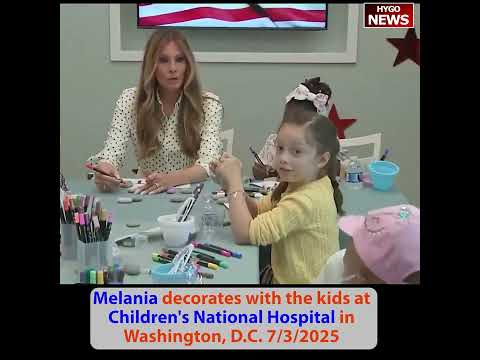
The video then pivoted to First Lady Melania Trump’s visit. “FLOTUS Melania Trump First Lady of the United States delivers gifts to the kids at Children’s National Hospital: ‘Look! We have surprises for you!’”
Children’s hospital visits are a standard First Lady activity. Melania Trump’s specific visit included gift deliveries and decoration with young patients. The visit occurred in the days before July 4, adding holiday themes to the clinical setting.
The Conversations With Children
The video captures specific interactions. “So what do you like to do? Do you like sport? Do you like dancing? Do you like music? What do you like? I play football. You play football. I play soccer. That’s soccer. I play dancing, dancing, I play games.”
The conversations are warm. Melania is asking children about their interests. The children — presumably patients at the hospital — are responding with their specific activities. Football (American), soccer, dancing, games, gymnastics, singing — each child has their specific interests that Melania is engaging with.
“Are you good? Yeah? I like it. I play gymnastics, dance, and sing. Sing? Which songs do you like?”
The specific engagement is the kind of First Lady activity that generates goodwill across political lines. Patient families see their children receiving presidential attention. The children themselves receive gifts and attention that improve their hospital experience.
”K-Tok’s”
The transcription captures a possible reference to K-Tok. “And there’s a new room called K-Tok’s, which is kind of family-like. It’s so I like it. It’s beautiful.”
The reference may be to a new pediatric facility or program at the hospital. Children’s National, like many major pediatric hospitals, has various specialized programs and facilities. Melania’s visit included a specific new facility that she highlighted in her remarks.
The Gifts
“Look, we have surprises for you. Some gifts for everybody. So everybody gets to stay over there and some blankets. You can take them home or put them in your room.”
Gifts and blankets for hospitalized children. The specific items are simple and practical. Children in hospitals benefit from personal items that make their rooms feel more like home. Blankets are both functional and comforting.
”I Like To Sleep”
The video captures one child’s response. “I have a favorite thing about this room, the bedding. I like to sleep. It’s nice. I like to sleep.”
The child’s enthusiasm about the hospital bedding is the kind of moment that captures the unselfconscious humanity of pediatric care. Children who are hospitalized for significant conditions can still find joy in small things — good bedding, kind visitors, specific gifts. Melania’s visit provided that kind of joy for this particular child.
“I always have a favorite thing when I go to bed. I don’t think I don’t sleep.”
The exchange is informal and personal. Melania is engaging with the child at the child’s level, not as a ceremonial First Lady but as an adult having a conversation with a young person.
”Be Careful Don’t Fall Down Here”
The video’s closing note captures Melania helping. “So everybody have position. Oh be careful don’t fall down here.”
The practical maternal instinct is visible. Melania is watching out for the children’s safety during the gift distribution. The specific concern — not falling — is the kind of thing a careful adult around children naturally notices.
The Broader Context
The First Lady’s hospital visit is unrelated to the legislative and political activities that otherwise dominate the video. But its inclusion in the coverage is not accidental. The administration wants Americans to see Melania Trump engaging with children at a Washington hospital. The visit builds personal regard for the First Lady across political lines.
Critics of the administration may view Melania’s hospital visit through partisan frames. But most Americans, regardless of their political orientation, respond positively to First Lady visits to hospitalized children. The visit is apolitical in the sense that caring about hospitalized children is not a partisan position.
The Integration Of Multiple Themes
The video captures the administration operating across multiple dimensions simultaneously. Trump announcing the bill signing and flyover ceremony. Trump announcing the Patriot Games youth athletic competition. Trump acknowledging RFK Jr.’s leadership role. Melania visiting hospitalized children.
Each element contributes to the administration’s overall political presentation. Major legislation is ceremonially signed with military honors. Youth fitness and civic unity are promoted through new athletic competition. The First Lady engages warmly with vulnerable children in a Washington hospital. The administration is presenting itself as fully rounded — serious on policy, ceremonially substantial, civically engaged, personally warm.
The July 4 Positioning
All of this occurs in the framing of July 4 — Independence Day. The signing of the bill on that specific date is not accidental. The administration is positioning the legislation as Independence Day for American economic freedom. Future July 4 celebrations will include anniversaries of the bill’s signing, reinforcing the historical association.
For supporters of the administration, the July 4 signing adds patriotic weight to the bill’s significance. For critics of the administration, the July 4 signing is viewed as cynical political positioning. Both readings will circulate. The administration has bet that the association with Independence Day is politically valuable enough to justify the specific timing choice.
Key Takeaways
- Trump on the signing ceremony: “We’re signing at about 5:00p — and at about 5:00p, we’re going to have B-2s and F-22s and F-35s flying right over the White House.”
- The political attendance: “The Speaker and I and John Thune were all there together with most Republican senators and congressmen and women.”
- Trump’s summary: “Biggest tax cut in history, great for security, great on the southern border…the biggest bill ever signed of its kind.”
- The aspirational framing: “It’s going to make this country into a rocket ship.”
- The Patriot Games: “America 250 will also host a brand new first of its kind youth athletes…led by our great Secretary of Health and Human Services, Robert F. Kennedy, Jr.”