 HYGO News
 Trump on BBB: most incredible bill No Tax on Tips/SS/Overtime, tariffs tremendous money, hottest
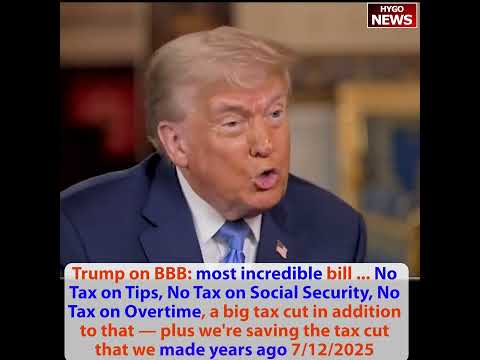
Trump on BBB: most incredible bill No Tax on Tips/SS/Overtime, tariffs tremendous money, hottest
In an extended interview, President Trump made the direct case for the One Big Beautiful Bill — “the most incredible bill … the biggest bill of its kind ever passed” — arguing that without it the public would have faced “a 68% tax increase” as the 2017 cuts expired. On tariffs: “hundreds of billions of dollars are coming in … it’s a tremendous amount of money to this country,” with countries “very upset now because they’ve been taking advantage of us for 30, 40 years.” He defended the Secret Service in the wake of the Butler assassination attempt — “mistakes were made … they had a bad day” — while noting the president’s job is more dangerous than race car driving or bull riding. And, tying the domestic argument to the bigger picture, he argued the four years between his terms were “almost like they tried to kill our country” — before finishing with the signature line: “the beautiful thing is now we have the hottest country in the world."
"One of the Most Incredible Bills Ever Passed”
Trump opened the interview with the legislative achievement he has been most eager to explain in his own words. “It’s unbelievable. It’s the most incredible bill. One of the most incredible bills ever passed, and it’s the biggest. It’s the biggest bill of its kind ever passed.”
The “of its kind” qualifier is important. The bill — known as the One Big Beautiful Bill — is a comprehensive tax, border, energy, and defense package that combines what would ordinarily be three or four separate pieces of legislation. Judged against the usual standard of what a single bill accomplishes in a single session, the package is unusually broad.
“No tax on tips, no tax on social security, no tax on overtime, a big tax cut in addition to that.” That is the core consumer-facing pitch. Each of those provisions targets specific populations: service workers living on tip income, retirees drawing Social Security, hourly workers logging overtime, and the broader middle-class tax base.
The 68% Cliff
Trump then made the case for the provision that has received less attention than the headline cuts but is arguably the most important piece of the bill’s fiscal math. “Plus we’re saving the tax cut that we made years ago, which is big and expired in another couple of months that would have expired. They would have had a 68% tax increase, and now they have a tax cut.”
The 2017 Tax Cuts and Jobs Act included provisions that were set to expire at the end of 2025. Without action, millions of taxpayers would have seen significant effective tax increases as individual tax rates reverted to pre-2017 levels. Trump’s “68% tax increase” framing — referring to the percentage change for some brackets when the combined effect of expiring provisions was counted — is presented as worst-case shorthand rather than a universal figure. The underlying claim — that a large tax increase would have hit in 2026 absent congressional action — is correct.
“You have to explain that to people because, you know, the public, they’re doing, they’re driving a cab, they’re working as a lawyer, accountant or teacher, or doing any one of a million different things. They’re not into it like we are. You have to explain it so every chance you get.”
That is the political problem Trump is describing. The 68% cliff averted is an abstract counterfactual. What would have happened did not happen. Convincing voters that the cut they did not see — the tax increase they did not experience — was a political accomplishment is harder than convincing them about the tax cut they did see.
”The Democrats Are Fake. They’re Part of the Fake News”
Trump’s explanation for why selling the bill is harder than it should be leans into his familiar media critique. “What they do is they set a phony, you know, they’re fake. The Democrats are fake. They’re part of the fake news, and the fake news will take it and they’ll go with it.”
The Trump theory of the information environment — that Democrats and the mainstream press function as a single messaging apparatus — is now a fixed feature of his rhetoric. Whether or not that model captures the complexity of modern political media, it is the model Trump uses to explain why provisions that should be popular remain politically under-defended.
”Hundreds of Billions of Dollars” From Tariffs
On tariffs, Trump made the operational fiscal claim that has become central to his second-term argument. “It’s a tremendous amount of money to this country. It’s really incredible. The potential of this country is incredible.”
“It’s been run very foolishly. It’s been run stupidly, stupidly, so stupidly,” he said, referring to the pre-Trump trade posture. “And some of the countries are very upset now, because they’ve been taking advantage of us for 30, 40 years, and I had it stopped.”
“I was stopping in the process, and then we had the COVID in the last part of my administration.” The COVID interruption reference is Trump’s framing of why the first-term tariff program was not allowed to complete its arc. The 2020 pandemic and its economic fallout disrupted the trade realignment in progress.
“But we still, we had the strongest economy in the history of our country, and this is going to be better. I predict this is going to be better. The money coming in, the tariffs coming in, hundreds of billions of dollars are coming in, they’re pouring in.”
The “hundreds of billions” claim is the specific number the administration has been pointing to. Tariff revenue, as a line item on the federal balance sheet, has indeed climbed substantially in 2025 — from roughly $80 billion in the preceding fiscal year to a much higher trajectory under the expanded tariff schedule. The exact figure for the full year is still being computed. Trump is forecasting that the annualized pace will land in the “hundreds of billions.”
Deals as an Alternative to Letters
A specific operational detail Trump raised: some countries will get tariff determinations by letter, others by bilateral deal. “In some cases we’ll make deals, you know, we’ll make a direct deal as opposed to a letter, and we’ve already made some of them with various countries.”
That procedural distinction — letter vs. deal — reflects how the administration is scaling the tariff program. Small or non-strategic trading partners receive letter-based determinations. Strategic partners receive negotiated agreements that may include sector-specific adjustments, phase-in periods, or reciprocal commitments. The bilateral-deal approach is resource-intensive but produces more durable outcomes than unilateral letter-based determinations.
”Experience Is Very Important”
The interviewer suggested that the four-year gap between Trump’s terms might have contributed to his current success. Trump agreed — with a twist. “Well, experience is very important in life. I think talent is more important than experience, but if you can have them both somehow, it’s a very good thing, but experience is very important.”
“Talent over experience” is the Trump theory of personnel. “Both together” is the acknowledgment that experience compounds. In the second term, Trump has explicitly chosen advisors who have both the talent he values and the experience of having worked through the first term’s frictions.
“I think it also helped. It was very bad for the country, but it also helped to have four years of horror. What went before me was horror. By comparison, I think anything looks good, and I don’t want to demean what we’ve done, because we’ve done a lot of records, but what they’ve done to our country should never be forgiven."
"Almost Like They Tried to Kill Our Country”
Trump’s most pointed characterization of the Biden years came next. “Allowing millions and millions of people to come into our country that shouldn’t be here. Such a big aspect of what we’re doing now with the borders, and it could have been so easy.”
“When I gave over the country, the border was great. Now it’s better than it was, but it was much worse than it was in 2016 when I took it over. That was a border problem also.”
Then the line that landed hardest: “I think when people see the horror show that we had for four years, an absolute horror show, it was almost like they tried to kill our country. The beautiful thing is now we have the hottest country in the world. I’m satisfied with it.”
“Tried to kill our country” is one of the sharpest political indictments Trump has offered of his predecessor. Paired with “hottest country in the world” — the phrase that has become the administration’s summary of its economic and diplomatic position — the two-part statement frames the transition from 2024 to 2025 as the country being rescued from deliberate damage.
The Butler Response: “They Had a Bad Day”
Trump’s handling of the Butler assassination attempt remains carefully calibrated. Asked about the Secret Service’s performance, he offered a measured but unforgiving assessment of specific failures.
“They should have had somebody in the building. That was a mistake. They should have had communications with the local police. They weren’t tied in. They should have been tied in, so there were mistakes made, you know, shouldn’t have happened. And that building was a prime building in terms of what they were trying to do.”
“But I was satisfied in terms of the bigger plot, the larger plot. I was satisfied. And you know, I have great confidence in these people. I know the people, and they’re very talented, very capable. They had a bad day, and I think they’ll admit that at a rough day.”
The distinction Trump is drawing matters. He is not absolving the Secret Service of the specific Butler failures — the unattended building, the lack of tie-in with local police. He is absolving the agency as an institution. “Mistakes were made” on a specific day, but “great confidence” in the people and their capability more generally.
”This Is a Very Dangerous Job”
Then the remark that revealed something of how Trump thinks about the personal risk of his position. “This is a very dangerous job being president. You know, I say a race car driver, 1% of 1%. Think of that. Die. It’s not a lot. A bull rider. I think that’s pretty dangerous. It’s like 1 tenth of 1%. Die. And with a president, it’s like 5%.”
The 5% figure is a back-of-the-envelope estimate — four presidents have been assassinated out of 45 individual men who held the office before Trump, roughly 9%, with several additional surviving attempts. Trump’s “5%” understates the historical rate rather than inflating it. The comparative frame — that the presidency is statistically more dangerous than race car driving or bull riding — is meant to lodge the point that the job carries real mortal risk.
“Why didn’t you tell me this?” Trump joked. “I could have maybe made a different decision, but I wouldn’t have made a different decision because we’re doing so well. The country is back.”
“The country is back” is the interview’s closing frame. It ties the legacy discussion, the bill, the tariffs, the comparison with the Biden years, and even the Butler risk calculus into a single assertion. The country is back. The decision to run again was the right one. The bill signed and the tariffs flowing and the horror show ended.
Key Takeaways
- Trump called the One Big Beautiful Bill “the most incredible bill … the biggest bill of its kind ever passed,” citing No Tax on Tips, Social Security, and Overtime alongside saving the 2017 cuts to prevent a “68% tax increase.”
- On tariffs, Trump said “hundreds of billions of dollars are coming in, they’re pouring in” — with some countries getting letter-based determinations and others negotiating bilateral deals.
- On the Secret Service after Butler: “Mistakes were made” — specifically, “they should have had somebody in the building … should have had communications with the local police” — but Trump expressed “great confidence” in the agency’s people.
- Trump estimated the presidency’s mortal risk at “5%” — “more than race car driver (1% of 1%) or bull rider (1 tenth of 1%)” — while saying he would not have made a different decision because “we’re doing so well. The country is back.”
- On Biden’s four years: “It was almost like they tried to kill our country … allowing millions and millions of people to come into our country that shouldn’t be here … The beautiful thing is now we have the hottest country in the world.”