 HYGO News
 Trump on Amy Barrett: 'Very Smart, Very Good Woman'; Vance Links Immigration to Housing Crisis, Shuts Down Heckler
Trump on Amy Barrett: “Very Smart, Very Good Woman”; Vance Links Immigration to Housing Crisis, Shuts Down Heckler
A compilation from March 10, 2025, paired two distinct moments. Trump deflected a reporter’s attempt to get him to attack Supreme Court Justice Amy Coney Barrett — whom some supporters had labeled “a DEI hire” after she sided with liberal justices — by saying “she’s a very good woman, she’s very smart.” Separately, VP Vance delivered a substantive address to the National League of Cities connecting mass immigration directly to the housing affordability crisis, was interrupted by a heckler, and shut her down: “I see one of our nice representatives wants to continue to flood the country with illegal immigrants, making your communities and cities unaffordable.” Vance cited data showing “the average income it takes to buy a new house is nearly two times the average salary of your typical American family.”
Trump on Barrett: Refusing the Bait
A reporter tried a gotcha question designed to either alienate Trump from his own Supreme Court appointee or put him at odds with his supporters.
“Your supporters are attacking Supreme Court Justice Amy Coney Barrett. You put her on the bench. They’re saying she’s a DEI hire. Do you regret putting her on the bench?” the reporter asked.
Trump’s response was a masterclass in neutralization. “Look, she’s a very good woman. She’s very smart,” he said. “And I don’t know about people attacking her, I really don’t know. I think she’s a very good woman.”
The response accomplished several things simultaneously. It refused to criticize Barrett, preserving the relationship between the president and a justice he had appointed. It professed ignorance of the attacks, avoiding endorsement of the “DEI hire” characterization. And it pivoted to positive language — “very good woman, very smart” — that would be the quote used in media coverage.
The controversy had erupted after Barrett sided with the liberal justices on a case that disappointed conservative legal activists. Some Trump supporters had applied the “DEI hire” label — typically used to describe appointments made based on demographic characteristics rather than qualifications — to Barrett, whose selection had been celebrated by conservatives precisely because of her intellectual credentials.
Trump’s refusal to pile on reflected political maturity. Attacking a sitting Supreme Court justice would have created a constitutional confrontation and undermined judicial independence. Defending her too aggressively would have alienated supporters who felt betrayed. The “very good woman, very smart” middle ground acknowledged both Barrett’s qualifications and the frustration without taking sides.
Vance: Immigration and the Housing Crisis
VP Vance delivered a policy-heavy address to the National League of Cities that connected immigration enforcement to the domestic issue that affected local governments most directly: housing affordability.
“I have to say, I’m hard-pressed to think of a time in my 40 years of life where it’s been so hard for normal American citizens to afford a home,” Vance said. “Even renting a home has become a challenge or, worse yet, fallen completely out of reach for so many of our families.”
He personalized the problem. “I was talking with a relative a couple of years ago, and she just made an offhanded observation as a younger person. She was looking to buy her first home and just mentioned that when her parents were growing up, they could have a nice home on a single middle-class income,” Vance said. “And she was sort of mentioning this as a sorrowful thing. She was sad that that wasn’t true for her generation.”
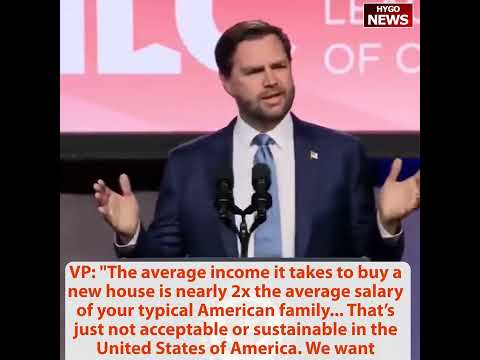
Vance then provided the data: “I read recently that the average income it takes to buy a new house is nearly two times the average salary of your typical American family. Not the average American worker, but the combined incomes of a husband and wife. And that’s just not acceptable or sustainable in the United States of America.”
He articulated the aspiration: “We want Americans to be able to afford the American dream of homeownership, because we know that when people own their homes, it makes them a stakeholder — a stakeholder in their neighborhoods, in their cities, and ultimately in this country that all of us love so much.”
The Immigration-Housing Connection
Vance then made the argument that set him apart from conventional Republican housing policy: mass immigration was a primary driver of housing unaffordability.
“We’ve also unfortunately made it way too easy for people to compete against American citizens for the precious homes that are in our country,” Vance said.
He cited international evidence: “It’s actually not just an American problem either. If you go to Canada, where because of their laws and regulations they’ve seen a massive increase in the number of people who have come into their country — you go to the United Kingdom, you go across the world, and you see a very consistent relationship between a massive increase in immigration and a massive increase in housing prices.”
The argument was economically straightforward: housing supply was constrained by zoning, permitting, and construction costs. When millions of additional people entered a country — whether legally or illegally — they increased demand for housing without increasing supply. The result was higher prices, bidding wars, and the exclusion of American families from the homeownership market.
The international comparisons strengthened the argument by showing that the pattern was not unique to America. Canada, the UK, and other countries that had experienced immigration surges had all seen corresponding increases in housing costs. The correlation was too consistent across too many countries to be coincidental.
Shutting Down the Heckler
During Vance’s remarks, a woman in the audience interrupted to challenge the immigration enforcement policy. Vance’s response was immediate and effective.
“I see one of our nice representatives out here wants to actually, I guess, continue to flood the country with illegal immigrants, making your communities and cities unaffordable,” Vance said.
He then addressed the heckler directly with measured respect: “But ma’am, with all respect, one of the reasons why we’re doing what we’re doing is because we want to make it more affordable for Americans to live. That is one of the reasons why we’re doing what we’re doing.”
The response worked because it connected the heckler’s objection to the substance of the speech. The woman was protesting immigration enforcement; Vance was arguing that immigration enforcement was essential to housing affordability. By redirecting the interruption to his central argument, Vance turned the disruption into a demonstration of the point he was making: some people prioritized open borders over affordable housing for American families.
Key Takeaways
- Trump deflected a “DEI hire” question about Justice Amy Coney Barrett: “She’s a very good woman. She’s very smart. I don’t know about people attacking her.”
- VP Vance told the National League of Cities that “the average income to buy a new house is nearly 2x the average salary” of an American family: “That’s just not acceptable.”
- He drew a direct connection between mass immigration and housing unaffordability, citing consistent patterns in the U.S., Canada, and the UK.
- Vance shut down a heckler by saying she “wants to continue to flood the country with illegal immigrants, making your communities unaffordable.”
- He framed immigration enforcement as essential to the “American dream of homeownership” that made citizens stakeholders in their communities.