 HYGO News
 Trump on 2 US nuclear subs: We had to do that; HILLARY CLINTON should PAY A PRICE, landmark EU deal
Trump on 2 US nuclear subs: We had to do that; HILLARY CLINTON should PAY A PRICE, landmark EU deal
President Trump confirmed he ordered two U.S. nuclear submarines repositioned in response to a specific nuclear threat made by a former Russian president — almost certainly referring to Dmitry Medvedev, the former Russian president now serving as deputy chairman of Russia’s Security Council, whose recent public statements included nuclear threats. “We had to do that … A threat was made and we didn’t think it was appropriate, so I have to be very careful … I do that on the basis of safety for our people.” Trump also characterized the landmark EU trade deal and — in a pivot on the Hillary Clinton accountability question — said Clinton “should pay a price” for her role in the manufactured Russia collusion narrative. “I let Hillary off the hook. I totally let her off the hook … And then I come in and they did the same thing to me. The differences, they actually meant it.” Now, Trump is saying: the situation has changed. “I think they should pay a price."
"We Had to Do That”
Trump’s confirmation of the submarine deployment. “We are being deployed in nuclear submarine. Oh yeah, well we had to do that. We just have to be careful.”
“Being deployed in nuclear submarine.” Two U.S. nuclear submarines have been repositioned. Exact deployment locations are classified, but the repositioning is itself public.
“We just have to be careful. And a threat was made and we didn’t think it was appropriate.”
The predicate for the repositioning: a specific nuclear threat was made by a Russian official. The response is calibrated but unmistakable — the U.S. can and will reposition nuclear assets in response to such threats.
“So I have to be very careful. So I do that on the basis of safety for our people.”
“Safety for our people” is the framing. Not escalation. Defensive positioning. The submarines are positioned to respond if a nuclear threat materializes, not to initiate aggression.
”A Former President of Russia”
“A threat was made by a former president of Russia and we’re going to protect our people.”
That is the specific source identification. “A former president of Russia.” Russia has had three presidents since 1991 — Yeltsin, Putin, and Medvedev. Putin is the current president (Medvedev served 2008-2012 between Putin’s terms). The only living former Russian president who issues threats is Medvedev.
Medvedev, in his current role as deputy chairman of Russia’s Security Council, has been a prolific source of bombastic Russian commentary. His social-media output has included various threats toward Western countries and leaders. Recent Medvedev statements have apparently reached the specific threshold of unacceptable threat that triggered the U.S. submarine repositioning.
“We’re going to protect our people.” That is the commitment. The United States will take the actions necessary to protect American citizens from foreign nuclear threats, even when those threats come from officials whose primary function is rhetorical positioning rather than actual authority.
The EU Deal Reprise
Trump then summarized the EU trade deal. “And we made a deal where they’re going to buy billions and billions of dollars worth of our product and our energy. They’ve opened up the entire European Union for free trade, which is something that nobody thought could happen, so that our countries can now go in there and compete, which is one of the biggest markets.”
“Opened up the entire European Union for free trade.” That is the specific framing. Not partial market access. Not preferred access for specific categories. Free trade access. U.S. exporters competing in the EU on the same terms they would have competing in the U.S. market.
“It might be the biggest market, somebody said, but it’s right up there when you add the countries, all of those countries together. And we have the right to work there. We don’t pay tariffs. And they will be, we’re bringing the tariffs for them to 15%.”
The 15% figure on EU imports. The zero-tariff access for U.S. exports to the EU. Both have been confirmed elsewhere in the administration’s announcements. Trump is restating them as part of the overall trip wrap-up.
“They’re going to buy $600 billion worth of our military equipment. They’re going to buy hundreds of billions of dollars of other equipment and $750 billion worth of energy.”
The combined $1.45 trillion EU commitment. Military equipment: $600 billion. Energy: $750 billion. Other equipment: hundreds of billions. All being absorbed into the EU’s purchasing budget over the coming years.
“And it’s a great deal for both. I think Europe’s going to be very happy with it. They seem to be very happy and the market’s doing good."
"Like a Hangover”
“And it’s a deal like a deal good for peace. We have all these countries. If we didn’t make the deal that always be like a hangover, it would be not good. But it’s a great deal for the United States and I hope it’s a great deal for them too.”
“Deal good for peace.” The trade deals reduce bilateral friction. Friction reduction reduces the likelihood of escalation. Deals as peace infrastructure.
“Like a hangover.” If the deal had not been reached, the pre-deal tariff escalation would have persisted as a chronic friction between the U.S. and EU. Hangover-style residual damage. The deal resolves that friction.
”New Emails Suggest Hillary Personally Approved”
The pivot to the Clinton question. “These new emails, Mr. President, suggest essentially that Hillary Clinton personally approved the Russia hoax. With Obama. With Barack Obama. And my question is, is she finally going to pay for what she did or does she get a pass again?”
That is the direct question. The Gabbard document releases have apparently produced new email evidence showing Clinton’s direct role in the Russia collusion narrative creation — in coordination with Obama. The reporter is asking whether Clinton will face accountability.
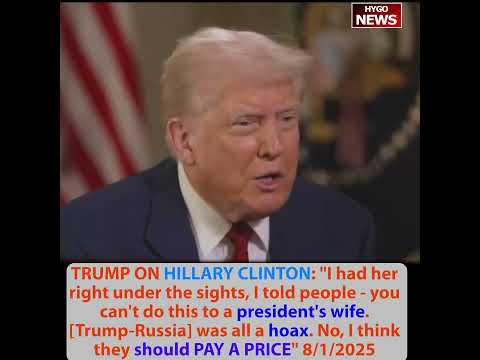
“So, you know, we had her and I had her right under the sites and I told the people, look, you can’t do this to a president’s wife, an ex-president.”
Trump’s 2016-17 posture. He had Clinton “right under the sights” — could have pursued prosecution. He declined. The stated reason: she was an ex-president’s wife and former Secretary of State. Prosecuting her was inappropriate by his standards.
“And she was Secretary of State. But you can’t do this to the wife of a president.”
The institutional argument. The wife of a former president, in Trump’s framing, occupies a specific position that should be protected from partisan prosecution. Former secretaries of state similarly carry institutional weight that creates norms against prosecution.
”I’ll Tell You How I Feel About It in a Second”
“Do you still feel that way? If you, well, I’ll tell you how I feel about it in a second.”
The reporter pressing for an update. Trump accepting the question.
“If you remember, I was at a rally and it was after the election and they said, lock her up, lock her up. And I said, no, no, no, look, we won. Just relax.”
That is Trump’s 2016-17 framing. Post-election rallies where supporters chanted “Lock her up” received Trump’s pushback. “We won, just relax.” Trump explicitly discouraged his own supporters from pursuing Clinton accountability.
“And I didn’t do what other people would have done, what they would have done.”
That is the restraint acknowledgment. Other political figures in Trump’s position — winning a bitterly contested election, with documented opposition misconduct — might have pursued prosecution aggressively. Trump chose not to.
“And then they went after me and they meant it. I said, you know, it’s amazing. Always felt that you shouldn’t be doing this stuff. And I let Hillary off the hook. I totally left her off the hook. And then I let her off the hook for, you know, for what? And then I come in and they did the same thing to me. The differences, they actually meant it.”
That is the key framing. Trump extended restraint to Clinton. The Democratic Party’s subsequent response was not reciprocal restraint but aggressive pursuit of Trump. “They actually meant it” — the prosecutions were serious, not performative.
“They hurt a lot of people, a lot of people. And it was all a hoax. And now they have it in black and white.”
“Hurt a lot of people.” Carter Page’s life disrupted. George Papadopoulos imprisoned. Michael Flynn’s financial devastation. Paul Manafort’s lengthy incarceration. Multiple campaign associates and administration officials had careers destroyed through prosecutions that, per the administration’s framing, were predicated on manufactured intelligence.
“All a hoax. And now they have it in black and white.” The Gabbard documents, per the administration’s characterization, demonstrate the manufactured nature of the Russia narrative in documentary form. What was previously speculation is now evidence.
”I Think They Should Pay a Price”
“No, I think they should pay a price.”
That is the updated Trump position. Clinton should pay a price. Not just Obama. Not just Brennan, Clapper, Comey. Clinton specifically.
“How directly? By the way, it’s a very big price. It could be the biggest scandal in the history of our country, but it continues onward. And that continues onward. You know, that scandal has continued from the…”
“Biggest scandal in the history of our country.” That framing has been consistent from Trump and his team throughout the Gabbard document release campaign. The claim: the Obama-Clinton manufactured intelligence operation exceeds in scale and consequence any previous American political scandal.
Whether that characterization holds up in historical assessment is for historians to determine. What matters operationally: the administration is treating the allegations as the biggest American scandal, and the DOJ is organizing its response accordingly.
“Continues onward.” The scandal is not resolved. The cover-up continues. The legal consequences have not yet materialized. More documents are coming. The story has extended significantly beyond its initial declassification moment.
The Pattern: Restraint Then Accountability
Trump’s narrative arc — 2016-17 restraint toward Clinton, 2025 willingness to see accountability — reflects specific evolution. The restraint was offered. The restraint was not reciprocated. Therefore the restraint no longer applies.
That framing creates political weight. Voters who viewed Trump’s 2016-17 restraint toward Clinton as honorable, who viewed the subsequent Democratic pursuit of Trump as excessive, will find Trump’s updated position defensible. The story is consistent: Trump would have left Clinton alone if left alone himself. He wasn’t left alone. Therefore Clinton faces consequences now.
For Clinton, the political consequences are likely more significant than the legal ones. Even if DOJ investigations do not produce criminal charges, the documentary record of Clinton’s alleged role in manufacturing the Russia narrative will become part of her public legacy. Her post-political-career influence — through foundations, memoirs, speaking engagements — becomes more constrained by that record.
Key Takeaways
- Trump confirmed two U.S. nuclear submarines were repositioned in response to a specific nuclear threat from a former Russian president (likely Medvedev): “A threat was made by a former president of Russia and we’re going to protect our people.”
- Trump reprised the EU trade deal: “They’ve opened up the entire European Union for free trade … $600 billion worth of our military equipment … $750 billion worth of energy.”
- On Hillary Clinton and the Russia hoax: “I let Hillary off the hook. I totally let her off the hook … And then I come in and they did the same thing to me. The differences, they actually meant it.”
- Trump’s updated position: “No, I think they should pay a price … It could be the biggest scandal in the history of our country, but it continues onward.”
- The 2016-17 restraint — “after the election and they said, lock her up, lock her up. And I said, no, no, no, look, we won. Just relax” — is no longer the operating posture.