 HYGO News
 Trump Establishes Religious Liberty Commission: 'Trust Our God -- He Knows Exactly Where We're Going'; Dan Patrick: 'Restoring Hopes of Millions'
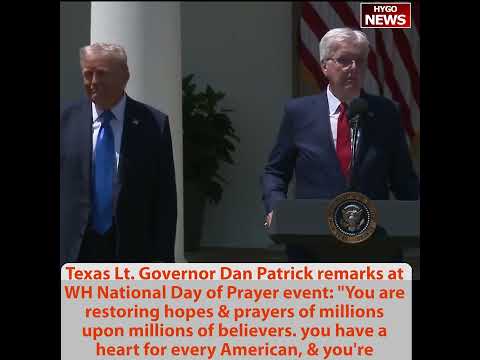
Trump Establishes Religious Liberty Commission: “Trust Our God — He Knows Exactly Where We’re Going”; Dan Patrick: “Restoring Hopes of Millions”
President Trump established the Religious Liberty Commission at the White House National Day of Prayer event in May 2025, quoting John Adams’s letter to Abigail: “Millions will be upon their knees at once before their great Creator, imploring his forgiveness and blessing and asking for his favor on the American cause.” Trump added: “Today, more than two and a half centuries later, in the heart of a free and proud America, we rejoice that God answered those prayers.” Texas Lt. Governor Dan Patrick, named commission chair, declared: “You are restoring the hopes and prayers of millions upon millions of believers. There’s never been a president who has invoked the name of Jesus more than you.” Trump closed: “We have to trust our God because our God knows exactly where we’re going.”
The John Adams Letter
Trump opened the National Day of Prayer with a historical connection that placed the event in the founding tradition.
“In a letter to wife Abigail, John Adams wrote of his first National Day of Prayer,” Trump recited. “‘Millions will be upon their knees at once before their great Creator, imploring his forgiveness and blessing and asking for his favor on the American cause.’”
He drew the line to the present: “Today, more than two and a half centuries later, in the heart of a free and proud America, we rejoice that God answered those prayers.”
He added the personal: “And I think God answered other prayers, because he’s put in an administration to run this country that’s going to make you proud again.”
The Adams quotation was a masterful choice for the occasion. John Adams — the second president, one of the founding generation, and the man who declared the first National Day of Prayer — had described a scene of national humility before God. Trump was claiming continuity with that tradition: just as Adams’s generation had prayed for divine favor on the American cause, Trump’s generation was praying for the same.
The implication that God had answered prayers by placing the Trump administration in power was theologically bold but politically resonant. For the millions of evangelical and Catholic Americans who had prayed for national renewal, Trump’s election felt like an answer to prayer. The religious liberty commission was the institutional expression of that belief.
Dan Patrick: Commission Chair
Texas Lt. Governor Dan Patrick delivered emotional remarks as the commission’s chairman.
“Mr. President, thank you for establishing what I think will be one of the most important presidential commissions in history,” Patrick said. “It will be one of your great legacies, of which you will have many.”
He described the inheritance: “We have in this country a magnificent inheritance of religious liberty. And every believer today, no matter your faith, has a claim to that inheritance.”
He stated the founding principle: “We were a nation birthed by prayer, founded on the Judeo-Christian ethic to ensure that people could worship as they wished without interference from government.”
He identified the threat: “But that is no longer the case. The last administration attacked people of faith for four years.”
He stated the principle: “There’s a saying that no one should get between a doctor and a patient. I think we would say no one should get between God and a believer. No one should get between God and those seeking Him.”
He described the need: “There are so many people in this country — they may have a family, they may have a job with a lot of employees — but they’re alone, and the only person they can turn to is God, because He is their refuge and their wellspring of hope.”
He stated the right: “No one, no government, no school district, at any level of government or in the private sector should say to someone, ‘You can’t pray here.’ That is our right.”
Patrick’s description of the commission’s purpose — ensuring that government did not interfere with Americans’ ability to pray, worship, and exercise their faith — placed the Religious Liberty Commission in the tradition of the First Amendment itself. The commission was not creating a new right; it was defending an existing one that had been eroded by years of progressive hostility to religious expression.
”No One Should Get Between God and a Believer”
Patrick’s formulation crystallized the religious liberty argument in a single sentence. The progressive project of the past several decades had systematically narrowed the space for religious expression in American life — removing prayer from schools, challenging religious symbols on public land, forcing religious organizations to comply with mandates that violated their beliefs, and penalizing individuals who acted on their faith in the public square.
The Religious Liberty Commission was designed to reverse this trajectory. By establishing a formal presidential commission staffed with “the foremost faith leaders, scholars, and thinkers,” the administration was creating an institutional advocate for religious liberty within the executive branch.
”Trust Our God”
Trump closed the event with a personal statement of faith.
“As we bow our heads on this beautiful day, once again we have to trust our God,” Trump said, “because our God knows exactly where we’re going, what we’re doing, knows every inch of our life.”
He prayed: “And may He continue to hear our prayers, to guide our steps, and build up our beloved nation to even greater heights.”
He acknowledged the controversy: “We’re in the process of doing some great things. I get criticized no matter what, but I just go forward because everyone knows we’re right.”
He stated his philosophy: “All we’re doing is what they’ve done to us for 40 years, but we’re doing it bigger and better. That’s the only thing we’re doing.”
The “trust our God” closing was the most explicitly devotional statement Trump had made during his second term. It was not a political invocation of God as a rhetorical device; it was a statement of dependence on divine guidance. For a president managing simultaneous crises across multiple fronts — tariff negotiations, peace talks, legislative battles, judicial challenges — the expression of trust in God was both a personal confession and a signal to his faith-based constituency.
”Never a President Who Invoked Jesus More”
Patrick’s observation that “there’s never been a president who has invoked the name of Jesus more than you” was historically debatable but emotionally accurate. Trump had spoken about Jesus by name at Easter events, prayer services, and public appearances more frequently and more explicitly than any recent president.
The claim reflected a cultural moment in which public Christian expression by a president was itself a political act. In an era when mentioning Jesus in a government setting was treated by progressive commentators as a violation of church-state separation, Trump’s willingness to name Christ publicly was experienced by believers as an act of courage.
Key Takeaways
- Trump established the Religious Liberty Commission, quoting John Adams: “Millions upon their knees before their Creator, imploring his favor on the American cause.”
- Dan Patrick named chair: “You’re restoring the hopes and prayers of millions of believers. No one should get between God and a believer.”
- Patrick: “The last administration attacked people of faith for four years. No government should say ‘you can’t pray here.’ That is our right.”
- Trump: “Trust our God — He knows exactly where we’re going. May He guide our steps and build our nation to greater heights.”
- Patrick: “There’s never been a president who has invoked the name of Jesus more than you.”