 HYGO News
 Trump: 'Only Two Genders -- Male and Female'; 'Ending the Marxist War on Women'; 25% Tariff on All Foreign Cars
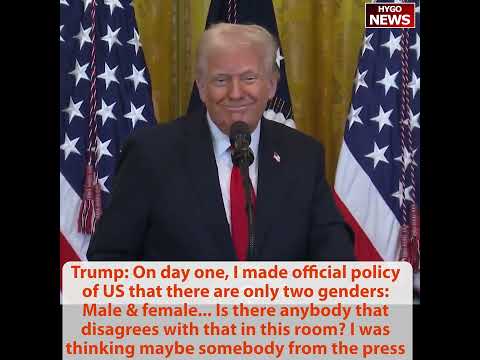
Trump: “Only Two Genders — Male and Female”; “Ending the Marxist War on Women”; 25% Tariff on All Foreign Cars
President Trump delivered remarks in March 2025 covering two major policy fronts: gender policy and auto tariffs. On gender, he declared that “under the Trump administration, we’re ending the Marxist war on women” and reminded the audience that “on day one, I made the official policy of the United States government that there are only two genders: male and female.” On trade, he announced “a 25 percent tariff on all cars that are not made in the United States,” saying the policy would “continue to spur growth like you haven’t seen before” as companies moved plants back from Mexico and Canada.
”The Marxist War on Women”
Trump opened with a direct attack on the Biden administration’s gender policies.
“For four long years, we had an administration that tried to abolish the very concept of womanhood and replace it with radical gender ideology,” Trump said. “Maybe you heard something about that.”
He cited specific examples: “They destroyed women’s spaces and even tried to replace the word ‘mother’ with the term ‘birtherPerson.’ A mother became a birtherPerson. What’s that all about?”
Trump connected the policy to the electoral result: “Then you wonder why they lost. They tried to figure out why did they lose.”
He cited a current example: “I saw a congressman today for the Democrats. He was having a big fight on television early this morning trying to make it so that really he thinks men should play in women’s sports. He hasn’t given that up yet. He was fighting like crazy. I said, this guy is going to lose. He’s going to lose badly.”
Trump assessed the party’s trajectory: “The whole party is still into that. They haven’t learned.” Then the joke: “We don’t want them to learn, frankly. We want them to keep fighting. Let’s not tell them.”
The humor carried a serious political observation. The gender ideology issue had been one of the most significant factors in the 2024 election, particularly among suburban women and parents. The fact that Democratic members of Congress were still publicly defending men competing in women’s sports suggested the party had not absorbed the lesson of November 5th.
”Ending the War and Protecting Women”
Trump described his administration’s approach as protective rather than merely oppositional.
“Under the Trump administration, we’re ending the Marxist war on women,” Trump said. “And you had a war on women. And we’re protecting women’s rights, defending women’s dignity, and standing up for the American moms and daughters — so many are represented here, great people in this room.”
He characterized the effort as collective: “American women have never had bigger champions than all of us in the White House. I mean, it’s me, but it’s the group of men and women.”
Then the policy foundation: “On day one, I made the official policy of the United States government that there are only two genders: male and female.”
Trump posed the challenge to the room: “Is there anybody — seriously, is there anybody that disagrees with that in this room?”
He glanced at the press: “I was thinking maybe somebody from the press might raise their hand. I don’t think so. There aren’t too many people.”
The Day One executive order establishing that the federal government would recognize only two biological sexes had been one of the administration’s most consequential early actions. It affected every federal agency, program, and regulation that referenced gender, from Title IX enforcement to military service requirements to prison housing policies. By making it “official policy,” Trump had created a government-wide standard that could not be circumvented by individual agencies or progressive bureaucrats.
25% Auto Tariff: “Not Made in the United States”
Trump then pivoted to the trade announcement that would send shockwaves through the global auto industry.
“What we’re going to be doing is a 25 percent tariff on all cars that are not made in the United States,” Trump said. “If they’re made in the United States, it’s absolutely no tariff.”
He described the baseline: “We start off with a two and a half percent base, which is what we were at, and we go to 25 percent.”
The tenfold increase — from 2.5% to 25% — was the most dramatic tariff escalation in the auto industry since the formation of modern trade agreements. At 2.5%, foreign-made cars faced a negligible cost disadvantage. At 25%, a $40,000 imported car would carry a $10,000 tariff, making domestic production massively more competitive.
Companies Moving Back
Trump described the effect the tariff announcement and broader economic policies were already producing.
“As you know, and as you’ve been seeing — not reported as accurately as it should be, because it’s a massive story — business is coming back to the United States so that they don’t have to pay tariffs,” Trump said. “And I think also because of November 5th, the election. They’re very happy.”
He highlighted AI investment specifically: “AI is coming back to levels that nobody’s ever seen before. It’s sort of a new business, I guess, when you think about it. But plants are going up all over the United States, and many of them have already been started.”
Trump described the administration’s approach to enabling the construction: “We’re getting early electricity taken care of. We’re getting permits very quickly for them. And we’re going to make their life very happy. They’re coming in with tens of billions of dollars. Individual plants will cost 10, 15, 20 billion dollars.”
He announced a regulatory innovation: “We’re going to let them build electricity generating plants along with their plant. And they can’t even believe it. And we’re going to get them very quick permits.”
Trump cited his track record: “As I’ve done always. I did that in Louisiana with two LNG plants. I got them one permit in one day after waiting 14 years, and the other one in one week after waiting for 12 years.”
The co-location of power generation with manufacturing facilities was a significant regulatory innovation. Traditional permitting required separate processes for manufacturing plants and power plants, each taking years. By allowing companies to build their own electricity generation alongside their factories, the administration was eliminating one of the most significant bottlenecks to large-scale industrial construction.
The Auto Industry Transformation
Trump concluded by placing the auto tariff in the context of the broader manufacturing renaissance.
“This is very exciting to me,” he said. “This is the automobile industry, and this will continue to spur growth like you haven’t seen before.”
He described the pre-tariff trajectory: “Before I was elected, we were losing all of our plants. They were being built in Mexico and Canada and other places.”
The reversal: “And now those plants largely have stopped, and they’re moving them to our country.”
The 25% auto tariff was the administration’s most direct intervention in a specific industry. Unlike the broader reciprocal tariffs planned for April 2, the auto tariff targeted a single sector with a rate designed to make domestic production the only economically rational choice. A company that could build a car in America faced no tariff; a company that built the same car in Mexico faced a 25% penalty. The math was simple, and the result was predictable: companies would build in America.
Key Takeaways
- Trump declared the “Marxist war on women” over, citing his Day One executive order establishing “only two genders: male and female” as official U.S. policy.
- He mocked Democrats still defending men in women’s sports: “The whole party is still into that. They haven’t learned. We don’t want them to learn.”
- Trump announced a 25% tariff on all foreign-made cars (up from 2.5%): “If they’re made in the United States, absolutely no tariff.”
- AI plants costing $10-20 billion each were being built across the country with fast-tracked permits and co-located power generation.
- Companies were moving plants back from Mexico and Canada: “Those plants largely have stopped, and they’re moving them to our country.”