 HYGO News
 Trump: Obama ringleader, got caught, witch hunt; Bessent: Fed big mission creep, should cut rates
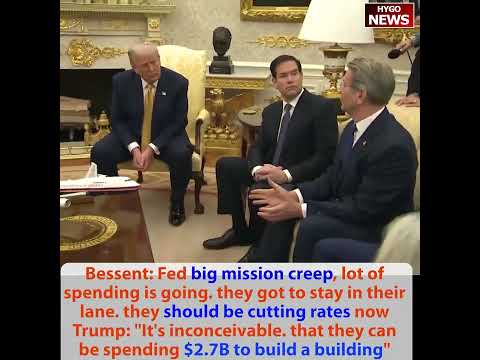
Trump: Obama ringleader, got caught, witch hunt; Bessent: Fed big mission creep, should cut rates
President Trump extended the Obama-as-ringleader framing into a sharper historical sequence, claiming the 2016 election-rigging attempt that “got caught” was followed by a 2020 election that “they did rig” and then his 2024 “landslide” win “every swing state won the popular vote.” “The witch hunt that you should be talking about is they caught President Obama absolutely cold, Tulsi Gabbard.” Trump also recalled his own 2016 restraint: “When we caught Hillary Clinton, I said, you know what? Let’s not go too far here … I let her off the hook … After what they did to me … it’s time to go after people.” Treasury Secretary Scott Bessent called for an “internal investigation” of the Federal Reserve’s “big mission creep” — focused not on monetary policy but on institutional drift — while arguing “they should be cutting rates now.” And AstraZeneca announced a $50 billion U.S. manufacturing investment “because of the election and because of the fact that the tariffs are placed."
"Barack Hussein Obama Is the Ringleader”
Trump opened with the framing he had used previously — but now extended forward in time. “No, Barack Hussein Obama is the ringleader. Hillary Clinton was right there with him, and so was Sleepy Joe Biden, and so were the rest of them. Comey, Clapper, the whole group, and they tried to rig an election, and they got caught.”
The full list of named participants continues to grow: Obama as ringleader, plus Clinton, Biden, Comey, Clapper. Each name represents a specific role in the operation Trump is alleging. Obama as director. Clinton as beneficiary and partial financier (via campaign payment for the Steele Dossier). Biden as participant (and later president during whose term the matters were slow-walked). Comey as FBI director during the operation’s active phase. Clapper as DNI who produced the January 2017 ICA.
”And Then They Did Rig the Election in 2020”
“And then they did rig the election in 2020. And then because I knew I won that election by a lot, I did it a third time, and I won it a landslide. Every swing state won the popular vote.”
That is Trump’s framing of the three consecutive presidential cycles as a sequence: rigging attempt in 2016 that “got caught,” rigging that “did” succeed in 2020, and then overwhelming return in 2024.
“Every swing state won the popular vote” — that is factual regarding 2024. Trump won every swing state and won the popular vote — the first Republican to do so since George W. Bush in 2004.
The 2020 election-rigging claim, however, remains disputed. Courts, state election officials, and federal authorities across multiple layers have not validated the broad systemic fraud claims Trump has made. The 2016 manufactured-intelligence claim Gabbard has documented is distinct from the 2020 election integrity claims, which rest on different evidence and argumentation.
“But I won that all the same way in 2020. And look at the damage that was caused."
"Witch Hunt”
“The witch hut that you should be talking about is they caught President Obama absolutely cold, Tulsi Gabbard. What they did to this country in 2016, starting in 2016, going up to 2020 of the election, they tried to rig the election, and they got caught. And there should be very severe consequences for that.”
“Witch hunt” — a term that was used for years to describe the investigations against Trump — is now being used in reverse. Trump is arguing the actual witch hunt is the conduct of Obama and his team, which targeted Trump based on manufactured evidence. Gabbard’s declassification has, in Trump’s framing, exposed the real witch hunt.
“Very severe consequences” — that is the operative phrase. Trump is not calling for rhetorical reproach. He is calling for consequences. Whether that translates to actual DOJ action is the question.
”I Let Her Off the Hook”
Trump recalled his 2016 restraint toward Clinton. “You know, when we caught Hillary Clinton, I said, you know what? Let’s not go too far here. It’s the ex-wife of a president, and I thought it was sort of terrible. And I let her off the hook, and I’m very happy I did.”
That is a revealing admission. Trump, during the 2016 campaign, had at one point suggested Clinton should be investigated for her email server and the Clinton Foundation. After winning the election, he explicitly decided not to pursue prosecution — he is saying so here, on camera, with the “let her off the hook” phrasing.
“I’m very happy I did” — even in retrospect, even while framing the 2016 Obama-Clinton operation as treasonous, Trump is glad he did not prosecute Clinton.
“After what they did to me, whether it’s right or wrong, it’s time to go after people.”
That is the pivot. Trump is framing his 2025 posture as different from his 2017 posture. In 2017, he chose restraint. In 2025, “it’s time to go after people.” The change, in his framing, is driven by what “they did to me” during the first term and the post-presidency lawfare years.
”Obama’s Been Caught Directly”
“Obama’s been caught directly. So people say, oh, you know, a group, it’s not a group. It’s Obama. His orders are on the paper. The papers are signed. The papers came right out of their office.”
Trump is asserting the documentary record is specific. Obama’s orders — signed, on paper, traceable to his office — are in the documents Gabbard has declassified.
That is an evidentiary claim. If the documents are what Trump is characterizing them as, they represent a paper trail of specific conspiracy directives from an identified originator. Whether they survive legal scrutiny is the question. The documents are being released publicly, so the public and legal analysts can assess them directly.
“They sent everything to be highly classified. Well, the highly classified has been released. What they did in 2016 and in 2020 is very criminal. It’s criminal at the highest level. So that’s really the things you should be talking about.”
Bessent on “Big Mission Creep”
Treasury Secretary Scott Bessent pivoted to a different flank of administration pressure. “I called yesterday and this morning for the Fed to do a big internal investigation to understand not their monetary policy, but everything else.”
“Not their monetary policy, but everything else” is a specific scoping decision. Bessent is not challenging the Fed’s core mandate — monetary policy decisions — but the surrounding activity: regulation, financial stability research, building projects, personnel decisions, outside activity.
“The Fed has had big mission creep, and that’s where a lot of the spending is going. That’s where, whether they’re building these new or refurbishing these buildings.”
“Big mission creep” is the framing the administration has been building. The Fed, under multiple chairs, has expanded its activities beyond monetary policy into regulatory territory, climate risk analysis, diversity and equity initiatives, research output on a broad range of topics, and physical infrastructure. Each of those expansions has been defended on its merits by the Fed’s leadership. The administration is arguing the cumulative expansion is unjustified and represents an institution that has lost focus on its core mission.
”They Should Be Cutting Rates Now”
“And I think they got a stake in their money. I think that based on the way they cut rates last fall, they should be cutting rates now. It’s inconceivable. I know the Fed very well that they can be spending $2.7 billion to build a building.”
The building cost figure has now crept up to $2.7 billion — from earlier $2.5 billion references. Either the cost estimates have been revised, or Trump is using a maximalist figure for rhetorical effect.
“Spending $2.7 billion to build a building. They don’t do anything. It’s the greatest job. You show up one day, a half a day. You make a little speech. The economy is doing well. The economy is not doing well. We’re going to raise interest. And he’s got it wrong.”
That is Trump’s characterization of the work intensity of Fed officials. It is a caricature — Fed governors and regional presidents work significantly more than “one day, a half a day” — but it captures the populist framing that the Fed is a low-intensity, high-status institution producing analytically weak outputs.
”Too Late, Too Late, Too Late”
“That’s why I call him TOOLATE. TOOLATE. TOOLATE. And it’s really too bad. But it is affecting people that want to buy houses. And that shouldn’t happen. And you know, you should lower them. Those rates should be three points lower. That’s what they should be. Three points lower. Maybe more than that.”
“Three points lower, maybe more” — that is the administration’s desired path. Three points down from current Fed policy rates would be an extraordinarily aggressive cutting cycle, faster than even the Powell-era post-COVID cuts. Whether the economy genuinely supports that pace of cuts is a question analytically distinct from the political pressure. The administration’s framing is that it does. The Fed’s framing is that it does not.
AstraZeneca’s $50 Billion
The final item. “We have a big announcement. AstraZeneca, the big drug company, is going to spend $50 billion, just announced $50 billion in the United States in order to build various places all over the country, big manufacturing plants, pharmaceutical plants all over the country.”
$50 billion. Pharmaceutical manufacturing plants across the United States. That is an industrial-reshoring announcement at the scale the administration has been predicting in its tariff-reshoring thesis.
“So that’s an honor. And he said they did that because of the election and because of the fact that the tariffs are placed. So they’re building their facilities in New York. $50 billion. That’s a big investment.”
“Because of the election and because of the fact that the tariffs are placed” — that is AstraZeneca’s stated rationale. The $50 billion commitment is attributed, per the company’s own framing, to the Trump administration’s policy regime. The tariffs on imported pharmaceuticals that the administration has announced are the specific lever that shifted AstraZeneca’s capital-allocation decision toward U.S. domestic manufacturing.
”And It’s Going to Be a Very Good Investment”
“And it’s going to be a very good investment. They have no doubt about it. So thank you to AstraZeneca.”
That is Trump closing on a positive note. A $50 billion capital commitment from a major multinational pharmaceutical company is the kind of data point that validates the administration’s reshoring thesis in concrete terms. The thesis: tariffs create incentives. Incentives drive capital allocation. Capital allocation produces domestic manufacturing capacity. AstraZeneca is the latest proof.
Three Pressure Points
The Obama-ringleader accountability drive. The Fed mission-creep critique. The AstraZeneca reshoring announcement. Three distinct stories, all in a single press gaggle, all advancing separate but coherent administration priorities.
The administration’s message discipline across those three items is consistent. Each item provides evidence for a larger argument: the deep state corrupted the electoral process, the Fed has lost focus on its core mission, and reshoring is delivering specific capital wins. Each item has its own detractors. The cumulative force of the three is what defines the political moment.
Key Takeaways
- Trump named the accountability chain: “Barack Hussein Obama is the ringleader. Hillary Clinton was right there with him, and so was Sleepy Joe Biden, and so were the rest of them. Comey, Clapper, the whole group.”
- Trump’s self-reflection on 2016 restraint: “When we caught Hillary Clinton, I said, you know what? Let’s not go too far here … I let her off the hook … After what they did to me … it’s time to go after people.”
- “Obama’s been caught directly … his orders are on the paper. The papers are signed. The papers came right out of their office” — with “very severe consequences” ahead.
- Scott Bessent: the Fed has “big mission creep” and needs “a big internal investigation to understand not their monetary policy, but everything else” — while cutting rates.
- AstraZeneca announced a $50 billion U.S. manufacturing investment “because of the election and because of the fact that the tariffs are placed” — the largest single reshoring commitment announced to date.